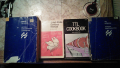
I still have just about all of my older reference books from the late 50s and 60s. e.g., Mullard ref for Transistor circuits, RCA Thyristor Manual for just a couple.
Good app notes were the norm, not the exception. And companies would compile them and publish them in handbooks, where one could learn not only about the semiconductor products themselves, but also lots of circuit techniques.
Members here have already discussed handbooks from National, Motorola, TI and others. But an absolute gem is General Electric’s “SCR Manual Including Triacs and other Thyristors”.
This almost 700-page thyristor encyclopedia would provide the most comprehensive treatise on these devices, including discussion of some extraordinary complex circuits like the cycloconverters and resonant-commutated choppers and very obscure semiconductors like the PUT, programmable unijunction transistor and the SUS, silicon unilateral switch.
I still have my well-used 1972 copy.
I think National Semiconductor is the best. I too prefer the older style of TI datasheets.
When I left my job as an R&D Technician at HP Labs, my boss told me to take whatever databooks I wanted with me. I took the NatSemi Linear + Applications + Voltage Regulators, Signetics Memory + Linear Applications, RCA CMOS, HP Optoelectronics + Applications Manual 1st Edition, Motorola Zener Diodes + CMOS + MECL, Intel Memory + Component Data, TI TTL (2 versions and a pocket reference) + Transistors + Power Transistors, and a few others.
I've pretty much read the NatSemi. Signetics, and HP Optoelectronics applications handbooks cover-to-cover.
RCA CMOS – The first one I got when I started learning about digital; it was also the first I lent to a neighbor, who moved away a few months later and never returned it.
RCA CMOS – The first one I got when I started learning about digital; it was also the first I lent to a neighbor, who moved away a few months later and never returned it.
I know this is a trick question. One cannot compare the datasheet for a 555 to one from an advanced 32 bit microcontroller.
One would have to compare exactly identical ICs, sourced from a multitude of companies, including obscure and defunct ones, in all three continents. In other words, an ubiquitous, low cost, well known, easy to buy IC.
Off my head, I could think of a few candidates, 555, 741, 358, 7805. I am sure there are a few more. From these I chose the 358 because.....reasons.
I searched for the datasheets from 10 different companies, and took a screenshot of the front page, which I have attached. You will notice that I included two from Texas Instruments. TI has recently revamped its datasheet portfolio, and greatly expanded the datasheet information with all the myriad variants, but simultaneously becoming more verbose. I prefer their older style.
To me the best looking datasheets are (were) those from National Semiconductor. The font, the way schematics are drawn, the amount and arrangement of the parametric information and relevant circuit examples. To me at least, those datasheets are the gold standard. Of course, other people will have different opinions.
I am like most people I liked the National data sheets better than TI's.
I caught TI inflating the specs of some of the parts going from the National specs to the TI specs.
Also, TI got pretty slipshod on their newer data sheet on the TL074 and similar op amps. They seem to have mixed up the specs of the A, B, and C parts, and seem to be pushing the new H suffix part. Totally ignorant of them.
The case of the TL074H is even worse than at first glance. The input it is no longer JFET but CMOS, which are noisier. This has significant implications to the device’s target audience, the audio community. Already there are some complaints. Let me see if I can find them and link them.
RCA CMOS – The first one I got when I started learning about digital; it was also the first I lent to a neighbor, who moved away a few months later and never returned it.

 Facebook
 Google
 GitHub
 Linkedin