Where to find a pcb designer or learn this?

Thread Starter

flash01694

Joined Mar 7, 2018
26
Hello guys,

So I have a pretty low arduino background and I am a process engineer, which basically means I know electronics at a basic level. I have a fairly good understanding of resistors, batteries, power, capacitors, and of basic laws like ohm's and Thevenin's and Norton's.

I have a project in my head that I want to work on but I have no idea whatshowever on how to get it done.

it's like a harry potter wand which lights up in different colors and it's controlled by an accelerometer. The general idea is that you have an rgb led at the tip of the wand and a accelerometer in it, and the rgb led lights up in a different color according to the move you made.

Now my question is: is there a website were I can find someone which can do the circuit design and software?
or, even better, where can I learn how to do it? I have found different courses on udemy but none seems to really explain what I'm looking for

thank you very much for your help!
 

shteii01

Joined Feb 19, 2010
4,644
U say u have a project in mind. Does it use Arduino? If it does, then use appropriate Arduino board to develop software. Arduino website and Arduino playground have most or all the material u might need.

For pcb design and general freelancer services u can try https://www.upwork.com/
 

mcgyvr

Joined Oct 15, 2009
5,394
or, even better, where can I learn how to do it? I have found different courses on udemy but none seems to really explain what I'm looking for
Google is the place you start..

From there with a suitable search term you have TONS of sites that are spreading information/knowledge in one form or another..
Youtube is also an excellent source of learning.. There are TONS of tutorials on it..

The best Engineers don't know everything... But they know where to go for the answers.
 

mcgyvr

Joined Oct 15, 2009
5,394
Example of what I just said..
I went to google and entered "accelerometer rgb led"
I got this as result #1
https://www.vernier.com/engineering/arduino/projects/control-led-with-accelerometer/

I then entered "circuit design software tutorial"
I got this as result #1
This as #2 (Diptrace is my personal PCB design package of choice..I find it far superior to Eagle as far as usability.. However.. I have not experienced Eagle since Autodesk aquired them and I am a fan of Autodesk software as a daily user of their CAD software)

and with Google I can learn anything.. Because I simply know how to Google..

One tip.. Never assume any single source is correct or the best,etc... rely on multiple sources and when the data/information is in sync you can typically rely on it.. But you also must use common sense/logic/judgement..
 

BR-549

Joined Sep 22, 2013
4,931
No.....you will not find a website that shows you how to build the wand.

And a lot will depend on what you mean when you say "move". How do you define "move"?

Up? down? left? right? fast? slow? long? short? and how do you want to match which color to which movement?

What color do you want when you spin tip of wand in small circle? What color if you reverse circle?

It all depends on the details.

If you decide on simple details.....you might use discreet analog components.......but if you want the fancy stuff.......a microprocessor and programming will be needed.

Many skills are needed for this project. Component research, circuit design, programming and surface mount construction.

How much time have you got?
 

mcgyvr

Joined Oct 15, 2009
5,394
No.....you will not find a website that shows you how to build the wand.

?
Not likely to find a website walking you through exactly what you want to build (unless someone else has the exact same idea as you)..
But you will find plenty of websites teaching the concepts needed to allow you have the knowledge to build what you want..
 

Thread Starter

flash01694

Joined Mar 7, 2018
26
Thank you guys for the many replies,

Google is the place you start..

From there with a suitable search term you have TONS of sites that are spreading information/knowledge in one form or another..
Youtube is also an excellent source of learning.. There are TONS of tutorials on it..

The best Engineers don't know everything... But they know where to go for the answers.
yes that is true indeed, but given that english is not my first language and that I don't know the specific skills needed for such a thing I had no idea what to search, thank you for providing ideas!
 

Thread Starter

flash01694

Joined Mar 7, 2018
26
No.....you will not find a website that shows you how to build the wand.

And a lot will depend on what you mean when you say "move". How do you define "move"?

Up? down? left? right? fast? slow? long? short? and how do you want to match which color to which movement?

What color do you want when you spin tip of wand in small circle? What color if you reverse circle?

It all depends on the details.

If you decide on simple details.....you might use discreet analog components.......but if you want the fancy stuff.......a microprocessor and programming will be needed.

Many skills are needed for this project. Component research, circuit design, programming and surface mount construction.

How much time have you got?
thank you for the reply!

one move would certanly be kind of a "fast trowing" move, like trowing a rock. that would light up a green led

the other move would be like drawing a circle in the air with the wand itself, and it would just light up a white led

I don't think I made my self really understandable but I can provide videos in case
 

mcgyvr

Joined Oct 15, 2009
5,394
thank you for the reply!

one move would certanly be kind of a "fast trowing" move, like trowing a rock. that would light up a green led

the other move would be like drawing a circle in the air with the wand itself, and it would just light up a white led

I don't think I made my self really understandable but I can provide videos in case
I fully understand you and your English is just fine to me..

You are more than capable of using a search engine like Google..
Google does not require the English language at all... It accepts multiple languages..

If you want the users on this site to design it for you or get you further along in the design then you will need to provide more details on the desired functions.. But if you just want to learn to do it yourself then the details of its intended operation really don't matter..
 

BR-549

Joined Sep 22, 2013
4,931
Well, you have a lot to study. Study LEDs.....then study RGB LEDs.

Once you understand what inputs a rgb led needs for it's different colors........you will want to study programming microprocessors. This will decide the color.

Then you will study accelerometers. 3 outputs minimum and more likely six. These outputs have to be compared to a reference and to each other.......more programming decisions.

Then you get to prototype the circuit. That takes supplies, test equipment and time.

And when you get all done......you get to miniaturize it to wand size.
 

Thread Starter

flash01694

Joined Mar 7, 2018
26
I fully understand you and your English is just fine to me..

You are more than capable of using a search engine like Google..
Google does not require the English language at all... It accepts multiple languages..

If you want the users on this site to design it for you or get you further along in the design then you will need to provide more details on the desired functions.. But if you just want to learn to do it yourself then the details of its intended operation really don't matter..
it's not just about finding things result but more to correlate them to one another. I got into this yesterday and it's like reading another language to me at the moment, not easy to understand which piece goes where. I'm sure once I spend some more time reading here and there it' ll get better.

Well, you have a lot to study. Study LEDs.....then study RGB LEDs.

Once you understand what inputs a rgb led needs for it's different colors........you will want to study programming microprocessors. This will decide the color.

Then you will study accelerometers. 3 outputs minimum and more likely six. These outputs have to be compared to a reference and to each other.......more programming decisions.

Then you get to prototype the circuit. That takes supplies, test equipment and time.

And when you get all done......you get to miniaturize it to wand size.

realistically speaking, if I devote like 5 hours every saturday how long would that take me in your opinion?
As far as programming is concerned I know some basic C and "arduino" language but haven't touched it for some 3/4 years so I'm pretty rusty.

If I were to hire a "professional" to do it how long do you think it would take him or her?

I'm sorry for the many questions
 

ebeowulf17

Joined Aug 12, 2014
3,307
it's not just about finding things result but more to correlate them to one another. I got into this yesterday and it's like reading another language to me at the moment, not easy to understand which piece goes where. I'm sure once I spend some more time reading here and there it' ll get better.


realistically speaking, if I devote like 5 hours every saturday how long would that take me in your opinion?
As far as programming is concerned I know some basic C and "arduino" language but haven't touched it for some 3/4 years so I'm pretty rusty.

If I were to hire a "professional" to do it how long do you think it would take him or her?

I'm sorry for the many questions
I have no idea what to estimate in terms of your learning curve if you want to do this yourself. It's a rewarding experience, so if you're not on a strict timeline, you might want to just try for a while and see what you think of your progress. I've been dabbling in the Arduino world for 5 years or so, sporadically, and it's a lot of fun.

As for how long it would take a pro, I also have almost no idea, but I could share my own vaguely-related experience: Just recently I wrote gesture recognition code and some very crude graphic demonstrations for a TFT screen project. I spent roughly 40 hours getting to that point (this was the early proof of concept stage of a much larger project.) On the one hand, I only dabble in this stuff, so a real programmer would be much faster. On the other hand, I used existing Arduino and Adafruit libraries to do a lot of the heavy lifting. If your chosen components didn't have suitable libraries, a programmer would have to spend a lot more time sorting out low level details.

Ultimately it depends a lot on the programmer, your component selection, and how those two come together. Even if there aren't publicly available libraries that are good enough, some programmers already have enough experience with certain devices that the effect is the same - they'll already have chunks of code ready to go and can hit the ground running.
 

BR-549

Joined Sep 22, 2013
4,931
flash01694.........forget it. You need 4 hours everyday for a long period. It would take much more commitment than 4 hours a week.

You got to eat, drink, sleep and poop electronics to learn it.

Electronic people are not normal people.
 

Thread Starter

flash01694

Joined Mar 7, 2018
26
as far as this project is concerned I really am in a hurry so I will find someone who can do it.

But after reading some stuff I'm getting intrigued, so little by little I will find my way into this world.

As far as I understood the first step is to get to know arduino a little bit better, so thats what I'm gonna do. I'm probably gonna get a book cause I don't do well with videos, if anyone has a suggestion that would wonderful.

Anyhow, thank you guys very much for your help, cheers!
 

philba

Joined Aug 17, 2017
959
One of the problems you will find is that all the inexpensive accelerometer chips have mostly gone to an LGA package which can be a real challenge to use. There are some that use larger packages but they are more expensive.It's all surface mount. I'm not sure there are any through-hole accs made anymore.

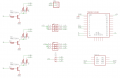
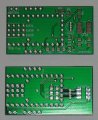
Why not start with a small(ish) accelerometer module like this one and something like an Arduino nano. You can find cheaper accelerometer modules on ebay/aliX. That should be able to fit inside the base of a wand (25-30 mm in diameter). Here's a board I made that that uses a Teensy 2.0 (very similar to an Arduino Nano), an ebay accelerometer module and RGB LEDs. I designed it to take one through hole RGB LED or up to 2 surface mounts ones. The surface mount ones are pretty easy to solder and are on either side of the board so you get light on both sides. With just one LED, it's pretty bright so I expect 2 would be even better. The accelerometer doesn't appear to be sold anymore so you'd need to adapt it. Total cost is about $10 plus the PCB.
rgb fob acc.png
RB033482 cropped.jpg

I also have another design that does pretty much the same but can take up to 16 LEDs (8 on each side). It's based on an ATTiny and a Kionix LGA accelerometer - it's fairly small. All surface mount and very much of a challenge to build if you've never made a PCB before. It uses a micro USB connector so it can be driven from a USB battery. Also programming it will require an Atmel ICE. I think it's simply too advanced for you at this point, though. Total parts cost is about $4 plus the PCB.
 
Top