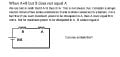
It makes the unsubstantiated claim that "it is a fact" that if you want max power to be dissipated in A that something MUST be true. Then it makes another unsubstantiated claim that for maximum power to be dissipated in A the opposite must be true.
This has NOTHING to do with whether equality is symmetric.
It has to do with what assumptions and constraints are being arbitrarily imposing on A and B. If different constraints are imposed, then it isn't surprising that the results are different.
EDIT: Changed the wording to make it clearer that I'm talking about what the problem is claiming and not what the TS is claiming.
I think it was the OP's problem that stated the A=B constraints, not the OP.
But the OP hasn't stated what he wants other than for us to apparently solve the problem but, as frequently noted, this is Homework Help, not Homework Do.
I think it was the OP's problem that stated the A=B constraints, not the OP.
But the OP hasn't stated what he wants other than for us to apparently solve the problem but, as frequently noted, this is Homework Help, not Homework Do.
Yes, it is the problem that is making the claims, not the TS. I didn't mean to word it in such a way that it implied that the TS was the source of the claims, but it can certainly be read that way very easily.
This is not a homework problem or a trick question. Someone said,"It makes the unsubstantiated claim that "it is a fact" that if you want max power to be dissipated in A that something MUST be true. Then it makes another unsubstantiated claim that for maximum power to be dissipated in A the opposite must be true." It is an electrical fact that for maximum power to a load, the load resistance must be equal to the source resistance. It is also true that for the load to receive maximum power, the source resistance must be zero ohms. Thus for maximum load power from an amplifier or power supply with an internal resistance of B, A must equal B but B can not equal A. Sounds like a mathematical contradiction. Try it for a simple 12 volt source with an internal resistance of 4 ohm. For max power the load must be 4 ohm. But then adjusting the internal resistance to zero ohms will cause the 4 ohm load power to increase quite a bit.
This is not a homework problem or a trick question. Someone said,"It makes the unsubstantiated claim that "it is a fact" that if you want max power to be dissipated in A that something MUST be true. Then it makes another unsubstantiated claim that for maximum power to be dissipated in A the opposite must be true." It is an electrical fact that for maximum power to a load, the load resistance must be equal to the source resistance. It is also true that for the load to receive maximum power, the source resistance must be zero ohms. Thus for maximum load power from an amplifier or power supply with an internal resistance of B, A must equal B but B can not equal A. Sounds like a mathematical contradiction. Try it for a simple 12 volt source with an internal resistance of 4 ohm. For max power the load must be 4 ohm. But then adjusting the internal resistance to zero ohms will cause the 4 ohm load power to increase quite a bit.
It's not a contradiction at all; you are falling for a very common fallacy. You memorized an equation that applies to a very specific situation and you went and tried to generalize it to all situations, including ones for which it does not apply. The entire development regarding max power transfer is based on the premise that you have no control over the source resistance and that it is whatever it is and you can only change the load resistance. Go through the development -- the only variable is the load resistance. The source resistance is fixed. Thus, whatever results you get only apply to situations in which you can't change the source resistance.
It is NOT "an electrical fact that for maximum power to a load, the load resistance must be equal to the source resistance."
This simply is not a true statement.
If you CAN change the source resistance, then your development has to reflect that ability and you discover that max power transfer increases as the source resistance goes down.
So to recap, for maximum power transfer to a load in a system consisting of a voltage source with a purely resistive source resistance and a purely resistive load resistance:
IF the source resistance is fixed and you can choose the load resistance, max power to the load occurs when the load resistance is equal to the source resistance.
IF the load resistance is fixed and you can choose the source resistance, max power to the load occurs when the source resistance is equal to zero.
IF you can choose both the load and the source resistance, then you want them to be equal and as small as possible. In the limiting case of both going to zero, the power transferred to the load goes to infinity.
I have a similar argument. B is a given, A is a result, period.
It is actually true that the load impedance must equal the source impedance for maximum power transfer, but after all that's called the Maximum Power Transfer Theorem. In the network shown, that means that when A is made equal to B then A gets the maximum possible power from the source.
The "SOURCE" however, and i put that in all caps, is NOT the battery alone, the source is the BATTERY AND THE RESISTOR 'B' taken both together as an immutable object. This simply means that the theorem does not have to hold if in fact you change resistor B, unless you also change resistor A to match again. In fact, the SOURCE IMPEDANCE is B, so for the theorem to hold we have to keep A equal to B.
This theorem is used to show what kind of load is best for a given source when we want max power in the LOAD, not to show what happens when we want to know something about B. B is a given, A is a result.
I wanted to avoid that discussion because it ends up getting into theoretical muddy water. This happens from time to time in electrical theory.
For example, we might argue that if the resistance is zero, then it's not resistance anymore so it could not be considered to be part of the discussion that includes resistances.
The main discussion i think is talking about what happens with electrical quantities that are not part of reality in and of themselves alone but require some other element or assumption to be validated. In this simple argument it's the reality of resistance that can come into question.
In main theory however, a zero resistance is said to draw infinite current from a non zero voltage source and so we jump the reality a little and say that this must require infinite energy, probably because we assume that the voltage source is still not zero even though that's impossible too.
There are theoretical situations where one way or the other is more convenient. It is then that the application has a huge influence on how we should interpret the results and of course that is because the application is the final reality.
Recall for example what i deem the "aniselectronic short" which is a perfect zero Ohm short sometimes and an open circuit other times, even though we have not changed the circuit at all. That's how theory works sometimes even though in the real world it cant be both.
This is an indeterminant form (namely infinity multiplied by zero), so you need to step back and look at the limits using something like L'Hospital's Rule.
While not rigorous, one way to think of this particular case is that you have infinity-squared, which trumps the zero-to-the-first. In fact, in this case we know what this infinite current times this zero resistance is -- it's the applied voltage of the ideal battery. So we have a constant voltage multiplied by an infinite current.
We had a question similar to this: https://en.wikipedia.org/wiki/Two_capacitor_paradox
In one of our exams in school physics. They didn't ask where the energy went but I thought I must have done something wrong because energy can't just disappear. I asked our physics master and he added a resistor into the circuit and derived the formula for the energy disipated in that resistor. The value of the resistor does not appear in that formula so the power disipated is the same whatever the value of the resistor- zero to infinity.
We had a question similar to this: https://en.wikipedia.org/wiki/Two_capacitor_paradox
In one of our exams in school physics. They didn't ask where the energy went but I thought I must have done something wrong because energy can't just disappear. I asked our physics master and he added a resistor into the circuit and derived the formula for the energy disipated in that resistor. The value of the resistor does not appear in that formula so the power disipated is the same whatever the value of the resistor- zero to infinity.
If you set up the equations explicitly, you have a current flowing through a voltage drop in the first capacitor (as it discharges), a current flowing through a voltage drop in the second capacitor (as it charges), and a current flowing through a voltage drop between the capacitors. There is power and energy associated with all three. People forget about the last one. Due to symmetry, it dissipates the half of the energy that was originally stored on the left capacitor. To be even more mathematically rigorous, you have a current impulse that transfers charge between the capacitors and that impulse goes through a step change in voltage. The integral across that step/impulse works out to half of the energy stored on the capacitor. None of this requires introducing non-ideal aspects to the device models.
One thing to note is that while the math works out very nicely and neatly as long as you are careful to account for everything, the math says nothing about how the energy that is removed from the system gets removed or what form it is transformed into, only that it IS accounted for mathematically.

 Facebook
 Google
 GitHub
 Linkedin