What's the purpose of a joule thief?

ian field

Joined Oct 27, 2012
6,536
I want to make a joule thief, but I haven't been able to find a toroid bead yet.
You don't need fancy materials - I've seen people get away with winding a blocking oscillator JT inductor round a nail.

A bit of ferrite rod from a scrap transistor radio will work.

A common mode mains choke from a scrap PSU will usually work - once you figure out the correct phasing of the 2 windings.

Various other manufactured inductors/transformers can be modified - some of the lower power CFL ballast inductors don't have much wire on the bobbin, sometimes there's enough space in the limbs of the "E" cores to feed in a base winding.
 

Thread Starter

tjohnson

Joined Dec 23, 2014
611
I found this webpage that shows several joule thief circuits that can be made without toroids: http://www.talkingelectronics.com/projects/LEDTorchCircuits/LEDTorchCircuits-P1.html

I don't have a 10nF capacitor, so I can't build the more efficient circuit mentioned there, but I'm hoping to be able to make the simplest one. I have all the necessary materials, except I'm not sure if I have a type of wire that will work for the coil. Must it be magnetic wire, or will insulated 22- or 28-gauge wire work?
 

Wendy

Joined Mar 24, 2008
23,859
The main use of a joule thief for me is efficiency, it will drive an LED with a voltage that would not work by itself.

You could use a nail or a screw to make an inductor, I have. It is not that finicky.
 

Thread Starter

tjohnson

Joined Dec 23, 2014
611
The main use of a joule thief for me is efficiency, it will drive an LED with a voltage that would not work by itself.

You could use a nail or a screw to make an inductor, I have. It is not that finicky.
Thanks, I understand that I can use a nail or a screw, but:
I'm not sure if I have a type of wire that will work for the coil. Must it be magnetic wire, or will insulated 22- or 28-gauge wire work?
 

Brownout

Joined Jan 10, 2012
2,390
Though many may argue they aren't really Joul Thief's, I've found a-many converters in commercial equipment that are based on the basic JT. Typically to provide high frequency, high voltage to fluorescent lamps. ie. I've found them in night lights, CCF bulbs and copiers/scanners.
 

Thread Starter

tjohnson

Joined Dec 23, 2014
611
@DickCappels: Thanks for pointing me to your website. I'm going to bookmark it, as it looks like it contains many useful projects.

For some reason, I hadn't noticed that the link you gave in post #22 was to your website. I suppose I was in a hurry and missed the beginning of the URL, and hadn't scrolled to the top of your page to see your "Flooring Nail Inductor."
 

Thread Starter

tjohnson

Joined Dec 23, 2014
611
Nearly any copper wire will work if you have enough turns. As Wendy said, the circuit is not finicky.


I noticed that you wrapped twisted wire around the nail. Would I need to use two wires as well?

I thought of just using a single wire and splitting it into two wires on each end, but I don't think that would work because it wouldn't be equivalent.
 

Wendy

Joined Mar 24, 2008
23,859
Think transformer. A small coil around a large coil.

I don't like thick wire myself, I can roll 10 or more turns of magnet wire for every turn of #22 wire. More of esthetics than anything.
 

Thread Starter

tjohnson

Joined Dec 23, 2014
611
Think transformer. A small coil around a large coil.
Sorry, I'm still not sure that I understand. Do you mean that I do need two wires, one coiled around the other? It looks like the wood core inductor on @DickCappels' page uses only one wire, but there's no circuit diagram for it.
 

ian field

Joined Oct 27, 2012
6,536
Sorry, I'm still not sure that I understand. Do you mean that I do need two wires, one coiled around the other? It looks like the wood core inductor on @DickCappels' page uses only one wire, but there's no circuit diagram for it.
A common way of making a blocking oscillator starts with one length of wire.

Wind on about 15 - 20 turns for the collector, at the end of that winding you bring out a loop of wire and twist it to make a neat tapping, then wind on another 12 - 15 turns for the base (connected via a resistor). The loop that's twisted out for the tap is the +1.5V Vcc.

If you use enamelled copper wire - which some suppliers call; "magnet wire", its fairly easy to scrape off enough enamel at the end of the tap to tin some solder on it, the heat will peel more enamel off so you can make a sound solder joint.

You can use insulated hookup wire, but stripping the end of the loop can be fiddly - solid wire is slightly easier than stranded.
 

takao21203

Joined Apr 28, 2012
3,702
There are other ways.

Such as adding wire to a ready made inductor.
Its easier with large ones but Ive done it with a RF inductor (needs extra parts though).
Or using small HF transformers. RadioShack or Maplin dont have these and even real distributors dont always have a good selection but they do exist.

Its possible with some TOKO HF transformers too.

Still talking about the original unmodified Joule Thief, not the variant with 2 coils and a capacitor divider.

The nail circuit really is a bit creepy as iron has high losses starting at a few KHz. you may see very reduced battery life.

EMI Toroids are easy to buy and cheap in quantity but not worth the hassle ordering a single piece from a distributor. They normally expect $100 order minimum and consider that as "small", true some accept any small order with a shipping surcharge.

Im not mentioning my own sales on ebay here...

But really EMI toroids are common, still mass produced, and dont cost much.
Cores from PC mainboards arent really good for JT,
neither the ones used for common mode chokes (used in line filters).

I have made transformers with cores as small as 6mm but magnetic parameters must be suitable.
 

boatsman

Joined Jan 17, 2008
187
There are other ways.

Such as adding wire to a ready made inductor.
Its easier with large ones but Ive done it with a RF inductor (needs extra parts though).
Or using small HF transformers. RadioShack or Maplin dont have these and even real distributors dont always have a good selection but they do exist.

Its possible with some TOKO HF transformers too.

Still talking about the original unmodified Joule Thief, not the variant with 2 coils and a capacitor divider.

The nail circuit really is a bit creepy as iron has high losses starting at a few KHz. you may see very reduced battery life.

EMI Toroids are easy to buy and cheap in quantity but not worth the hassle ordering a single piece from a distributor. They normally expect $100 order minimum and consider that as "small", true some accept any small order with a shipping surcharge.

Im not mentioning my own sales on ebay here...

But really EMI toroids are common, still mass produced, and dont cost much.
Cores from PC mainboards arent really good for JT,
neither the ones used for common mode chokes (used in line filters).

I have made transformers with cores as small as 6mm but magnetic parameters must be suitable.
I have successfully built a Joule thief using a toroid from a line filter and I used thin plastic insulated wire in two colours. I save all depleted AA and AAA cells and use them with this circuit until the battery is depleted
 

Thread Starter

tjohnson

Joined Dec 23, 2014
611
A common way of making a blocking oscillator starts with one length of wire.

Wind on about 15 - 20 turns for the collector, at the end of that winding you bring out a loop of wire and twist it to make a neat tapping, then wind on another 12 - 15 turns for the base (connected via a resistor). The loop that's twisted out for the tap is the +1.5V Vcc.

If you use enamelled copper wire - which some suppliers call; "magnet wire", its fairly easy to scrape off enough enamel at the end of the tap to tin some solder on it, the heat will peel more enamel off so you can make a sound solder joint.

You can use insulated hookup wire, but stripping the end of the loop can be fiddly - solid wire is slightly easier than stranded.
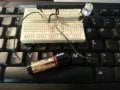
I tried building a joule thief circuit based on your post and @DickCappels' floor nail inductor, but it isn't working. Here's a picture of the breadboard:
20150723_191959[1].jpg
 

Brownout

Joined Jan 10, 2012
2,390
Not a JT builder, but I do know it's easy to get the leads from the 'tickler' coil (the secondary) reversed. If it's not working, try reversing those leads.
 

Thread Starter

tjohnson

Joined Dec 23, 2014
611
Oh, do I need to wind the secondary coil around the primary one? I probably didn't wind my inductor correctly.
 
Top