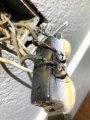
What would cause this outlet to be fried?

Thread Starter

120volts

Joined Sep 26, 2014
62
Hello, good folks:

Yesterday I had occasion to troubleshoot three bedroom electricity that all of a sudden went out. I got lucky and started opening outlets and found the one pictured below. The question is, how in the world did this ever get fried?

It’s actually new home owners (about a month) who only used a nightlight plugged in there. The outlet is extremely old so perhaps the previous owner did something or perhaps just old age?

I also found the outlet at the hot wiring was extremely hot to the touch when I opened it most likely from the extremely high resistance of the hot, frayed wires.

Anyway, I replace the outlet and everything works great. But I’m just curious what my cause this.
 
Last edited:

bertus

Joined Apr 5, 2008
22,921
Hello,

I do not see any pictures.
You can upload the pictures to the forum using the "Upload a File" button.

Bertus
 

bertus

Joined Apr 5, 2008
22,921
Hello,

That looks like the old cotton isolated wires.
Better have the wires replaced to avoid a short and possible fire.

Bertus
 

Thread Starter

120volts

Joined Sep 26, 2014
62
No, Bertus, they are not the old cotton wires. They are 14 gauge copper with modern insulation. But after getting fried they do look like cotton!! It also seems like moisture residue (greenish/white) unless that's from the smoking wires over time. My mommy always told me not to smoking was bad for you. :)

I also forgot to mention all the outlets in the house do not have a ground (older house) from all the two prong outlets and no ground wire attached anywhere. And this particular outlet was hard plastic to boot, so not likely the ground is strapped to the unseen backside. I further tested with a outlet tester and it showed "no ground". Could this be the cause if owner(s) plugged in appliances requiring three prong with a "two to three prong" adapter?
 

ebp

Joined Feb 8, 2018
2,332
It looks to me like it has been wet (green goop on wire, though it could be a product of reaction between a hot wire and the insulation) and like something white has been carelessly sprayed into the box and onto the receptacle. It looks a bit like the near screw is not properly tightened, but it's hard to tell.

I've seen many safety agency approved receptacles that I simply would not use. The contacts are inferior and lose contact force, though they shouldn't if the plug isn't being inserted and removed frequently. These are the sort of receptacles that sell for less than a dollar. I regard them as house burners. I will only use "commercial" or "specification" grade receptacles. They cost 3 or 4 times as much, but are much better made and very much safer, in my opinion.
 

panic mode

Joined Oct 10, 2011
4,974
check if overcurrent protection is functional (failed breaker) or tampered with (over-sized). also outlet may be abused a(vacuuming and pulling for a bit more cable). this can reduce grip of the receptacle on plug contacts and once this is done, it does not matter what size load is connected next - weak contact will overheat.

it is hard to tell now since wires are already burned, it would be nice to see what this looked like when it was installed. i have seen plenty of bad practices such as nicked or scraped wires, damaged insulation like when using pliers to hold wire etc.

red flag is also that this is dusty. dust itself is normally not a problem but it is a issue if exposed to moisture or place where insects or whatever may be cocooning. also this may be indicative of another problem - air draft through the outlet box, which is common when on outer wall.
 

dl324

Joined Mar 30, 2015
18,326
It’s actually new home owners (about a month) who only used a nightlight plugged in there. The outlet is extremely old so perhaps the previous owner did something or perhaps just old age?
The outlet and wiring could have been damaged by the previous homeowners. They could have operated some high wattage appliance that caused the connection to the wiring to loosen over time from thermal cycling.
 
It looks like to me that the screw was tightened down on the insulation, not the wire. If that's the case, then poor connection.

I don't like daisy chaining that way any way for that reason. I wirenut a pigtail, so only one wire on each side. Ideal doesn't sell Term-a-nuts any more which were an excellent solution. It's difficult to see, just how much wire is wrapped around the screw.

I live in a 1960's house and the wires are 14/2 with ground. The boxes don't have a threaded hole for a ground screw, but are grounded; but not necessarily well to the Romex strain relief screw. Over time, all have been replaced with 3-wire outlets.

if a box is plastic, you obviously can;t ground the box.

If you have a metal box, the box needs to be grounded. The outlet and the box need to be grounded separately (there is an exception) with wires. Without the hole for the green screw on the box, you need to use a ground clip which only works with solid wire. Tapping a hole is also possible in some cases. All sorts of ground pigtails are available.

There does exist an obsolete non-polarized outlet where both blade receptacle heights are the same.

Hopefully, the house is wired with 14/2 with ground.

It's NOT PERMISSABLE to use a grounded outlet if the outlet is not grounded. Ii is permissible to use a GFCI outlet which has the ground pin ONLY IF the outlet is marked, NO PROTECTIVE GROUND. Stickers are usually in the GFCI box for this application.

So, if there is no ground wire, you need to replace the outlet with a GFCI and label it "NO Protective Ground".

Since it's daisy chained, you obviously have others.

You can actually get ~60 VAC from the ungrounded device ground pin to neutral if a 3-wire device with a line filter is plugged into an ungrounded outlet.
 
Last edited:

BillB3857

Joined Feb 28, 2009
2,573
I would have to agree that a loose connection was the prime cause with a heavy load down stream of the outlet that actually had the problem and was caused by daisy chaining.
The picture looks similar to something that happened to my neighbors outlet. He called and said FIRE was coming out of an outlet and nothing was even plugged into it. I went over and found his wife using an electric skillet at the other end of the counter. She said that the strangest thing happened. The skillet went off at the same time the other outlet started spitting FIRE! I forgot to mention that their house was wired with ALUMINUM WIRE!!!
Daisy chain wiring is bad enough but when combined with ALUMINUM WIRE, a catastrophe is just waiting to happen.
 

Thread Starter

120volts

Joined Sep 26, 2014
62
Yikes. This was a total fire hazzard. They are so lucky they called me last evening and I got there within a half an hour. The outlet was still hot to the touch.

I think everybody hit it on the nose. My feeling is the outlet or the circuit was overloaded and the outlet does appear to be 20 years or more years old. The eventual degrading of the wires at the terminals caused excessive resistance and he rest his history.

Customers are also complaining of brownout when running a vacuum cleaner for example, so I’d be curious to see if they still experience that after I replaced this outlet. Regardless, I have highly recommended an electrician change upgrade their panel as it does seem to be overloaded at this point (three rooms on one circuit). By the way the white stuff around the outlet is spray texture, though there was the usual dust inside as expected. These things are ooooold. Totally remodeled and beautiful home, just the electrical sucks for them.
 
It also looks like two different styles of painting the room. Usually, I take the outlet out just as you have done in the picture, but pulled out a bit further. You can see paint splatter from the roller.

In another possible case, it looks likes the outlet may have just been painted over with or without the plate on. Some people paint right over the outlet, cover and all.

I ran into that sort of bakelite box once and the threads were stripped on some of the boxes, so a threadsert might be in order.

Also note that the box is recessed. This does require spacers for the outlet screws. Usually, you can layer them. I've seen them in a lime green at the local hardware store.

You might actually find a 20 A FUSE on a 15 A circuit AND the outlet may have been mechanically loose. The screws may have also touched the side of the box, thus arcing, sparking and overheating.

The wire diameter looks like it changed by overheating.

There isn't anything fundamentally wrong with fuses except that Joe Homeowner can replace them with any size. e.g. A higher rating if the circuits continue to trip. Homeowner's insurance may not cover a main panel with fuses.

I recently had an issue at home with an outlet I replaced. The wire screws could hit the sides of the box, the way the replacement outlet was designed. The manufacturer blamed the dimensions of the box which it did fail. I blame the maker of the outlet for not protecting the head of the screw better.

The wires with a #12 on the screw (even though rated for #14) should not be able to touch the sides moving from side to side. It did AND the dimensions were maybe a mm to narrow.
 

dl324

Joined Mar 30, 2015
18,326
Some people paint right over the outlet, cover and all.
The contractors for my kitchen remodel were always doing crap like that.

The drywall contractor would cover outlet boxes to tweak the electrical contractors. Then the electrical contractors would make oversized holes that others would have to deal with. The electrical guys screwed up a hole for an outlet in my kitchen island. Instead of doing the right thing, which would have been costly, they found an oversized outlet plate to cover up their screw up. They're also the ones who wired my generator switch wrong so I was back feeding the utility line the first time I fired up my generator.

County inspectors were worthless. For every violation they caught, there were about an equal number that they missed.
 

Externet

Joined Nov 29, 2005
2,630
Being both black wires toasted, I would say that some high consumption appliance was plugged in another outlet daisy chained to this one; and this pictured one had the contact screws not tight/clean, causing the toasting by resistance of the poor connection (weakest point). Check other outlets on the same circuit, but you may not find the same problem if their screws were tight and healthy.
 

Thread Starter

120volts

Joined Sep 26, 2014
62
Being both black wires toasted, I would say that some high consumption appliance was plugged in another outlet daisy chained to this one; and this pictured one had the contact screws not tight/clean, causing the toasting by resistance of the poor connection (weakest point). Check other outlets on the same circuit, but you may not find the same problem if their screws were tight and healthy.
Totally!!! All what I suspected so I did open a couple of other outlets but they looked good. But the end line is that they need to upgrade their very old panel, ground, and change outlets. Customer paid enormous price for the house already so who knows what they’ll do. I did advise them already not to use heavy draw appliances or at the same time or risk another blown outlet.
 
Top