What would be a suitable transformer for this circuit?

PeteHL

Joined Dec 17, 2014
580
The transformer is a very much integral part of the circuit. It provides the feedback to make the circuit oscillate. So there is no way the posted circuit can possibly use a 555 or am LM386 as substitutes.
ALSO, transformers are still used, but not usually for audio amplifier outputs. So a low-power transformer, 200 to 500 ohms primary impedance, center tapped, to 8 ohms, or 10 ohms secondary impedance, should work.

A NOTE TO ALL: the TS did not ask for a redesign that would be entirely different!!
Yes, but a redesign without the transformer that functions identically would be worthwhile, wouldn't it? Don't ask me to do this. A low-power transformer with a center-tapped primary is very uncommon, I would say.
 

MisterBill2

Joined Jan 23, 2018
27,652
Yes, but a redesign without the transformer that functions identically would be worthwhile, wouldn't it? Don't ask me to do this. A low-power transformer with a center-tapped primary is very uncommon, I would say.
For perhaps 25 years most small transistor devices that had a speaker had just such a transformer. So there are a lot of used ones around. In addition, distributors such as Digikey have a few pages of them in the catalog.
While push-pull output stages are much less common now, audio transformers are still used.
Probably he know nothing resellers like amazon do not have them, though.
And while some sort of cobble with a 555 might produce a signal fitting the same general description, it would not be a very close approximation.
 

Audioguru again

Joined Oct 21, 2019
6,826
The low power supply voltage, the high impedance of the oscillator circuit and the low impedance of the transformer secondary winding will result in a very low sound level from a speaker.

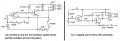
The original schematic had the 1st transistor looking upside down so I redrew it:
 

Attachments

MisterBill2

Joined Jan 23, 2018
27,652
Actually, the center tapped transformer from a 6 or 12 volt wall wart type power supply will work quite well, although not a great match for a speaker.
 

MisterBill2

Joined Jan 23, 2018
27,652
An output transformer from a pocket size transistor radio has the correct ratio to drive a speaker. The volume will not match a current siren speaker, but consider that the circuit presented is not very powerful., so the sound will not be very loud no matter what..
And for those suggesting a total redesign, consider that the TS has told us that they have the circuit boards and the rest of the parts. At least that is what I got from the statement.
I HAVE a circuit board with a modern circuit that uses a CD4001 quad-nor gate and it has a full four TO-220 transistor bridge driver. That would do the TS no good because they want to use the on-hand PCBs.
Some times going to a more modern scheme is not the goal.
 

Audioguru again

Joined Oct 21, 2019
6,826
The battery is only 4.5V.
The class-A output transistor drives half of the 900 ohms primary winding. Half the winding is 225 ohms.
4.5V/225 ohms= 20mA peak which is 14.1mA RMS. Then the power is 14.1mA squared x 225 ohms= 45mW (0.045W) of power.
A speaker producing only 45mW has a fairly low sound level if you are holding it.

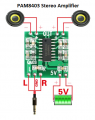
If A modern bridged power amplifier powered from 4.5V (a PAM8403) drives an 8 ohm speaker then the output is 8V p-p which is 2.83V RMS and the output power is 1.0W, or 2W with distortion that doesn't matter on a siren sound.
 

MisterBill2

Joined Jan 23, 2018
27,652
The battery is only 4.5V.
The class-A output transistor drives half of the 900 ohms primary winding. Half the winding is 225 ohms.
4.5V/225 ohms= 20mA peak which is 14.1mA RMS. Then the power is 14.1mA squared x 225 ohms= 45mW (0.045W) of power.
A speaker producing only 45mW has a fairly low sound level if you are holding it.

If A modern bridged power amplifier powered from 4.5V (a PAM8403) drives an 8 ohm speaker then the output is 8V p-p which is 2.83V RMS and the output power is 1.0W, or 2W with distortion that doesn't matter on a siren sound.
Implementing "a modern bridged power amplifier" on the existing PCBs that the TS is hoping to use would be a real achievement as I see it. Of course there may be a scheme for doing that which I don't see. Sharing that scheme will benefit most of us.
 

Audioguru again

Joined Oct 21, 2019
6,826
The datasheet of the PAM8403 shows a stereo class-D bridged audio power amplifier that is powered from 2.5V to 5.5V and produces 2.4W into 4 ohms per channel with low distortion when powered from 5V.
Assembled amplifier modules are available from many Chinese online sites.

We do not know of a simple siren circuit that produces a slowly sweeping up and down frequency like in North America.
The boo, bee, boo, bee, 2 frequencies sound of a European siren is much simpler to make.
 

Attachments

Top