This kind of board I call protoboard. What is the recommended AWG to use with it? I usually use 24 AWG solid, I've been seeing 22AWG solid on sale, While you can use 24 AWG solid I don't think it is good for the board. Discuss?
I've found that #22 works best and #24 is just a little too skinny.
I mainly use #24 now because wire has gotten too expensive for me (used to be $3/100', now it's $8) and I have thousands of feet of bulk CAT5 cable. I find that the insulation slides on the wire too easily and the wires pull out of the solderless breadboard a bit too easily.
Anything larger than #22 is, well, just too large.
22AWG historically has been a bear to insert for me, which leads me to speculate it is too big, One thing nice about a forum like this, stupid questions are allowed, even from a moderator. I would rather ask than go off half cocked.
22AWG historically has been a bear to insert for me, which leads me to speculate it is too big, One thing nice about a forum like this, stupid questions are allowed, even from a moderator. I would rather ask than go off half cocked.
22 AWG used to be the standard about a hundred years ago. 24 AWG generally works reliably (which is a good thing, because many ceramic cap leads aren't even that big). How the end of the wire is cut has an influence on insertion force. It it is cut with cutters that leave a wedge shape, the orientation of the wedge makes a big difference.
I suspect that back in the days when ProtoBoard was a registered trademark and there were only about two competitors on the market, quality might have been better.
As an aside, do not run vast currents through the power distribution strips. One of my clients did this to one of my genuine ProtoBoards. The poor thing played fuse at each and every "gap" between the groups on the strip. I wouldn't have believed that possible. It was a 2 kW battery charger capable of delivering 80 A continuously and going to batteries that wouldn't complain if you asked them for a thousand amps.
The vote is 22AWG and/or 24AWG, nothing smaller or larger.
If 24AWG is easier to insert then go with that. I never have to pay for wire. I collect scraps after the telephone-line installer has left the building.
Just remember that breadboards are for breadboarding. The circuit will be taken apart once you've finished debugging and testing.
The vote is 22AWG and/or 24AWG, nothing smaller or larger.
If 24AWG is easier to insert then go with that. I never have to pay for wire. I collect scraps after the telephone-line installer has left the building.
Just remember that breadboards are for breadboarding. The circuit will be taken apart once you've finished debugging and testing.
Call me a heretic ... but I never breadboard (well, maybe only when I want to prove the iteraction between two or three components, but that only happens once in a dozen blue moons, or so)
I always sim in LTSpice (if I can) and then design directly on AutoCAD and etch a PCB. Then I patch it if necessary, and retest it several times. Normally the second time around everything works how it should.
I have breadboarded some bits at pieces. A lot of the things I've designed didn't lend themselves to any sort of breadboarding technique, so PCBs were almost always my next step after paper. Affordable simulation came too late for most of what I did. Now I just wonder what I should do with a vast accumulation of parts that I'll never use. I wish I could send parts by email.
I do a lot of SMD prototype work, things get really small.
I use tinned bare #24 AWG wire and #30 AWG wire wrap wire.
A spool of micro Teflon tubing is the bomb, it's just the right size to slip over the bare #24 wire.
Teflon doesn't melt, so you can relax a bit more when soldering, the results look really clean as well.
It's much easier to slip a piece of Teflon over a wire than it is to cut and strip a piece of hookup wire.
No sniffing burning insulation either.
Wire wrap is great when you have lots of closely spaced pins to solder to.
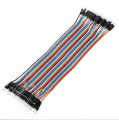
Those jumpers are one of the things I'll buy from AliExpress. They come in two lengths and 3 polarities (M-M, M-F, F-F); 40 of each for under $2 as I recall. And free shipping.

 Facebook
 Google
 GitHub
 Linkedin