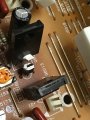
This is in an Onkyo Receiver, I finally have my parts but I don't know what type of compound they used. It's almost like a ceramic but maybe it's just so dry it only seems that way to me.
It could be an acrylic adhesive or an epoxy adhesive, in either case with thermally-conductive "filler" such as zinc oxide.
It looks like the intent is just to thermally couple the small device to the large one, probably for temperature compensation or maybe for over-temperature protection. There would be very little heat flow, so a high-performance material wouldn't be necessary. There are thermally conductive silicone adhesives, which remain flexible, that would probably be satisfactory. Any of the "grease" or "paste" materials would eventually run away with such a wide gap.
My tendency would be to strap the sensor transistor to the big guy with some heat sink grease and leave long legs on it, but that might make the time constant too short and have the amp get all jiggy when it is perfectly safe. In other words, it's a balancing act. Just chip the white stuff off, find out how big the gap is, and work from there.
There is such a thing as heat-sink adhesive. If that smaller device is a temp sensor that's intentionally connected to the larger component, that's what I'd use.
There is such a thing as heat-sink adhesive. If that smaller device is a temp sensor that's intentionally connected to the larger component, that's what I'd use.
The biasing resistor is connected to it's base Q6015 which is the B- rail, connected to the base of Q6045 , I seen a post that @crutschow said to an individual in another thread that if he put a diode on a Transistor in his schematic that it would follow the temperature to control thermal runaway or something. I really didn't understand it.
I used to use an acrylic heatsink adhesive that had glass microbeads to assure electrical isolation of the part from the heatsink. Nice stuff, but I discovered it was quite electrically conductive until fully cured! As I recall there were three variants, the stuff with the spacers, one designed to allow prying the part off without the aid of hydraulic equipment and one high-strength (are you SURE you and to glue this down?) type.
In another thread, the TS posted pics of a control module for a diesel engine. It had a whole bunch of TO-220s glued to the heatsinks. You have to be brave, reckless or highly confident in some critical evaluation to do that for an engine control module.
Interesting to note on killivolt's board that the flat side of the small package is on the round side of the outline silkscreen.
It is very common in conventional class AB amplifiers built with bipolar transistors to use a "Vbe multiplier" circuit with a small transistor to set the quiescent bias current for the output transistors. It's the bias current that moves a class B amplifier toward being class A. Because Vbe (base-emitter forward voltage) varies with temperature, fixed bias voltage is unsuitable - temp goes up, Vbe goes down, bias current goes up, temp goes up some more - Bang!. The small transistor is normally thermally coupled to the heatsink so its temperature tracks the power devices reasonably well. It backs off the bias as the temperature rises to keep the bias current from getting out of hand.
Initially I thought the small device was spaced away from the large one, but it kind of looks like the small one is a TO-92 (or similar) with the round back against the big device, and the blob was just rather sloppy application.
Unless you can find some from a Chinese vendor and are willing to wait a month or 3 for it, thermally conductive adhesive in a small put-up is likely to be hard to find. Some of it is quite expensive and shelf life is limited, so buying a 30 mL tube when you need 0.3 probably isn't something you want to do.
Initially I thought the small device was spaced away from the large one, but it kind of looks like the small one is a TO-92 (or similar) with the round back against the big device, and the blob was just rather sloppy application.
Unless you can find some from a Chinese vendor and are willing to wait a month or 3 for it, thermally conductive adhesive in a small put-up is likely to be hard to find. Some of it is quite expensive and shelf life is limited, so buying a 30 mL tube when you need 0.3 probably isn't something you want to do.
Yes, here is the replacement I purchased. TO-92S it appears they are leaning the package into the other Transistor, so just the top front of this package is touching.
There are lots of things that could be used for good thermal conductivity, but they require a permanent mechanical clamp.
My inclination would be to see if it is possible to bring the flat face of the small device into intimate contact with the large one - longish leads on the small one if necessary - don't solder the small one yet. If that can be done, I'd use good-quality ordinary epoxy (slow cure stuff usually stronger than the fast cure types) to glue the two together, using some sort of strong spring clip to hold them, with the objective of having the thinnest possible layer of epoxy between them.
The parts should be very clean - use 95 or 99% alcohol.
Had a second look at new photo - big device is fully insulated; you could use a "plastic iron" epoxy with powdered iron in it - just be very careful to keep it away from the leads.

 Facebook
 Google
 GitHub
 Linkedin