What to replace ceramic disc capacitors with?

Thread Starter

John Czerwinski

Joined Jun 19, 2017
71
Working on a Wells Gardner k7500 monitor and ran across a ceramic Disc Capacitor that needs replacing. I have parts chassis that I pulled a replacement, but I'll need to rebuild the donor chassis at some point. What is being used now to replace these disc capacitors?

For example, the circuit that this failed capacitor has these specs
C800 Ceramic Disc Capacitor - .01uF 10% Y5R 250V
C801 Ceramic Disc Capacitor - .01uF 20% Y5U 500V
C802 Ceramic Disc Capacitor - 1500 pF 5% NPO 50V MON
C803 Ceramic Disc Capacitor - .022uF 20% X7R 500V MON
C804 Ceramic Disc Capacitor - 1000pF 10% Z5F 2KV

I've seen other chassis use Polyproethelyene to replace some, but would like to confirm best practice.

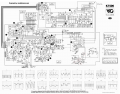
I've attached the schematic of the chassis with the disc capacitors circled, in case there's questions what type of circuit these are used in.
 

Attachments

MisterBill2

Joined Jan 23, 2018
27,336
The most critical specifications on a capacitor are the voltage rating, followed by the stability, if it is in a circuit that demands stability. Coupling capacitors may demand lower leakage and lower losses, or greater stability.
 

SamR

Joined Mar 19, 2019
5,475
Ummm... In what way has it failed? Pictures please! Have you checked it with an LCR meter? When replacing ceramic caps there are 2 things to note. Voltage rating can go higher, but NOT lower. A slight increase in capacitance is usually acceptable unless it is in an oscillator whose frequency is critical. Another thing that may be relevant is temperature rating. Hotter temps tend to mean shorter lifespan and may be helped by a higher temp rating. 150°C instead of 105°C IF the cap is even getting close to being that hot. Mounting the cap "up on its legs" instead of close to the board can assist with cooling as well.
 

Thread Starter

John Czerwinski

Joined Jun 19, 2017
71
Ummm... In what way has it failed? Pictures please! Have you checked it with an LCR meter? When replacing ceramic caps there are 2 things to note. Voltage rating can go higher, but NOT lower. A slight increase in capacitance is usually acceptable unless it is in an oscillator whose frequency is critical. Another thing that may be relevant is temperature rating. Hotter temps tend to mean shorter lifespan and may be helped by a higher temp rating. 150°C instead of 105°C IF the cap is even getting close to being that hot. Mounting the cap "up on its legs" instead of close to the board can assist with cooling as well.
When I got the chassis, the capacitor was physically damaged and was open circuit. Also, the rating was 250V when the specs called for 500v, but overvoltage didn't seem to what caused the physical damage.
 

schmitt trigger

Joined Jul 12, 2010
2,056
Open circuit meaning exactly what?

When you say that, do you mean zero or very low capacitance as measured with an LCR meter?
Because for DC, as measured with a DMM, a capacitor should always measure open circuit.
And I would also request pictures of the failed device.
 

MisterBill2

Joined Jan 23, 2018
27,336
A physically broken (damaged) capacitor will certainly effectively an open circuit. THAT can be visibly verified, no instruments required. AND CERTAINLY most ceramic capacitors can be damaged thru mechanical abuse. The broken condition is often obvious. And especially ceramic disc capacitors can break.
 
Top