What relay?

sghioto

Joined Dec 31, 2017
8,634
Can you talk me through it? Sorry to ask, if I’m going to put it together I need to understand.
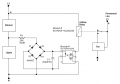
R1 limits the current to a maximum of 12 ma when the lights are fully on at 240vac. This value can be lowered if needed.
D1 rectifies the ac to a dc pulse. This can be changed to a bridge or full wave rectifier for increased output.
C1 is a filter to smooth out the dc pulse to steady value.
R2 is to keep the gate at 0 volts when the dimmer is off. May not be required.
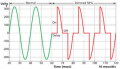
Depending on the model of dimmer switch the output is not a continuous sine wave but a pulse, something like the image below.
The rectified dc voltage level depends on the duty cycle of the dimmer output as seen in the red .
SG
1600364806526.png
 
Last edited:

djsfantasi

Joined Apr 11, 2010
9,237
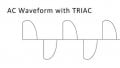
What is the waveform of the dimmer output? If it’s a typical Triac based dimmer, it’s a chopped AC wave, like the image below.
873041F1-D71C-4540-8BE5-B90FD8797787.jpeg

So at the 1.5V level, the duty cycle is 0.625%. But the circuit is using a half wave rectifier (diode), which further reduces the duty cycle to 0.312%. With 50Hz AC source, the dimmer will be on for 0.125mS and off for 39.875mS.

Is a 220uF capacitor sufficient to smooth out this scenario and provide (a minimum) of 0.5mA to the Triac gate?

I don’t know myself for sure. Just asking a question.
 

sghioto

Joined Dec 31, 2017
8,634
TS won't know until he tries it. The BTA202X gate trigger is rated at a minimum .25ma to a max of 5ma. With a 20K resistor that's down to less than 12 volts at .25ma. At a 1.5 volt level the lights would be off for all practical purposes maybe at the 12 volt level (5%) as well.
SG
 

Thread Starter

StuManFlu

Joined Sep 15, 2020
39
TS won't know until he tries it. The BTA202X gate trigger is rated at a minimum .25ma to a max of 5ma. With a 20K resistor that's down to less than 12 volts at .25ma. At a 1.5 volt level the lights would be off for all practical purposes maybe at the 12 volt level (5%) as well.
SG
I would like to have a go at building this but have to work out where to start. Really appreciate your insight. How likely do you think it is that it will work? Are there any variables to consider with the choice of components?
 

sghioto

Joined Dec 31, 2017
8,634
How likely do you think it is that it will work? Are there any variables to consider with the choice of components?
I would give it better than 50% from the values listed. R1 is the most critical. You can go with a lower value but that does increase the power dissipated across the resistor especially when the lights are max brightness.
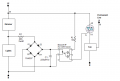
Here's a second version using a solid state relay (SSR) to activate the mechanical relay. This SSR typically only requires .27ma to operate and using a full wave rectifier will double the output voltage.
I actually prefer this version more, give it better than 75%.
SG
EEE Fan control full wave.png
 

Thread Starter

StuManFlu

Joined Sep 15, 2020
39
I would give it better than 50% from the values listed. R1 is the most critical. You can go with a lower value but that does increase the power dissipated across the resistor especially when the lights are max brightness.
Here's a second version using a solid state relay (SSR) to activate the mechanical relay. This SSR typically only requires .27ma to operate and using a full wave rectifier will double the output voltage.
I actually prefer this version more, give it better than 75%.
SG
View attachment 217489
Looks elegant thank you. Is there a reason the the solid state relay couldn’t control the supply directly to the fan without the need for a electromagnetic relay? What is the function of the 4 diodes and the C1 ?
 

sghioto

Joined Dec 31, 2017
8,634
Probably
Is there a reason the the solid state relay couldn’t control the supply directly to the fan without the need for a electromagnetic relay? What is the function of the 4 diodes and the C1 ?
Probably can but not this SSR it's only rated at 270ma
The four diodes are what is called a full wave rectifier. This will double the average voltage available to the SSR over using a single diode. C1 smooths out the pulsed dc to a steady level.
The idea is to try and make the voltage detector very sensitive because I don't know what the minimum voltage from the dimmer switch will be. Might be able to accomplish with a single SSR rated high enough to handle the fan motor.
OK, version #3 replacing relay with triac.
SG
EEE Fan control full wave.png
 

djsfantasi

Joined Apr 11, 2010
9,237
The idea is to try and make the voltage detector very sensitive because I don't know what the minimum voltage from the dimmer switch will be.
The minimum voltage is 1.5V per the TS specification. Unless made from Schottky diodes, the full wave rectifier will drop ~1.4V, leaving only 0.1V for the SSR.

The minimum voltage from the dimmer isn’t the critical voltage. The voltage that should be used in the design should be the minimum voltage for the lamps to function. It likely is higher than 1.5V. But, it should be higher than the SSR operating threshold plus the diode drop across the full wave rectifier.
 

Thread Starter

StuManFlu

Joined Sep 15, 2020
39
I would say the trigger voltage can be assumed to not be a big issue in terms of the practical use of lights in the bathroom. In most cases the lights will be on or off only or may be dimmed to 50% it unlikely that they will be dimmed to say 2% or 5% in practical use so they should reach the trigger voltage without a problem considering the top operating voltage is 240v. Maybe I can provide some more details on the dimmer or fittings? What would you need and I can try and find that info?
 

Thread Starter

StuManFlu

Joined Sep 15, 2020
39
Probably

Probably can but not this SSR it's only rated at 270ma
The four diodes are what is called a full wave rectifier. This will double the average voltage available to the SSR over using a single diode. C1 smooths out the pulsed dc to a steady level.
The idea is to try and make the voltage detector very sensitive because I don't know what the minimum voltage from the dimmer switch will be. Might be able to accomplish with a single SSR rated high enough to handle the fan motor.
OK, version #3 replacing relay with triac.
SG
View attachment 217492
Looks good and no mechanical relay to make noise or go wrong. Will the full wave rectifier be sensible to operate at high voltage considering that the max voltage will be 240v? Anything to worry about for practical application of this? Things like heat output of the solid state relay or TRIAC that could make them impractical to use? Not suggesting that there is just don’t know what the issues this could throw up in actual application.
 

Thread Starter

StuManFlu

Joined Sep 15, 2020
39
Looks good and no mechanical relay to make noise or go wrong. Will the full wave rectifier be sensible to operate at high voltage considering that the max voltage will be 240v? Anything to worry about for practical application of this? Things like heat output of the solid state relay or TRIAC that could make them impractical to use? Not suggesting that there is just don’t know what the issues this could throw up in actual application.
Sorry please ignore the first question here. The 20k resister would reduce the voltage...... what would the voltage range be after the 20k resistor?
 

djsfantasi

Joined Apr 11, 2010
9,237
Sorry please ignore the first question here. The 20k resister would reduce the voltage...... what would the voltage range be after the 20k resistor?
It would depend on the operating current of the SSR. Then use Ohms law to calculate the voltage drop of the resistor. V = 20,000 * Issr.

Also note that you’ll have a voltage drop across the full wave rectifier. A typical value would be 1.4V (2 times a diode drop of 0.7V). This is independent of the current.
 

Tonyr1084

Joined Sep 24, 2015
9,744
Bathroom fan ? ? ? I have one. Also have a timed switch unit. Turn the fan on for 60 minutes. Take a shower, fill the room with steam. Done bathing, the fan continues to run whether you're in the room or not. Or you can use a PIR (Passive InfraRed) motion detector to turn the fan on when it detects someone in the bathroom. Set it to the full time period after the last motion is detected.

My cats set off the hallway motion detector. Fortunately it's set for the shortest period of time; test mode. Lights will come on for (mine) 12 seconds. Long enough for someone to walk through the hall. Solved the cat problem with a small piece of black tape across the bottom of the lens so as to not see anything below a certain point. However, I don't recall off hand just how long the PIR can be set for.

[edit] Here's one that can be set for 30 seconds to 30 minutes beyond motion sensing. [end edit]
 

Thread Starter

StuManFlu

Joined Sep 15, 2020
39
Bathroom fan ? ? ? I have one. Also have a timed switch unit. Turn the fan on for 60 minutes. Take a shower, fill the room with steam. Done bathing, the fan continues to run whether you're in the room or not. Or you can use a PIR (Passive InfraRed) motion detector to turn the fan on when it detects someone in the bathroom. Set it to the full time period after the last motion is detected.

My cats set off the hallway motion detector. Fortunately it's set for the shortest period of time; test mode. Lights will come on for (mine) 12 seconds. Long enough for someone to walk through the hall. Solved the cat problem with a small piece of black tape across the bottom of the lens so as to not see anything below a certain point. However, I don't recall off hand just how long the PIR can be set for.

[edit] Here's one that can be set for 30 seconds to 30 minutes beyond motion sensing. [end edit]
Yes for sure I have an IP rated PIR option that I could order but it’s not ideal. Would prefer to make it work via the switch if I could. TBH I can’t believe something doesn’t exist off the shelf to resolve the issue....
 
I have had a bathrrom fan on a delay on break timer (20 minutes) for a long time, but the timer went south being in the attic heat and I havent fixed it. It takes a LOT of effort.

So, you have a flood light that takes about 5 minutes to get full bright (light property).
An IR Lamp that is controlled by a mechanical timer (20 minutes).
A fan that would turn-off via a delay on break timer.

3 globe type vanity lamps: 0, 1, 2 or 3 bulbs can be on with switch on lamp fixture with a home made torque multiplier.
LED night light that's off if it's too bright.
 
Top