What is this circuit?

Thread Starter

k1ng 1337

Joined Sep 11, 2020
1,038
Hi what is the name of a circuit that performs this operation?

1) 10v DC supplying Load A and Load B

2) For as long as Load A draws 1A, Load B draws 0A

3) Inversely, when Load A draws 0A, Load B draws 1A

4) Therefore Load B's current draw is inversely proportional to Load A's current draw and scales in direct proportion as slave to Load A

In other words, the circuit must always draw 1A where Load B is an active load and Load A may or may not be connected to the circuit.

Regards,
Mark
 

MrChips

Joined Oct 2, 2009
34,807
Constant current 1A source.
If the supply voltage is always 10VDC, then the net load must always be 10Ω.
If the net load is not 10Ω then you cannot have a fixed 1A @ 10V.
 

Thread Starter

k1ng 1337

Joined Sep 11, 2020
1,038
Constant current 1A source.
If the supply voltage is always 10VDC, then the net load must always be 10Ω.
If the net load is not 10Ω then you cannot have a fixed 1A @ 10V.
Ok so it is then what the LM317 for example is doing in constant current mode, I'll study it's schematic.

Thanks
 

Irving

Joined Jan 30, 2016
5,109
Its not just a constant current source... I'm not convinced that would meet the inverse current sharing aspects of point 2 - 4, though a CC generator may be the starting point. And a CC source wouldn't be a fixed 10v either.
 

Thread Starter

k1ng 1337

Joined Sep 11, 2020
1,038
Its not just a constant current source... I'm not convinced that would meet the inverse current sharing aspects of point 2 - 4, though a CC generator may be the starting point. And a CC source wouldn't be a fixed 10v either.
I came across the circuit somewhere in literature. I'm thinking of an active device that can be added to a circuit (Load B) and uses feedback from Load A to set it's current draw. I'm going to try some CC source circuits in the simulator and see what's what. It's quite possible I misunderstood the function of the circuit I seen.
 

BobTPH

Joined Jun 5, 2013
11,514
Th power source cannot do this. Circuit B has to be an active load that monitors circuit A and draws 1A minus whatever circuit A is drawing. It can be done with an opamp and and a power transistor.
 

Ramussons

Joined May 3, 2013
1,568
Hi what is the name of a circuit that performs this operation?

1) 10v DC supplying Load A and Load B

2) For as long as Load A draws 1A, Load B draws 0A

3) Inversely, when Load A draws 0A, Load B draws 1A

4) Therefore Load B's current draw is inversely proportional to Load A's current draw and scales in direct proportion as slave to Load A

In other words, the circuit must always draw 1A where Load B is an active load and Load A may or may not be connected to the circuit.

Regards,
Mark
Condition 1 conflicts with the highlighted statement.

If you have a 1 amp (or any other value) Current Source, the current will be shared between A and B , the sharing being inversely proportional to their resistances.
If the Maximun voltage of the Current Source is limited to 10 Volts, then the value of A parallel B cannot be more than 10 Ohms.
 

BobTPH

Joined Jun 5, 2013
11,514
The TS did not sat anything about a constant current source. He said it was supplying 10V to two circuits.

Bob
 

Thread Starter

k1ng 1337

Joined Sep 11, 2020
1,038
No, they specify the current drawn by the two circuits. He even uses that term.

Bob
Thanks to all for considering the circuit in question. When consulting this forum, I have a tendency to be ambiguous with how I present information. While this circuit seems simple in my mind, the replies here have shown that it's either an unknown or invalid circuit or my terminology is poor which inevitably starts the discussion down the wrong path.

So I'll try one last time rephrasing what I imagine the operation to be:

1) 10v battery powering Load A and Load B
2) Load A may or may not be connected to the circuit at any time and may draw 0-1A at it's discretion
3) If Load A is not connected, Load B draws 1A by default so there is always 1A flowing regardless
4) As Load A is connected and begins to draw current from 0 to 1A, Load B will reduce it's current by the the same amount (the difference)

4 Possible states out of infinity where a 10V battery is always sourcing 1A:

Case 1) Load A: 0A / Load B: 1A
Case 2) Load A: 0.25A / Load B: 0.75A
Case 3) Load A: 0.5A / Load B: 0.5A
Case 4) Load A: 1A / Load B: 0A

This has been an exercise using imagination on what Load B would be comprised of, it is one I've been thinking about for a while which eventually demands an answer. :)

Regards,
 

MrChips

Joined Oct 2, 2009
34,807
I already gave you the answer.
You must apply Ohm's Law,

I = V / R

1A @ 10V demands that the net load is 10Ω.

Can you guarantee that the effective resistance of Load A in parallel with Load B equals 10Ω?
There is an equation for that. The resistance of Load A and that of Load B are interrelated.
 

BobTPH

Joined Jun 5, 2013
11,514
This new explanation is exactly as I already already understood it.

Load A is an unspecified variable load. It could be a battery charger for example.

Load B must be an active load that senses the current drawn from the battery and adjusts so that the total current is always 1A.

It is not impossible or even difficult needing only a sense resistor an opamp and a power transistor.

Bob
 

MrChips

Joined Oct 2, 2009
34,807
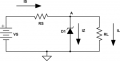
If you are looking for a circuit, look at a zener diode voltage regulator circuit:

1640731243584.png


The zener voltage is 10V.
Vs is infinitely large so that Vs and Rs constitute a 1A constant current source.

For some real values, let us assume Vs = 110V.
The voltage across Rs is 100V.
Hence, by Ohm's Law, Rs = 100V / 1A = 100Ω
IS = IZ + IL = 1A

RL can be any value from 10Ω to infinity.
When IL = 1A, Iz = 0A
When IL = 0A, Iz = 1A
 

Thread Starter

k1ng 1337

Joined Sep 11, 2020
1,038
If you are looking for a circuit, look at a zener diode voltage regulator circuit:

View attachment 256285


The zener voltage is 10V.
Vs is infinitely large so that Vs and Rs constitute a 1A constant current source.

For some real values, let us assume Vs = 110V.
The voltage across Rs is 100V.
Hence, by Ohm's Law, Rs = 100V / 1A = 100Ω
IS = IZ + IL = 1A

RL can be any value from 10Ω to infinity.
When IL = 1A, Iz = 0A
When IL = 0A, Iz = 1A
Interesting, so D1 and anything in series with D1 comprises Load A and RL is Load B.

If D1 is shorted to ground it will be a much better path than RL and so 1A flows. As resistance is added in series with D1, the resistance becomes a parallel calculation and so ohms law still applies where the diode characteristics are negligible compared to the series load. Sound about right?

Edit: this doesn't work in the sim, however if the series load after D1 is fixed and RL is adjusted the operation can be achieved with some tinkering however RS wastes significant power (100W in your example!). Perhaps a more elegant way to do it?
 
Last edited:

MrChips

Joined Oct 2, 2009
34,807
I don't follow what you are saying.

You have to give us a real application of what you are attempting to do. We understand in theory what you have stated but we cannot vision an actual application.
 

Thread Starter

k1ng 1337

Joined Sep 11, 2020
1,038
I don't follow what you are saying.

You have to give us a real application of what you are attempting to do. We understand in theory what you have stated but we cannot vision an actual application.
There is no application, I'm just trying to understand what happens to one system when it interacts with another given an initial set of conditions. The answers given in this topic has helped me look at the problem differently and so is a success. Unless someone cares to delve further by more examples I'd say this topic is closed.

Thanks :)
Mark
 

MrChips

Joined Oct 2, 2009
34,807
As already stated, the net load must always be equal to 10Ω

Ra||Rb = 10Ω

Ra and Rb are not independent.
If Ra changes, then Rb has to change also.

Rb = 10Ra / ( Ra - 10)

Conversely:

Ra = 10Rb / ( Rb - 10)
 

Irving

Joined Jan 30, 2016
5,109
Here's one approach...

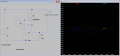
I1 is a current sink, pulling a variable current from 0 to 1A from the supply, through a sense resistor R1. U1/M1 act as a constant current source that aims to maintain the voltage across R1 at 10mV so the current it draws from V2 exactly mirrors the current drawn by I1,thus maintaining the load on V2 at 1A at all times..

1640815150610.png

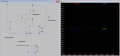
For those that want to argue I1 doesn't model the original question then here's a version that parametrically simulates a time-dependant resistor (R2) with the subcircuit I1+R3

1640815957908.png
 
Top