What is the frequency changing when I change the W?

Thread Starter

Luiz Fernando Vieira

Joined Aug 24, 2015
73
Hello, I assembled a circuit that is a crossed-out circuit using MOSFETs where I'm working with oscillators with an order of phantom capacitance and an inductor with nano, and I left these values fixed without using .step param in LT Spice. I used the `.step param` method on W to see the behavior, and I wanted to see the frequency behavior at each point. I ran a simulation to see the frequency behavior and noticed the change depending on the value of W. I understand that the frequency changes with the changes in the inductor and capacitor values in the tank circuit. I want to understand why this is happening. I tried using Matlab with some equations to see if it interferes with anything, but as far as I could, I didn't see any change.
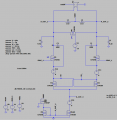

mosfet.png
 

ZCochran98

Joined Jul 24, 2018
351
More than likely you're seeing the effects of the parasitic capacitance in the MOSFETs. MOSFETs have a number of built-in capacitances that are related to the width of the device (and the length and quite a few other parameters), so by adjusting the width of the MOSFETs you're changing the total capacitance your circuit is "seeing." So in a sense you are changing the capacitances of your circuit, just not in the way you may have expected.
 

Thread Starter

Luiz Fernando Vieira

Joined Aug 24, 2015
73
More than likely you're seeing the effects of the parasitic capacitance in the MOSFETs. MOSFETs have a number of built-in capacitances that are related to the width of the device (and the length and quite a few other parameters), so by adjusting the width of the MOSFETs you're changing the total capacitance your circuit is "seeing." So in a sense you are changing the capacitances of your circuit, just not in the way you may have expected.
Yes, that's true, and so are the parasitic capacitances in the Cgs, Cgd, and Cds MOSFETs.
Is there any way I can use LTspice to measure them?
 

ZCochran98

Joined Jul 24, 2018
351
You might be able to use the .op command to get them (I haven't touched LTSpice in years), and after doing a bit of research, it appears someone asked a similar question a while back on Electronic Stackexchange. With .op you should be able to go find your schematic's .log file in the same folder and the corresponding device operating points.

Alternatively, if you want to try your hand at measuring them directly, you can try to set up a few basic circuits to approximate them, but they'll be bias-dependent (i.e.: based on your drain-source current, gate-source/gate-drain voltage, etc). However, if you know the DC operating points of all your MOSFETs, you might be able to extract effective capacitances by setting up glorified RC low-pass filters across various nodes or LC tank circuits. Alternatively, you can set up a few basic common-source amplifiers or whatnot and approximate the parasitic capacitances based on the high-frequency cutoff points.
 

MrAl

Joined Jun 17, 2014
13,680
Hello, I assembled a circuit that is a crossed-out circuit using MOSFETs where I'm working with oscillators with an order of phantom capacitance and an inductor with nano, and I left these values fixed without using .step param in LT Spice. I used the `.step param` method on W to see the behavior, and I wanted to see the frequency behavior at each point. I ran a simulation to see the frequency behavior and noticed the change depending on the value of W. I understand that the frequency changes with the changes in the inductor and capacitor values in the tank circuit. I want to understand why this is happening. I tried using Matlab with some equations to see if it interferes with anything, but as far as I could, I didn't see any change.


View attachment 358511
Hi,

Just wondering, are those two caps 200 Farad capacitors?
 
Top