What is the Electrons behavior when wire connected with only negative terminal of the battery ?

Thread Starter

maverick_spear

Joined Aug 16, 2017
10
I am reading some basics of the Electronics Physics, I read that when the circuit is completed, both terminals are connected with the battery, Positive side and the negative side, then there is some electrical energy flows from the start of the wire (From negative terminal when the first electron move in) to the end and causing the end electron to move out (Connected with the positive terminal). Now lets suppose we connected the wire with the negative terminal of the battery (Actual current flow not the conventional current flow) only, Current will not pass through neither we see any impact and I have seen in video that because the other end is connected with Air and its insulator therefore the electrons doesn't have the full path therefore it doesn't flow. But since electrons in the battery they have electrical potential energy therefore they will push the electrons in the conductor and electrons vibration appear, then why not we observe some heating impact on the wire due to electrons vibration as per electrical potential energy. Please correct me If I am wrong or please help me to understand.
 

crutschow

Joined Mar 14, 2008
38,912
The may move very slightly due to the potential but what makes you think the electrons vibrate?
The only vibrations are due to thermal agitation (Johnson noise) and that's the same whether the wire is connected to a battery potential or not.
It has nothing to do with the heating due to electrons moving through a resistance.
 

Thread Starter

maverick_spear

Joined Aug 16, 2017
10
The may move very slightly due to the potential but what makes you think the electrons vibrate?
The only vibrations are due to thermal agitation (Johnson noise) and that's the same whether the wire is connected to a battery potential or not.
It has nothing to do with the heating due to electrons moving through a resistance.
Well vibration doesn't mean any real vibration, it means that when electron comes out of the battery and enters into the conductor and push the electrons in the conductor, and so does the electron will cause the other electron to move but at the end of the wire there is air therefore no electron actually move out of the wire and hence some kind of back and fourth internal vibration happened. Hope you understand my point of view and correct me if my understanding is wrong. Thank you
 

WBahn

Joined Mar 31, 2012
33,312
Well vibration doesn't mean any real vibration, it means that when electron comes out of the battery and enters into the conductor and push the electrons in the conductor, and so does the electron will cause the other electron to move but at the end of the wire there is air therefore no electron actually move out of the wire and hence some kind of back and fourth internal vibration happened. Hope you understand my point of view and correct me if my understanding is wrong. Thank you
The wire became ever-so-slightly charged due to an ever-so-slight and vanishingly-brief current flow into the wire. Yes, there was a tiny bit of heat generated as a result, but I suspect it would take millions of dollars of effort to measure it.
 

BR-549

Joined Sep 22, 2013
4,928
It would be interesting to measure the current to charge a meter length of wire......and then measure the current to charge the earth(earth ground). Would there be a difference?

Is it the amount of free charge that determines charge current? OR both receptors are neutral, which is not referenced to the positive terminal.
 

recklessrog

Joined May 23, 2013
985
The may move very slightly due to the potential but what makes you think the electrons vibrate?
The only vibrations are due to thermal agitation (Johnson noise) and that's the same whether the wire is connected to a battery potential or not.
It has nothing to do with the heating due to electrons moving through a resistance.
Sorry to post this here, I tried to p.m Crutschow who is blocked, I am trying to find your design for a sla/gel battery charger, pls could you provide a link or p.m me? many thanks, Roger. Apologies for interrupting this thread.
 

Thread Starter

maverick_spear

Joined Aug 16, 2017
10
The wire became ever-so-slightly charged due to an ever-so-slight and vanishingly-brief current flow into the wire. Yes, there was a tiny bit of heat generated as a result, but I suspect it would take millions of dollars of effort to measure it.
But why small vibration/Heat as there are many electrons have high potential energy in the battery and they can continuously vibrate and continuously produce heat, why there is only small heat ? Apologize if I am asking some basic question. Thanks for your time.
 

crutschow

Joined Mar 14, 2008
38,912
it means that when electron comes out of the battery and enters into the conductor and push the electrons in the conductor, and so does the electron will cause the other electron to move but at the end of the wire there is air therefore no electron actually move out of the wire and hence some kind of back and fourth internal vibration happened.
The electrons will move ever so slightly but there is no significant vibration. They just move and stay there.

Basically the energy dissipated in the wire resistance will be 1/2CV² when V is the battery voltage and C is the capacitance of the wire to the other battery terminal.
 

crutschow

Joined Mar 14, 2008
38,912
have high potential energy in the battery and they can continuously vibrate and continuously produce heat
Why do you think they continue to vibrate?
They don't.
The potential energy from a steady DC voltage will not cause the electrons to vibrate.
There is no physics that predicts that, which is why such a wire does not warm up.
 
Last edited:

nsaspook

Joined Aug 27, 2009
16,503
But why small vibration/Heat as there are many electrons have high potential energy in the battery and they can continuously vibrate and continuously produce heat, why there is only small heat ? Apologize if I am asking some basic question. Thanks for your time.
Please read carefully what was posted in #2. You need to view the battery and suddenly connected wire as a system. Inside the battery there is high potential energy but it's not stored in electrons, it's stored in a electric field.
 

WBahn

Joined Mar 31, 2012
33,312
But why small vibration/Heat as there are many electrons have high potential energy in the battery and they can continuously vibrate and continuously produce heat, why there is only small heat ? Apologize if I am asking some basic question. Thanks for your time.
You keep confusing having a high potential energy with vibrations. Does a rock sitting at the top of a mountain vibrate more than it would sitting at the bottom of a valley solely due to it having a higher gravitational potential energy?
 

InPhase277

Joined Feb 15, 2018
23
It's more like a spring is pressing all the electrons toward the end of the wire away from the negative terminal, but since the circuit is open the electrons just pile up at the end of the wire, under pressure. It's like a line of people waiting to go through a door all pushing against the door. Because there is capacitance between the positive and negative, the electrons at the end of the wire "know that the positive terminal is there, but they just can't get there.

As has been stated, there is a fleeting instant, when the wire is connected, that the capacitance between the wire and positive pole is charged. In that instant, you could say a current was flowing in the wire and therefore some heat was generated, but it is a very short time. I would bet that the heating effect is so small that it would be impossible to measure against background noise.
 

MrChips

Joined Oct 2, 2009
35,276
You can calculate the charge and current flow when the wire is connected.

Q = C x V

where,
Q is the charge
C is the self-capacitance of the wire
V is the voltage of the battery.

The energy to move this charge is
½ Q x V
or
½ C x V x V

Granted, the self-capacitance C of the wire will be a few femto farads. Hence the charge Q will be very small indeed.

Incidentally, you explicitly referred to the case when the wire is connected to the negative terminal of the battery alone. Did you know that the same argument applies if you connect the wire to the positive terminal of the battery alone?
 

InPhase277

Joined Feb 15, 2018
23
Incidentally, you explicitly referred to the case when the wire is connected to the negative terminal of the battery alone. Did you know that the same argument applies if you connect the wire to the positive terminal of the battery alone?
The math and effects remain the same, but it is a more interesting case, in my mind. Connecting the wire to the positive side creates a deficiency of electrons at the end. Sort of an electron vacuum. That's a more interesting picture than a bunch of electrons crammed together like the 3 Stooges in a doorway.
 

Janis59

Joined Aug 21, 2017
1,894
RE:""we observe some heating impact on the wire due to electrons vibration""
Mamma mia, maledetto. What You smoke? Where from You grabbed such "knowledge"? Invented?

However, at nowadays education system we shall hear even more strange things every single day, to test do we believe or not. As I am working in certain school too, as the second job, I have many years demonstrated the lightwave pressure with so called light mills. Never I thought deeper, and just repeated what was taught to me. That light pressure is the thingy making the plates to rotate. Only this year I somehow (better late than never) I started to guess which direction it ought to rotate. Black surface is absorbing the photon, thus one portion of motional impulse is captured. The white surface is scattering the quantum, thus it receives the double portion of impulse. Therefore it is obvious that mill MUST rotate in the manner when black is running away, and white is running over (after) it. Of course, in the real school mill it is straight vice-versa. Black is the `wolf`, and white is the `rabbit`. So, the rotation is given by what ever You want, but not for the wave pressure what is `demonstrated` by this wonder mill. Probably, the vacuum is not the eternally deep, but at 1...0,01 Torr the count of molecules still is ca 1e+16 per cm3, therefore black surface is warming-up much more than a black, therefore Planck`s radiation is warming even nearby gas molecules, what becomes `nervous` alias hustle, thus hitting the black surface much harder than white.

So, sometimes are not so easy to realize, do the discussion member is simply `smoking something very strong` or indeed he has cached some strange and non-elementary yet common misbelief.

Aah, ya, about electron vibration. Electron is NOT the small ball, accurately spinning around the round and hard nucleus. It is smeared fog-like CLOUD with some certain forms of rather round or rather 8-shaped, or some other "location probability distribution functions". Yet statistically electron may have a vibrational states, of course, their frequencies are FAAAAAAAR over the any imaginable realistic frequency of electric circuits, of infrared frequencies. See https://en.wikipedia.org/wiki/Vibronic_spectroscopy as well the https://en.wikipedia.org/wiki/Molecular_vibration. And meditate what means the mass of oscillator, if many MOLECULES of mass tens and hundreds heavier than 1e-26 kg per piece has vibrational resonances between IR and VIS range, then electron mass is ca E-31 kg. How this nice fact affects the resonant frequency....... w^2=k/m thus the 6 `zeros` in mass will produce at least 3 `zeros` to rise-up the frequency, we need to call Rontgen for consult us about such frequencies.
 
Last edited by a moderator:

nsaspook

Joined Aug 27, 2009
16,503
The math and effects remain the same, but it is a more interesting case, in my mind. Connecting the wire to the positive side creates a deficiency of electrons at the end. Sort of an electron vacuum. That's a more interesting picture than a bunch of electrons crammed together like the 3 Stooges in a doorway.
I'm sure it's a lot less interesting in actuality due to the extremely small charge movement due the electric field. This is because of the small change of force on the huge number of free electrons in a good conductor.
 

MrAl

Joined Jun 17, 2014
13,859
I am reading some basics of the Electronics Physics, I read that when the circuit is completed, both terminals are connected with the battery, Positive side and the negative side, then there is some electrical energy flows from the start of the wire (From negative terminal when the first electron move in) to the end and causing the end electron to move out (Connected with the positive terminal). Now lets suppose we connected the wire with the negative terminal of the battery (Actual current flow not the conventional current flow) only, Current will not pass through neither we see any impact and I have seen in video that because the other end is connected with Air and its insulator therefore the electrons doesn't have the full path therefore it doesn't flow. But since electrons in the battery they have electrical potential energy therefore they will push the electrons in the conductor and electrons vibration appear, then why not we observe some heating impact on the wire due to electrons vibration as per electrical potential energy. Please correct me If I am wrong or please help me to understand.
Hi,

It sounds like you are asking a very very physical question that involves the utmost attention to reality as we know it, or rather as we describe it.
Let me try to outline the more important points that need to be addressed.

You are asking that, if we connect ONE end of a length of wire to the negative battery terminal what happens, paying most attention to any current that might flow in the wire.

Some of the key points are:
1. One end of the wire is being moved by hand or machine from one position (x1,y1,z1) in space to another position (x2,y2,z2) in space.
2. Eventually that one end comes into contact with the negative terminal while the other end is off in space at another point (x3,y3,z3).
3. The wire may be curved or straight.

So we have the wire moving where one end moves toward the negative terminal and the other end is off in space somewhere else not touching anything else.

The solution to this is probably going to involve the wave equation, and the wire could be treated as a transmission line. However a simpler view is to look at the static solutions and see what we can figure out. The static solutions would come from the Laplace equation which is much simpler than the wave equation, but we can actually visualize the solution even without solving any equations knowing the approximate shape of the static electric field.

To do this, we can envision the two poles of the battery with field lines coming out from both poles. The potential at different points in the field is different depending on the point of location, and the most negative is at the negative terminal and the most positive is at the positive terminal.
So when one end of the wire comes close to the negative terminal and the other is off in free space, the conductance of the wire causes at least two points in the field to "short circuit" and thus creates a current. Therefore, the current flows in the wire but because of the huge resistance of space, there will be very little current flow. Because of the capacitance of space there will be a larger abrupt current flow but that depends on exactly HOW and where we move the wire. It is possible to choose an orientation and a trajectory such that we get zero current, and it is possible to choose such that we get maximum current.

To visualize this in real life, move from an air filled environment to a water filled environment (container filled with water). You may need to add salt to the water to see this.
You can then place a negative electrode and positive electrode at convenient places in the container of water energized by a small battery and the electrodes would represent the battery terminals.
This allows you to measure the potential at different points at the surface of the water and that way you can map out the field lines. You'll soon see that the potential varies, and so when a short copper wire is placed in the container one end will be at one potential and the other end will be at another potential, and thus current will flow. It may be small but it will flow, as long as the wire is not perpendicular to the line between the two electrodes in which case it will be zero.
The current, if the wire is oriented such that we get current, will last as long as the battery lasts.
Note we did not even connect one end to the negative electrode yet, but when we do that we may get a more intense current flow but we get current flow EVEN if the other end of the wire is placed AWAY from the other terminal in a direction out from the negative terminal such that the other end is farthest away from the positive terminal.

If you dont want to do the water experiment then look on the web for a drawing of an electric field.
Keep in mind though that current flow depends highly on the orientation and shape of the wire. I quote straight lengths here to keep it simpler, but is possible to rotate the wire along the length such that we see zero current to max current, so the current could be zero or some max depending on the angle relative to the two poles.

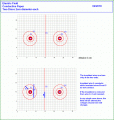
Here is a diagram of the equipotential lines and a few examples of wires inserted into the field.
I obtained the measured data from the web and just plotted it.
The medium in this case was conductive paper. The discrete version is a resistor grid which would look the same as the background grid in this diagram where each short line of the grid represents one resistor and all the resistors are the same value.
 

Attachments

Last edited:
Top