What is the different between speaker and power wire

MisterBill2

Joined Jan 23, 2018
27,684
I have come across steel wire with insulation that made it look like usable wire, I have come across coppery wire that undoubtedly contains some copper and other materials, and is under-sized for what the label calls it. The stuff described in post #20 was probably what is called "field phone wire", which may contain one copper strand. The strong springy strands are a steel alloy for mechanical strength, since it is intended to be used for military field phones, which use a relatively high line impedance and not much line current. It is amazingly strong, but mostly useful if you have military field phones. It is also useful for tying bundles of junk, if you have the means to cut it.

Aluminum wire for mains power distribution is ONLY used outside, where any hot spot connections will not start a fire in somebodies house. THAT is why it can be used. The cost is enough cheaper to make up for the cost of the wasted power.
 

MrAl

Joined Jun 17, 2014
13,724
I acquired some wire that was silver and springy. You could bend it nearly 90 degrees, let go and it would snap right back (the stripped wire strands). No matter how tight you twisted it, it would spring back to untwisted the moment you let go. It also would not take solder at all. I have no idea what it was made from, but fortunately I've only run across it once. It was low power application (ran on 9v battery) so maybe it was metal coated plastic or something?
Hi,

Sounds almost like tempered steel wire. I've been able to solder steel though to some degree.
 

MisterBill2

Joined Jan 23, 2018
27,684
Hi,

Sounds almost like tempered steel wire. I've been able to solder steel though to some degree.
Field phone wire has something that reduces the tendency to rust. And solderability is not part of the list of specifications. I am not sure what the treatment is that it gets, but the one time that I attempted to solder it did not work either.
 

shortbus

Joined Sep 30, 2009
10,049
Aluminum wire for mains power distribution is ONLY used outside, where any hot spot connections will not start a fire in somebodies house. THAT is why it can be used. The cost is enough cheaper to make up for the cost of the wasted power.
Then where is the splice changing aluminum to copper when supplying the breaker panel?
 

ebeowulf17

Joined Aug 12, 2014
3,307
Then where is the splice changing aluminum to copper when supplying the breaker panel?
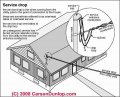
That's an interesting question... I'd have guessed that it was at the point marked "splices" in this diagram, in which case it's not in the house, but still kind of attached to it. I'm not sure though, that last bit of cable drop going into the house might be aluminum too?
upload_2018-11-14_7-25-25.jpeg
 

MisterBill2

Joined Jan 23, 2018
27,684
Then where is the splice changing aluminum to copper when supplying the breaker panel?
At my house, and all of those where I have seen that splice, it is outside, about a foot away from the house, where the solid aluminum conductors from the pole are spliced to the stranded copper conductors going down the wall to the meter box. From the meter box on into the house is my responsibility, and I have used all copper wire for that because entering the house with aluminum is not accepted by the electrical building code. While technically tghe meter box terminals are the point of demarkation between the power company and the property owner, the power company does not supply the section of wire leading down to the meter box.
I would presume that your house has a meter in the line before the breaker panel. If not, you must be getting free power. Or something?
 

shortbus

Joined Sep 30, 2009
10,049
I would presume that your house has a meter in the line before the breaker panel. If not, you must be getting free power.
I'm not sure though, that last bit of cable drop going into the house might be aluminum too?
The wire to my breaker box, done years ago is aluminum. The wire to my mother in laws breaker box, done 2 years ago is aluminum. Both were done by licensed electricians.

and I have used all copper wire for that because entering the house with aluminum is not accepted by the electrical building code
Must be a local regulation.
", for a 200-amp service, you would still be allowed to choose a 4/0 AWG aluminum or 2/0 AWG copper, but you would choose it from the 75 degree C column in Table 310.15(B)(16)." From a story about the 2014 NEC-
https://iaeimagazine.org/magazine/2014/05/04/2014-national-electrical-code-updates-wire-and-cable/
 

MisterBill2

Joined Jan 23, 2018
27,684
You must not be located in the state of Michigan and quite probably not in the USA. It has not been aceptable for inside applications for quite a while, for good reasons. Fires!
 

MrAl

Joined Jun 17, 2014
13,724
Hi,

There was also an issue with connectors that are made for copper wire that are used with aluminum wire. The dissimilar metals caused a problem of some kind, dont remember if it was corrosion or what now.
 

shortbus

Joined Sep 30, 2009
10,049
Hi,

There was also an issue with connectors that are made for copper wire that are used with aluminum wire. The dissimilar metals caused a problem of some kind, dont remember if it was corrosion or what now.
That is why the main(input breakers) in a panel are ,I think it is, Nickel plated. The plating is necessary to allow the aluminum wire to be used, but you still need to use anti corrosion compound with them. I got a hold of my oldest grandson last night, who is now a licensed electrician, and he told me how his company does it, according to the NEC.
 

MisterBill2

Joined Jan 23, 2018
27,684
While it is possible, in theory at least, to have connections to aluminum wire that are completely satisfactory and will remain so for 20 years, I still recommend avoiding the use of aluminum in electrical circuits INSIDE a residence. While some codes allow it, undoubtedly the result of serious lobby efforts, I think, common sense says otherwise. The additional one time expense of using copper entrance cables and wiring does not come close to the cost of having an installation that was not quite right repaired even once.

And when a client asks if I use aluminum wire, my response is still: "Only if you sign an agreement that you will not blame me when your house burns down." None of them have even blinked at the small cost increase of using copper wire. After all, what portion of most home electrical projects is the cost of the wire???

Aluminum wire is still fine for power company drops where there is no question about ownership and responsibility.
 

MaxHeadRoom

Joined Jul 18, 2013
30,696
And when a client asks if I use aluminum wire, my response is still: "Only if you sign an agreement that you will not blame me when your house burns down." None of them have even blinked at the small cost increase of using copper wire. After all, what portion of most home electrical projects is the cost of the wire???
The principle cause of fires due to Aluminum wiring is the use of copper-intended termination devices, outlets etc, it is imperative to use aluminum style termination devices only.
For e.g. Push-in termination devices are absolutely not to be used.
Max.
 

nsaspook

Joined Aug 27, 2009
16,357
While it is possible, in theory at least, to have connections to aluminum wire that are completely satisfactory and will remain so for 20 years, I still recommend avoiding the use of aluminum in electrical circuits INSIDE a residence. While some codes allow it, undoubtedly the result of serious lobby efforts, I think, common sense says otherwise. The additional one time expense of using copper entrance cables and wiring does not come close to the cost of having an installation that was not quite right repaired even once.

And when a client asks if I use aluminum wire, my response is still: "Only if you sign an agreement that you will not blame me when your house burns down." None of them have even blinked at the small cost increase of using copper wire. After all, what portion of most home electrical projects is the cost of the wire???

Aluminum wire is still fine for power company drops where there is no question about ownership and responsibility.
In the circuits for electric stoves, electric furnaces and other large 220 Volt equipment it's very common to use braided aluminum wires today, actually it's getting unusual to use copper for those applications. With the correct alloy multi-strand wire AL is perfectly safe as copper.
310.14 Aluminum Conductor Material. Solid aluminum
conductors 8, 10, and 12 AWG shall be made of an AA-
8000 series electrical grade aluminum alloy conductor material.

Stranded aluminum conductors 8 AWG through 1000
kcmil marked as Type RHH, RHW, XHHW, THW, THHW,
THWN, THHN, service-entrance Type SE Style U and SE
Style R shall be made of an AA-8000 series electrical grade
aluminum alloy conductor material.
I would NOT have old alloy (EC grade aluminum (AA-1350) ) solid core AL from the early 70's on the premises. My mom's house had a complete rewire because of AL wire and I've seen the danger first hand.

http://www.southwire.ca/en/commercial/aluminum-building-wire-40-years-later.htm
 

MisterBill2

Joined Jan 23, 2018
27,684
In the circuits for electric stoves, electric furnaces and other large 220 Volt equipment it's very common to use braided aluminum wires today, actually it's getting unusual to use copper for those applications. With the correct alloy multi-strand wire AL is perfectly safe as copper.


I would NOT have old alloy (EC grade aluminum (AA-1350) ) solid core AL from the early 70's on the premises. My mom's house had a complete rewire because of AL wire and I've seen the danger first hand.

http://www.southwire.ca/en/commercial/aluminum-building-wire-40-years-later.htm
The fact that a lot of people are doing it does not make it a good idea, nor a wise choice to save a few dollars. While a perfectly installed aluminum cable may be OK for a while, one small error would be setting the destruct timer for a future disaster. Is the risk worth the few dollars saved?? My answer from all of my clients is NO!.
 

shortbus

Joined Sep 30, 2009
10,049
So does that make you a 'boogeyman' or just a 'fear monger'?

You really should understand this more. Aluminum wiring is a problem when used with copper only fixtures, or when using solid/single strand wire. It is approved by the NEC, which you don't seem to understand means "National Electrical Code". I'd say they know a little more than a moonlighting electrician does. https://www.nfpa.org/NEC
 

nsaspook

Joined Aug 27, 2009
16,357
The fact that a lot of people are doing it does not make it a good idea, nor a wise choice to save a few dollars. While a perfectly installed aluminum cable may be OK for a while, one small error would be setting the destruct timer for a future disaster. Is the risk worth the few dollars saved?? My answer from all of my clients is NO!.
It's a modern engineering validated safe idea prejudicial mindsets notwithstanding. There have been minimal reports of abnormal wiring fires from the new alloys since the late 70's. In the same time frame there have been many cases of fire from copper wire used in the back stabbed wiring branch crap that's still on the market.

I wouldn't trust most of the 'plumber' electricians building homes to make proper connections with the best copper materials either
 
Last edited:

MisterBill2

Joined Jan 23, 2018
27,684
So does that make you a 'boogeyman' or just a 'fear monger'?

You really should understand this more. Aluminum wiring is a problem when used with copper only fixtures, or when using solid/single strand wire. It is approved by the NEC, which you don't seem to understand means "National Electrical Code". I'd say they know a little more than a moonlighting electrician does. https://www.nfpa.org/NEC
You are welcome to say whatever pops into your mind. My point about aluminum being unsatisfactory in other than a perfect installation is that after something is installed there is no means of assuring that in that systems lifetime somebody else will change any of it. And that person making the change may be clueless. In Utopia your claim would be totally correct. I do not live in utopia.
 

MrSoftware

Joined Oct 29, 2013
2,273
Forgetting the scientific explanations; the real world fact that insurance companies either charge more for insurance, or won't insure at all, homes with aluminum wiring says a lot.
 

nsaspook

Joined Aug 27, 2009
16,357
Forgetting the scientific explanations; the real world fact that insurance companies either charge more for insurance, or won't insure at all, homes with aluminum wiring says a lot.
If your home was built between the mid-1960’s and 1970’s with original AL branch wiring I don't blame them because the potential for electrical fires is higher. Modern up to current code braided AL wiring for high current 220 circuits is not a problem for permits, inspections or insurance.
 
Last edited:
Top