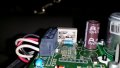
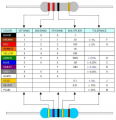
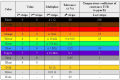
I looked this resistor up on digkey calculator and it don't have gold for third band. This is a 5 band resistor. Thanks anyone red red gold silver blue
10 ppm/K temperature coefficient for a 10% tolerance part would be exceedingly strange, though not impossible. I used to occasionally buy 0.1% tolerance resistors with 10 ppm tempco - at several times the price of 25 ppm parts of the same tolerance.
I suspect the blue band is the manufacturer's code for resistive material or something like that. It may denote something like flameproof and possibly fusible (fusible are almost always flameproof but flameproof aren't always fusible). The heavy leads do suggest it is a resistor - heavy leads help conduct heat to the PCB.
In my experience it is very rare to find a board with component outlines but no component ID printed on it.
The picture shows a wide red ring on the left and the same distance between the five rings, so I will read the code from the left:
Red Red Gold Silver and Blue.
I have no explanation for the blue ring.
The thickness of the wires indicates a resistor.
So right now my best bet is: 2.2 Ω 10%
Is the mentioned component in series with the capacitor (68nF 275VAC X2) just behind it?
It is possible that it is an inductor, sometimes they look exactly like the resisotrs(my professor almost failed me for that). Please check it with a multicet.
The picture shows a wide red ring on the left and the same distance between the five rings, so I will read the code from the left:
Red Red Gold Silver and Blue.
I have no explanation for the blue ring.
The thickness of the wires indicates a resistor.
So right now my best bet is: 2.2 Ω 10%
Is the mentioned component in series with the capacitor (68nF 275VAC X2) just behind it?

 Facebook
 Google
 GitHub
 Linkedin