What Is Probably Wrong With This Circuit?

JoeJester

Joined Apr 26, 2005
4,390
Both techniques, energizing the lamps, allow for a short on the load side without blowing multiple fuses while you troubleshoot. Have you measured the the resistance at the B+ and B- points on the de-energized set to ground and see if there was a short?
 
Last edited:

Thread Starter

abrogard

Joined Dec 20, 2018
78
Both techniques, energizing the lamps, allow for a short on the load side without blowing multiple fuses while you troubleshoot. Have you measured the the resistance at the B+ and B- points on the de-energized set to ground and see if there was a short?
I'm working up to getting there. Trying to put together this series lamp right now. To me that means building some wooden base to screw the lamp holder to and put a switch in and I might as well have it as a permanent lamp so build a cage around the lamp..... and so on... typical me, make a big job out of nothing...

Haven't measured at B- and B+. Not at all sure where to find them right now. Might need to get it out just to find them.

And to be truthful I don't understand how a resistance measurement at those points will work. You mean put the probes at B- and at ground? And then at B+ and at ground? Or you mean across B- and B+ to see if it shorts across there? I guess the latter. That makes most sense to me. :)
 

JoeJester

Joined Apr 26, 2005
4,390
The resistance checks are done with out having power applied to the unit. In fact, it's not plugged into the wall at all.

What is the model of your meter, so I can see what your working with.

Once I have looked at your meter's user manual, I'll tell you where to place the meter leads. I'll markup the schematic and post it to help guide you to the points.
 

Thread Starter

abrogard

Joined Dec 20, 2018
78
The resistance checks are done with out having power applied to the unit. In fact, it's not plugged into the wall at all.

What is the model of your meter, so I can see what your working with.

Once I have looked at your meter's user manual, I'll tell you where to place the meter leads. I'll markup the schematic and post it to help guide you to the points.
It is a 9205A. Like here: http://tekpower.us/multimeter/dt9205.html

I am planning to build this series lamp like in this circuit diagram, it's okay?

https://imgur.com/a/x8bQZak
 

Thread Starter

abrogard

Joined Dec 20, 2018
78
A switch is a good addition, but I would also get into the habit of unplugging it before delving in.
Yep. I'll be very keen to do that. I'm only putting the volts in when I have to in order to test.

Will it work alright with this lamp in series? Because it's going to drop voltage isn't it? What happens to a transformer when fed a lower voltage? It serves out the appropriate percentage of the input voltage as it did when the input was as design?

So then voltages around the board will all be too low?

Haven't built the thing yet. And I still wonder if I'll have to pull it out. I'll have to pull out the input plug and the output plug if I pull it out.
Could it still be tested in that condition?
Or will I need to extend their leads so's I can plug them in?

Maybe I'll be able to do it in place. That'd be good.

:)
 

dendad

Joined Feb 20, 2016
4,637
The amp should work with the lamp in series, but not at any power level. This sort of test setup is used for an unloaded state. In that condition, the device usually draws the minimum current and so the lamp will not heat up too much, so it will stay low resistance. Then the amp will have close to the correct supply voltage.
If the amp has a fault (or you try to turn up the audio) and tries to draw more current, the lamp will heat up and its resistance will increase ans so prevent excessive current flowing. If you cannot get the amp to run at rest with the lamp you have, just use a higher wattage one. The lamps must be incandescent, not LED or any other electronic ones.
You could add a switch to short out the lamp to run as normal but you may forget and start it that way. It is up to you.
 

JoeJester

Joined Apr 26, 2005
4,390
I have an additional question.

Did you choose 1.5A slow blow as the F3 fuse? Do you have a reference stating F3 is 1.5A? I can see a 1.5 A slow blow if the amplifier were 20 Watts, but the manual state's it is 30 W and that would require a 2.5 A slow blow for F3.
 

Thread Starter

abrogard

Joined Dec 20, 2018
78
I think it was written on the fuse I took out and I think it is written on the fuse holder or thereabouts. But I'm not sure right now. I've made the series lamp thing and it seems to work alright. In series with another lamp here I can see it is limiting current to the other lamp.

I didn't put a second switch in so's I could use it just as a lamp. Maybe I should. It's not much use for anything except this job really I suppose unless I do that. Here it is:

https://imgur.com/a/x8bQZak

so if I get a chance tomorrow I'll get a look at the thing. I don't think I have a reference anywhere else to the fuse values.

My worry is pulling the chassis out to work on it...
 

JoeJester

Joined Apr 26, 2005
4,390
My worry is pulling the chassis out to work on it...
Have you placed the lamp in series with the amplifier?

Have you learned how to use your multimeter to test diodes and transistors? Do you any diodes or transistors lying around?

You may be able to test the suspect transistors in circuit without removing the chassis.

The fuse was clearly identified as a 1.5 ampere. That is not in question. The question really is, if you didn't put in the 1.5 ampere fuse how do you know it was suppose to be a 1.5?

Earlier I had asked about that main speaker ... the identifying marks. Did you snap a picture?
 

Thread Starter

abrogard

Joined Dec 20, 2018
78
. No, haven't done that yet.Plugged it into the organ I mean.

Nor have I learned how to test diodes and/or transistors. I'll get onto that today, shouldn't be too much of a problem?

I see there's a transistor tester on the multimeter but I'm looking at testing them in situ aren't I ? In the circuit board. I guess there I go around the legs and note the voltages. A blown transistor will have the same voltage emitter and collector? Something like that?

And how to test a diode in situ? I suppose free standing I test resistance and it should be open circuit one way and a short the other.

So in circuit I don't know.

I suppose this is a DC circuit and diodes 1,2,3 are the rectifier?

I don't really know what's going on. A bit beyond me. Is it DC at 64V ?


. But I've pulled it out, pulled the back off again and taken more pics.

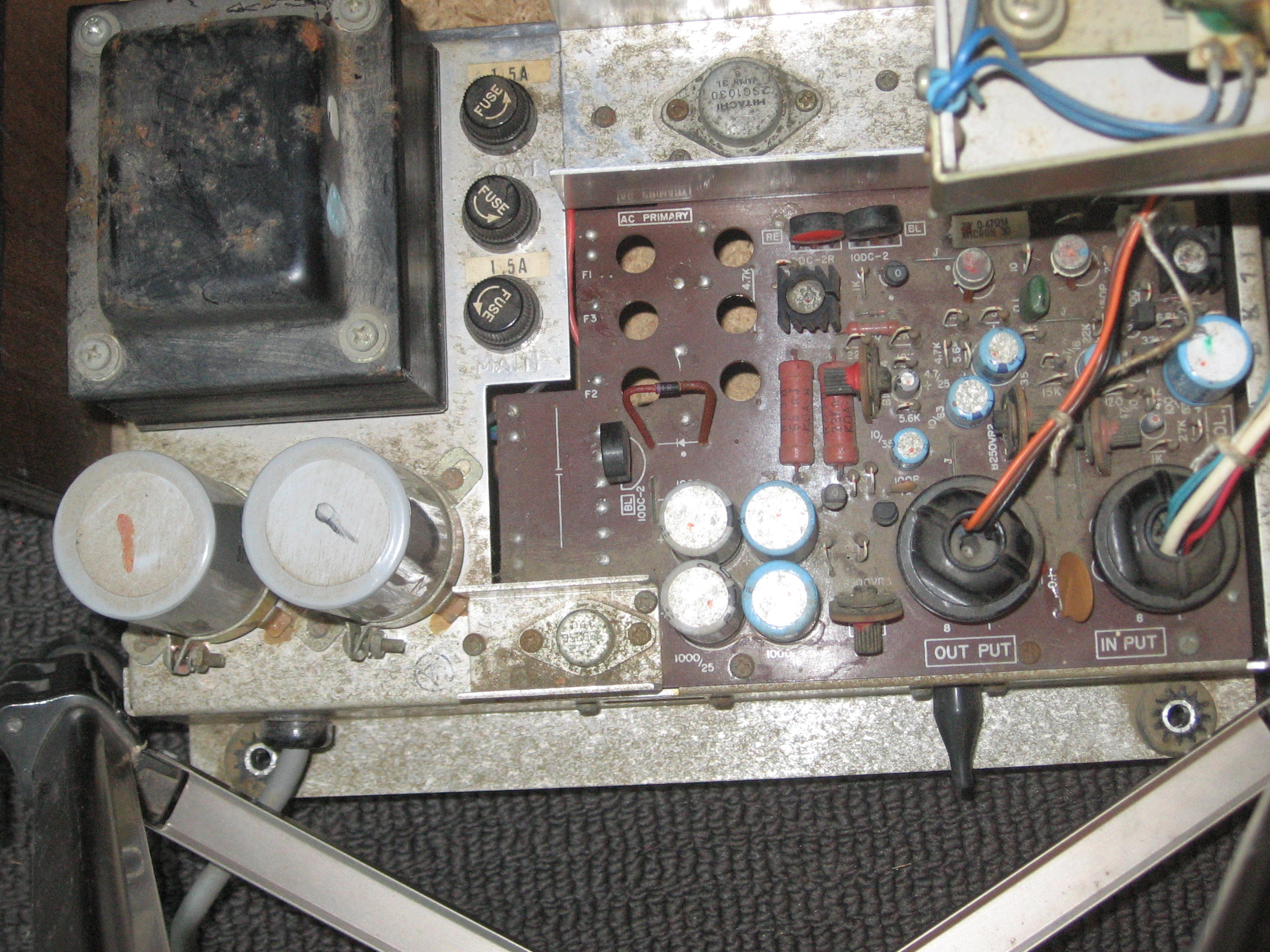
. The fuse sizes are marked on the chassis. Not the fuse numbers, just the sizes. I've taken a pic. Not real good but you can see all the markings if your software can help you with the darkest one. The markings are, from the 'bottom' (which is nearest the back of the machine) Main, 1.5A, 2.0A, 1.5A. I also found the original spare fuse packet still stuck to the inside of the cabinet near the elephant ear. It mentions 1.5A and 2.0A, too.

The fuse that was blown was the one at the top of the picture which would be fuse holder nearest the front of the machine. So it'd be 1,2,3 counting from the back.

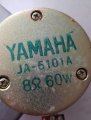
Sorry about the main speaker ID marks query. I thought I'd responded to that. My mistake. Well I've taken photos of the ID plate on the machine and the marks on back of the speaker. Hope that's what you wanted.

The new pics are back up on the imgur site we've been using: https://imgur.com/a/x8bQZak
 
Last edited:

dendad

Joined Feb 20, 2016
4,637
Just a thought, have you disconnected the speakers while you are playing around with the amp? It is a good idea to do that.
I generally plug in headphones ( if there is a socket ) first before speakers. That lets you listen to the amp but without the load applied. Also, it protects the speakers from getting damaged.
 

JoeJester

Joined Apr 26, 2005
4,390
All the pictures you do can be uploaded here.

Here is one I found on the internet and I wondering what your's looked like. I've also read the spec sheet that the model was a 30 amplifier.$_84.jpg
 

Thread Starter

abrogard

Joined Dec 20, 2018
78
Just a thought, have you disconnected the speakers while you are playing around with the amp? It is a good idea to do that.
I generally plug in headphones ( if there is a socket ) first before speakers. That lets you listen to the amp but without the load applied. Also, it protects the speakers from getting damaged.
Good idea. I'll look how I can do that. There's no headphone ability though.

:)
 

Thread Starter

abrogard

Joined Dec 20, 2018
78
According to the schematic, there is a headphone output. Marked as EJ
Well I'll be damned. I took a good look all around the thing and found nothing. I'll look again.

I found the chassis comes out pretty easy. At least half way. It is meant to, I think. Good design. Only the front two bolts need to come out and then it slides out. So I've done that.

And I plugged in the series light and the organ will switch on with that as a supply. I have the volume down lowest. I switched it off pretty quick.

So I guess that means I can probe it live now. If I know where to probe.

:)

oh... post pics here? They don't mind? Alright.

But how? It asks for a link. Means I have to put it on the web anyway, I think, right?

So I've put it on imgur and now I'll give this the link:

 
Last edited:

JoeJester

Joined Apr 26, 2005
4,390
Posting pictures here is preferred so when this thread falls off the first page people can still follow it.

Ok, when you turned on the organ with the lamp in series, did the light energize? Let it sit for a minute or so. If the lamp does not energize, you can make a couple of tests.

Before making any measurements, the black probe should be connected to G or Ct on the schematic. The DC Voltage setting will be on the 200 V range. The red probe will be connected to first B+ and then B-. Record and report your results.

If you can take a picture of the board, showing those test points, it would be appreciated. Also take a picture of the board where the Tr4, Tr5,Tr6, and Tr7 are located.

The schematic below highlights the test points .....

Untitled.jpg
 

Thread Starter

abrogard

Joined Dec 20, 2018
78
I guess the picture I just posted would be what you want?

Where on the board those places are I don't know. Seems to me there's very little available to probe from the top of the board. I need to be underneath perhaps. Not good.


edit: p.s. I found a jack socket underneath the keyboard. I guess that might be a headphone jack.

another edit: p.p.s.

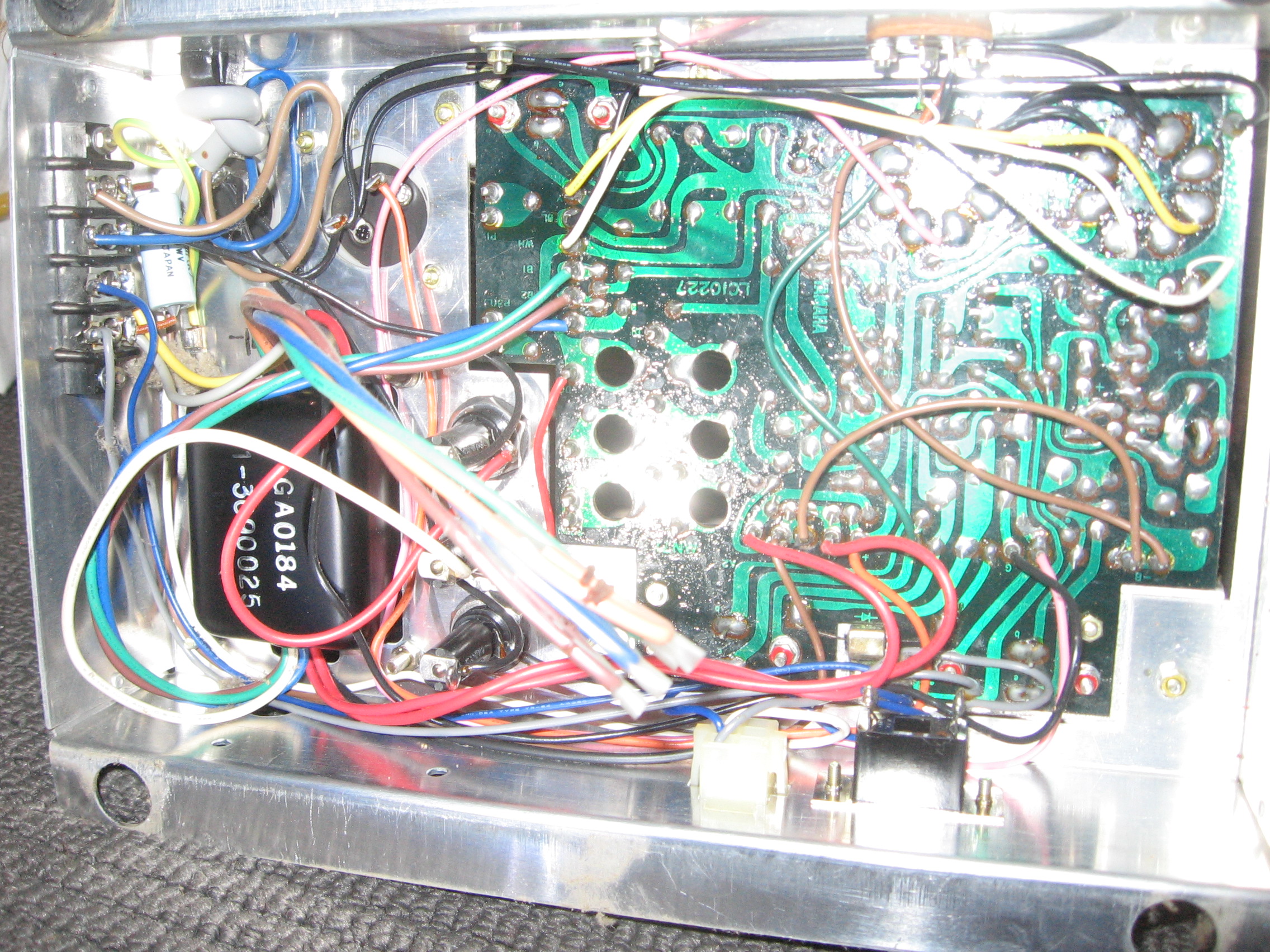
I just unsnipped a couple of cable ties, loosened up a cable and was able to turn the chassis over and look underneath. woohoo.... cooking with gas now, surely?

I still don't know what's what, though. Perhaps someone can identify the salient parts - ground and B- and B+ for me?

Here's the pic:

 
Last edited:

JoeJester

Joined Apr 26, 2005
4,390
Turn off the flash when you take pictures, especially on the bottom of the boards. Please post a new picture without flash. Then I can circle the test points.

Yes, the bottom of the board is where we can do some tests as long as you can keep the two plugs P1 and P2 connected.

If you have a small paint brush (half in or so), or canned air, you could knock off some of the dust on the component side of the printed circuit board (PCB).

=========
Initial test.

Make sure the speaker is connected.

On reading the schematic .... The first test points will be done using the resistance scale of your meter. Set the meter to read 20k.

1. Connect the black lead to Ct, at the chassis ground. Connect the red lead to B+ (orange 20 ga wire). Wait till the meter settles and record the reading. Connect the red lead to B- (brown 20 ga wire). Wait till the meter settles and record the reading.


2. Then we will do the reverse. Connect the red lead to Ct and the black lead to B+ and B-

What we are looking for is to ensure there is resistance and not zero.

If there are no shorts (very low resistance), we will test the voltages.

============
Connect the unit to AC power using the series Lamp.
Main volume is at minimum.

Power up the organ. Wait 1 minute and ensure the series lamp is not energized.
Set the DC voltage to 200V. Repeat the tests in step 1 only. Record your results.

=============
Report the results of the three tests.

Resistance Test 1
B+
B-

Resistance Test 2
B+
B-

Voltage Test
B+
B-
===============

In case you haven't noticed, you will be taking copious notes.
 

Thread Starter

abrogard

Joined Dec 20, 2018
78
Turn off the flash when you take pictures, especially on the bottom of the boards. Please post a new picture without flash. Then I can circle the test points.

Yes, the bottom of the board is where we can do some tests as long as you can keep the two plugs P1 and P2 connected.

If you have a small paint brush (half in or so), or canned air, you could knock off some of the dust on the component side of the printed circuit board (PCB).

=========
Initial test.

Make sure the speaker is connected.

On reading the schematic .... The first test points will be done using the resistance scale of your meter. Set the meter to read 20k.

1. Connect the black lead to Ct, at the chassis ground. Connect the red lead to B+ (orange 20 ga wire). Wait till the meter settles and record the reading. Connect the red lead to B- (brown 20 ga wire). Wait till the meter settles and record the reading.


2. Then we will do the reverse. Connect the red lead to Ct and the black lead to B+ and B-

What we are looking for is to ensure there is resistance and not zero.

If there are no shorts (very low resistance), we will test the voltages.

============
Connect the unit to AC power using the series Lamp.
Main volume is at minimum.

Power up the organ. Wait 1 minute and ensure the series lamp is not energized.
Set the DC voltage to 200V. Repeat the tests in step 1 only. Record your results.

=============
Report the results of the three tests.

Resistance Test 1
B+
B-

Resistance Test 2
B+
B-

Voltage Test
B+
B-
===============

In case you haven't noticed, you will be taking copious notes.
I've already used compressed air and a brush on it. That stuff seems to be stuck on. Probably from time and the heat I guess.

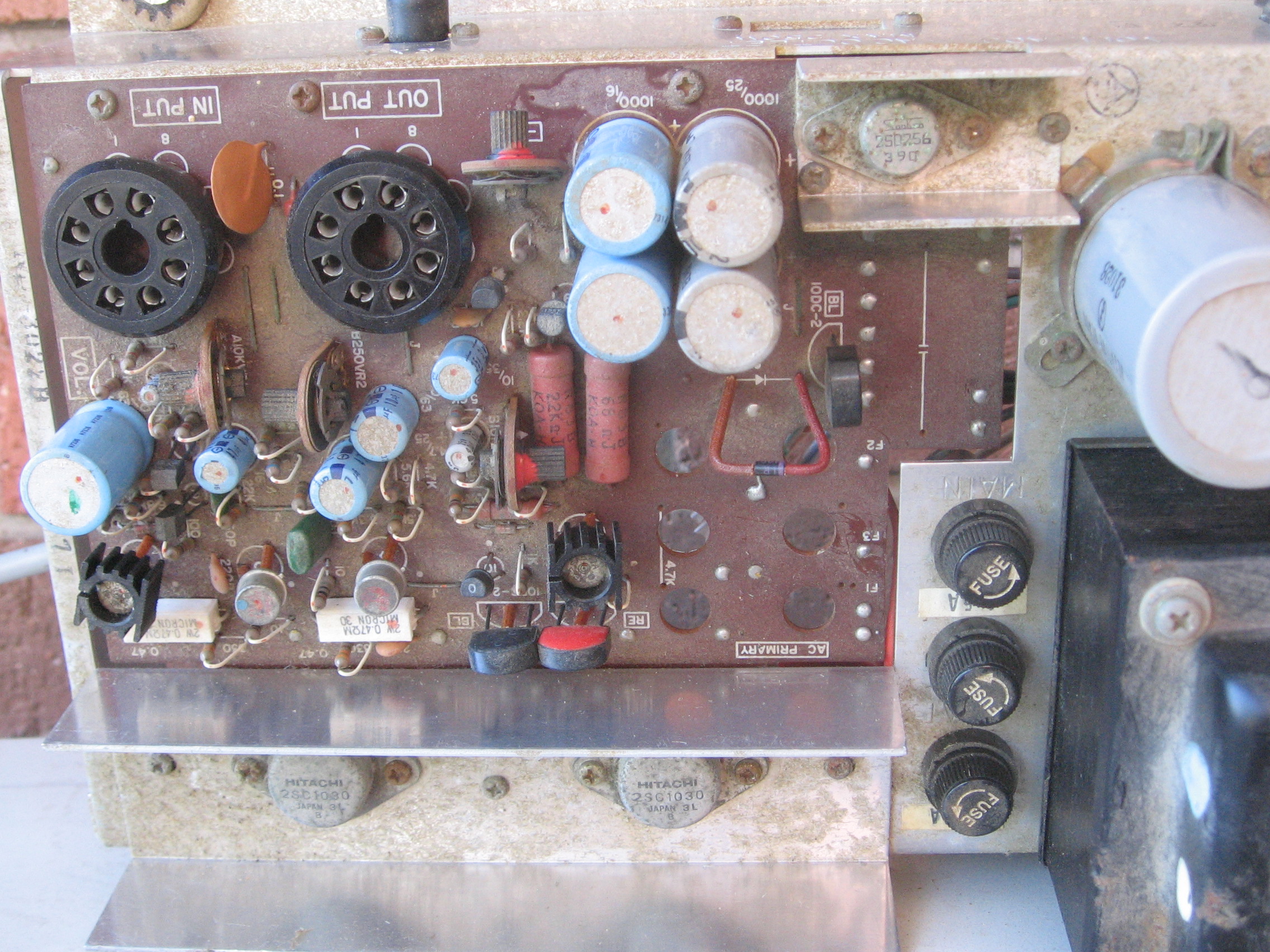
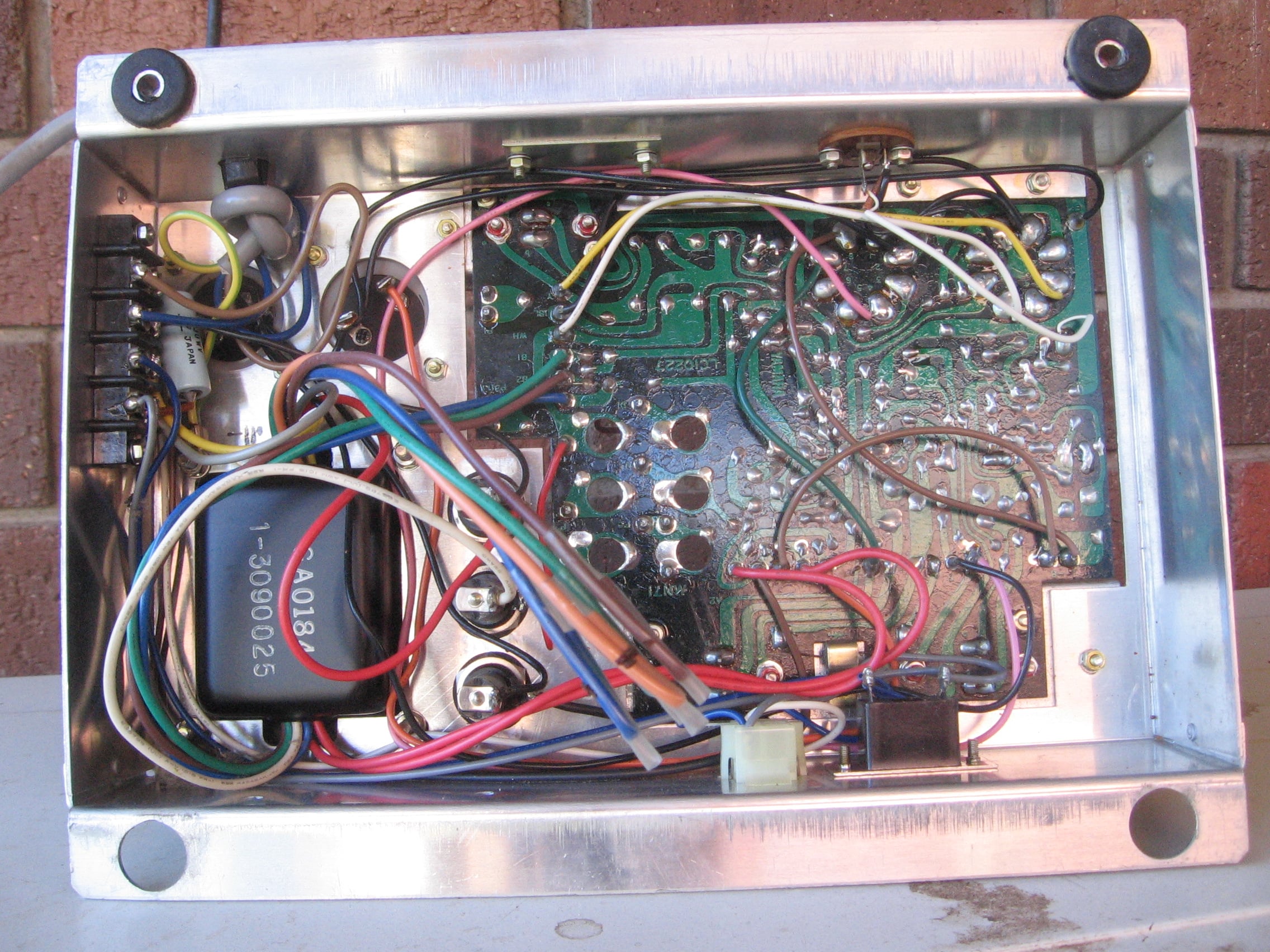
Got the board right out and into the daylight and made a couple of better pics and I'll post them here.

The lamp does energise as soon as I switch on. I noticed that yesterday.

I will study the board and see if I can identify points B. :)


Top