Calculating Thevenin resistance (probably simple)

Thread Starter

Sifunkle

Joined Aug 3, 2024
6
Hi all - long-time-listener-first-time-caller here,

Not formally a student - just a hobbyist/tinkerer trying to learn theory - but in the spirit of Homework Help, I figured algebraic unknowns would force me to actually think/understand.

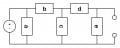
I’d love it if someone could walk me through how to determine Thevenin resistance for the following:
IMG_0573.jpeg
(Excuse the diagram: I don’t have any software suited to schematics. The lettered rectangles are intended as simple resistances.)

I understand Thevenin equivalence when following examples, but am not yet confident in applying to real world problems. In this case, I think I‘m confused about what’s parallel to what, and (in trying to whittle things down to an easy starting point) whether there are elements I can consider shorted while Thevenising.

My best guess at the moment is Rth = a || [(b || c) + d] || e (?)

(Only at this point in posting has it occurred to me to just build a circuit and get empirical with a DMM. Didn’t have the exact parts for the schematic I was studying, but it just clicked that any random resistors and the right approach should work… ah well, I’d still like to confirm how to do it from theory alone.)

If you’re curious, it’s a preamp output section (from a common source JFET). Some of the resistances are actually ‘halves‘ (?correct term?) of a potentiometer where the wiper connected to another module that I’m uninterested in (so for my purposes the wiper goes to ground). I’m trying to simplify the output impedance so things will be less cluttered if I ever depart the breadboard vero/PCB/etc.

Thanks in advance!
 

WBahn

Joined Mar 31, 2012
32,707
So your description of what this actually comes from opens up the possibility (perhaps probability) that your schematic doesn't match your real circuit as well as you are hoping. But leaving that aside.

To find the Thevenin equivalent resistance as seen at the output terminals, you set all sources to zero output, meaning that voltage sources are replaced by short circuits (since that forces the voltage to be zero) and current sources are replaced by open circuits (since that forces the current to be zero).

Then you just calculate the resistance that is left.

1722739536684.png
If given this network of resistors, what would the equivalent resistance be?

Don't make it harder than it is.
 

MrAl

Joined Jun 17, 2014
13,667
Hi all - long-time-listener-first-time-caller here,

Not formally a student - just a hobbyist/tinkerer trying to learn theory - but in the spirit of Homework Help, I figured algebraic unknowns would force me to actually think/understand.

I’d love it if someone could walk me through how to determine Thevenin resistance for the following:
View attachment 328521
(Excuse the diagram: I don’t have any software suited to schematics. The lettered rectangles are intended as simple resistances.)

I understand Thevenin equivalence when following examples, but am not yet confident in applying to real world problems. In this case, I think I‘m confused about what’s parallel to what, and (in trying to whittle things down to an easy starting point) whether there are elements I can consider shorted while Thevenising.

My best guess at the moment is Rth = a || [(b || c) + d] || e (?)

(Only at this point in posting has it occurred to me to just build a circuit and get empirical with a DMM. Didn’t have the exact parts for the schematic I was studying, but it just clicked that any random resistors and the right approach should work… ah well, I’d still like to confirm how to do it from theory alone.)

If you’re curious, it’s a preamp output section (from a common source JFET). Some of the resistances are actually ‘halves‘ (?correct term?) of a potentiometer where the wiper connected to another module that I’m uninterested in (so for my purposes the wiper goes to ground). I’m trying to simplify the output impedance so things will be less cluttered if I ever depart the breadboard vero/PCB/etc.

Thanks in advance!
Hi,

Calculating this is not that difficult as the previous post shows, but rather than build a circuit to find out what the value would be you could use a circuit simulator and just draw the circuit and use the simulator to analyze various aspects of the circuit, including total resistance.

There is a simulator many people here use which we often refer to as "LT Spice" but the original name was "SwitcherCad". You can download that for free and use it for a lot of different circuits. It only takes a little time to learn the basics of how to use it. It's completely free not just a hook to get you to download it by saying the download itself is free, both the download AND the use of the program is free and there is no time limit.
 

Thread Starter

Sifunkle

Joined Aug 3, 2024
6
View attachment 328529
If given this network of resistors, what would the equivalent resistance be?

Don't make it harder than it is.
Sorry - this is exactly the bit that’s hard for me! Easy when you know how, maybe? Or I’m just stupid, but it’s either ask or stay stupid. I try to avoid demanding attention like this, but the learning resources I‘ve found give examples that seem to jump straight from extremely simple to 4D rocket surgery. I suppose formal education has checks in place to ensure solid fundamentals before moving on; I’m probably building my castle on sand. Anyway…

I’m used to mentally tracing through a circuit from the voltage source, but I suppose “as seen at the output terminals” means I should start there instead. I‘ll point out that my understanding is ‘series = only one terminal touching; parallel = both terminals touching’, in case that’s wrong or too simplistic. So what I glean:
  • e is parallel to output terminals
  • d is in series with output terminals
  • c and b are in series with d, but parallel to each other
  • a is in series with b and with output terminals, but given the shorted voltage supply (theoretical zero resistance) perhaps a should be removed from the equation entirely (‘completely bypassed’)?
  • In which case: Rt = [(b || c) + d] || e (?)
Which is what I’d come up with originally, before deciding I probably couldn’t just ignore a right before I posted the thread. Still not remotely confident either of my guesses are correct.

So your description of what this actually comes from opens up the possibility (perhaps probability) that your schematic doesn't match your real circuit as well as you are hoping.
IMG_0551.jpeg

I’d recalled slightly incorrectly - the unwanted module’s output connected to that node in the top left (in the middle of e), but I don’t think I compromised much by snipping it straight off (low associated impedance so minimal loading effect?). Hope my blocky diagram otherwise represents the schematic accurately, but happy to be corrected if not!
 

Thread Starter

Sifunkle

Joined Aug 3, 2024
6
There is a simulator many people here use which we often refer to as "LT Spice" but the original name was "SwitcherCad". You can download that for free and use it for a lot of different circuits. It only takes a little time to learn the basics of how to use it. It's completely free not just a hook to get you to download it by saying the download itself is free, both the download AND the use of the program is free and there is no time limit.
I’ve seen lots of references to it, but had assumed its purpose would be far beyond my level. Also did not know it was free! I shall definitely look into it.

Thank you both kindly for taking the time to respond
 

WBahn

Joined Mar 31, 2012
32,707
Sorry - this is exactly the bit that’s hard for me! Easy when you know how, maybe? Or I’m just stupid, but it’s either ask or stay stupid. I try to avoid demanding attention like this, but the learning resources I‘ve found give examples that seem to jump straight from extremely simple to 4D rocket surgery. I suppose formal education has checks in place to ensure solid fundamentals before moving on; I’m probably building my castle on sand. Anyway…

I’m used to mentally tracing through a circuit from the voltage source, but I suppose “as seen at the output terminals” means I should start there instead. I‘ll point out that my understanding is ‘series = only one terminal touching; parallel = both terminals touching’, in case that’s wrong or too simplistic.
Two two-terminal devices are in "parallel" if they always have the same voltage across them. They are in series if the same current that flows through one must flow through the other.

Your description will often give you the correct answer, but it is relying on a recipe instead of an understanding of the concepts. Better to understand the concepts, because then you can apply them to any circuit.

So what I glean:
  • e is parallel to output terminals
Yeah... sorta. Certainly it is in parallel with whatever is connected to the output terminals. But since the terminals themselves are not a device, we usually don't talk about them being in series or parallel with things.
  • d is in series with output terminals
Definitely not. Current flowing in resistor 'd' does not have to go through whatever is connected to the output terminals (it could go through resistor 'e' instead).
  • c and b are in series with d, but parallel to each other
I know what you mean, but what you say is not correct. If c and b were in series with d, then the exact same current would have to flow through all three of them.

What you meant to say is that c and b are in parallel and the parallel combination of them is in series with d.
  • a is in series with b and with output terminals, but given the shorted voltage supply (theoretical zero resistance) perhaps a should be removed from the equation entirely (‘completely bypassed’)?
You've got some of the notion, but your description is very wrong. a is NOT in series with b precisely because there is another path for current to take -- namely the short circuit. This short is in parallel with a, which results in the parallel combination of those two paths having zero resistance. That combination is in series with b, and zero resistance in series with anything reduces to the resistance of the anything. This is an explicit way of noting what you concluded above, namely that a is completely bypassed by the shorted supply and can be removed entirely.

  • In which case: Rt = [(b || c) + d] || e (?)
This is actually correct, but based on some shaky reasoning.

Here is a better way to approach it.

Imagine replacing {a,b,c,d} with an equivalent resistor, Rabcd. That resistor is in parallel with Re, so

Rth = Re || Rabcd

Now cutoff Re and everything to the right of it and focus on {abcd}. Here we can see that Rd is in series with the equivalent resistance of {abc}, namely Rabc. So we have

Rth = Re || (Rd + Rabc)

Now clip off Rd and focus on Rabc. Here we have to parallel paths, on consisting of Rc and the other of the combination formed by {ab} (and the short, which we can't ignore much longer).

Rth = Re || (Rd + (Rc || Rab))

Now clip of Rab and we see that we have Rb in series with the parallel combination of the Ra and the short.

Rth = Re || (Rd + (Rc || (Rb + (Ra || 0 Ω) ) ) )

We can reduce (Ra || 0 Ω) to 0 Ω

Rth = Re || (Rd + (Rc || (Rb + 0 Ω) ) )

We can reduce (Rb + 0 Ω) to just Rb

Rth = Re || (Rd + (Rc || Rb) )

Of course, some of these are obvious simplifications that you can make early on.
 

Thread Starter

Sifunkle

Joined Aug 3, 2024
6
That is so incredibly helpful WBahn - I’m thrilled at my new understanding! (Initially wrote ‘I understand perfectly now,’ but that sounds like impending hubris...)

Ironing out my tenuous parallel/series definitions has done wonders. I’d subconsciously grasped the voltage and current rules, but trying to consolidate with the inaccurate definitions was creating the confusion. All of your corrections made perfect sense in the new light. I’ll endeavour to shoot the ‘connected terminals’ definition down whenever I see other amateurs eyeing it up.

Also love your approach of lumping resistances and working ‘outside in’. I wasted most of my time trying to work ‘inside out’ but being unable to identify the correct starting point.

Once again, big thanks! Couldn’t have hoped for a more informative reply!
 
Top