Facebook
 Google
 GitHub
 Linkedin
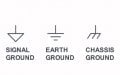
On another thread I postulated that we call ground "Zero" volts. But I contend that what we call zero volts may in actuality some much greater potential. Keep in mind the key is Volts, not current. Current flows when there's a differential potential between two points. Whether static or a dynamic charge, there's a potential. It's possible to have a grounded device that is statically charged. Not grounded in reference to earth ground, just a common ground. Which we all would agree doesn't mean zero volts. OR maybe it IS zero volts. It's whatever we want it to be. Like Shrodinger's cat. Left in a box for years we surmise it's probably dead. But we don't know that for certainty until we open the box. Thus a condition is unknown until it's measured. When measuring the activity of an atom we can only see it in an instant of time. Stringing a series of instances together we can get a motion picture, but just like a motion picture it's still one frame at a time. So voltage when measured is X volts at a given time.
Let me be clear; I'm way over my own head with this. I may be 10,000% wrong. I'm just posing a question to see where this goes. Maybe I'll learn something. There are plenty of members of AAC who are vastly more educated than I am. But education doesn't mean intelligent. Smart by life or by book, we all have something to contribute. Even smart by education. Not being educated to the same degree as another doesn't make one "not smart" or "dumb" as some might say.
So since I started an argument on another thread - what do you think ground is? Sure, there's the basic description of ground, being a common point or a zero point. But it's the point at which we start measuring some fictitious value. A battery of 1.5 volts has a potential difference of 1.5 volts from positive to negative. We often reference negative as ground. But if that battery has become statically charged to 3KVs (3,000 volts static) then from negative to COMMON ground we see 3KV. But from the positive terminal we see 3,001.5V. The potential between battery poles remains the same but all the while it's statically charged. So calling negative "ground" we're not talking about a real world situation where absolute ground is absolutely zero volts.
Your thoughts? Arguments? Agreements or disagreements?
Note: It's perfectly acceptable to disagree and argue. As long as we respect each others opinions and positions of beliefs in electronic terms.
Let me be clear; I'm way over my own head with this. I may be 10,000% wrong. I'm just posing a question to see where this goes. Maybe I'll learn something. There are plenty of members of AAC who are vastly more educated than I am. But education doesn't mean intelligent. Smart by life or by book, we all have something to contribute. Even smart by education. Not being educated to the same degree as another doesn't make one "not smart" or "dumb" as some might say.
So since I started an argument on another thread - what do you think ground is? Sure, there's the basic description of ground, being a common point or a zero point. But it's the point at which we start measuring some fictitious value. A battery of 1.5 volts has a potential difference of 1.5 volts from positive to negative. We often reference negative as ground. But if that battery has become statically charged to 3KVs (3,000 volts static) then from negative to COMMON ground we see 3KV. But from the positive terminal we see 3,001.5V. The potential between battery poles remains the same but all the while it's statically charged. So calling negative "ground" we're not talking about a real world situation where absolute ground is absolutely zero volts.
Your thoughts? Arguments? Agreements or disagreements?
Note: It's perfectly acceptable to disagree and argue. As long as we respect each others opinions and positions of beliefs in electronic terms.