What is causing this trace to look the way it does?

Thread Starter

SoaringFree

Joined Sep 15, 2016
20
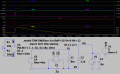
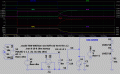
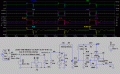
I have included a Spice schematic of my circuit as well as a trace profile for review.

The question I have is that I am not quite sure why the left side of the trace, square wave, looks like the charging of a capacitor even though there is no capacitor in the circuit. This scope trace is taken at -A- as seen on the schematic at the collector of the NPN (BC337). The 350v source that feeds the 2 zener diodes(100v, and 20v) is what I am using for the simulated voltage feedback from a 8mH coil primary Spice_4.pngafter it has been switched off and I am clamping it at 120v w/ the zeners. I know I am in saturation w/ the BC227 and I am able to read the signal w/ the microcontroller at -A-.
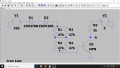
Could someone please explain to me why I am seeing this and a way to fix this low to high part of the trace to resemble a more pure square wave.

Thank you for your feedback.

S
 

Attachments

Papabravo

Joined Feb 24, 2006
22,082
Did it occur to you that zener diodes might have some capacitance associated with them? Also the transistor model will have capacitance between the elements: base-emitter and base collector as well as a Miller capacitance if it is used as an inverting amplifier.

The turn on of a power supply if it has a finite rise time can look like a pulse. That trace looks hand drawn. How about a trace from the simulation.
 

OBW0549

Joined Mar 2, 2015
3,566
The 350v source that feeds the 2 zener diodes(100v, and 20v) is what I am using for the simulated voltage feedback from a 8mH coil primary after it has been switched off and I am clamping it at 120v w/ the zeners.
The way you've got those Zener diodes connected, in series with the 350V source, they're not going to be doing ANY clamping. Google "zener diode clamping circuit" to see how it should be done.

Could someone please explain to me why I am seeing this and a way to fix this low to high part of the trace to resemble a more pure square wave.
Assuming that by "low to high part of the trace" you mean the slow risetime of the voltage at the collector of Q1 at the point marked "A", you cannot expect a fast risetime with the circuit you've designed. You have a means to turn Q1 ON via the pulse coming in through your resistors (why 4 of them, by the way?), but no means to force Q1 to turn OFF, other than letting its base charge and the charge in its base-collector Miller capacitance slowly drain off through those same resistors once the input pulse ends. Try connecting a 1.5 kΩ resistor between the base and emitter of Q1 to add a better turn-off path for the base; that should help a little.
 
Last edited:

ci139

Joined Jul 11, 2016
1,989
(not directly linked to your question)
be aware that the spice BjT model does not simulate the 6..8V reverse breakdown of the BE junction !!! = you need to put a forward rectifier in series with your Zeners
 

Thread Starter

SoaringFree

Joined Sep 15, 2016
20
Please find a sample, marked in red, of what my idea for this circuit is attached to this post.

Thanks and please remember I am not a professional but a hobbyist trying to learn and use this forum to do so.

S
 

Attachments

Papabravo

Joined Feb 24, 2006
22,082
Is the pulse you are trying to detect from node "COIL-" a positive going pulse or a negative going pulse. Instead of just whipping a piece of circuitry on us that you don't understand and have abbreviated for what purpose I don't understand, how about telling us what you are trying to do and what you have to work with.
 

Thread Starter

SoaringFree

Joined Sep 15, 2016
20
Is the pulse you are trying to detect from node "COIL-" a positive going pulse or a negative going pulse. Instead of just whipping a piece of circuitry on us that you don't understand and have abbreviated for what purpose I don't understand, how about telling us what you are trying to do and what you have to work with.
Pla
Is the pulse you are trying to detect from node "COIL-" a positive going pulse or a negative going pulse. Instead of just whipping a piece of circuitry on us that you don't understand and have abbreviated for what purpose I don't understand, how about telling us what you are trying to do and what you have to work with.
The pulse is a negative going pulse.
Please see post #1 for a description of what I am trying to do as well as the sample circuit in post #8 that I have based my circuit from.
 

Papabravo

Joined Feb 24, 2006
22,082
Pla

The pulse is a negative going pulse.
Please see post #1 for a description of what I am trying to do as well as the sample circuit in post #8 that I have based my circuit from.
I saw post #1 and it has a hand drawn, unlabeled picture of what looks like a positive going pulse with a slow rise time and a rapid fall time. Your LTSpice schematic is missing parts from the diagram you provided, and the circuit diagram you provided is missing critical details. You ask for help and then give us substandard materials to work with. Your original post asked for an explanation of what you were seeing. It was less than clear where you were seeing it since if the simulation was running there would be no need for the hand drawn, unlabeled, trace. You have not clearly explained what you are trying to do - at least not in a way I find understandable. Maybe someone else can penetrate the fog machine.
 

ci139

Joined Jul 11, 2016
1,989
Can you draw ((the circuit diagram)) (supposedly of) the transformer that has the pulse to it's input and output . . . or describe it verbally . . . important is how it's coupled to the GND of your MCU side , thank You
 

Thread Starter

SoaringFree

Joined Sep 15, 2016
20
Can you draw ((the circuit diagram)) (supposedly of) the transformer that has the pulse to it's input and output . . . or describe it verbally . . . important is how it's coupled to the GND of your MCU side , thank You
Sure,
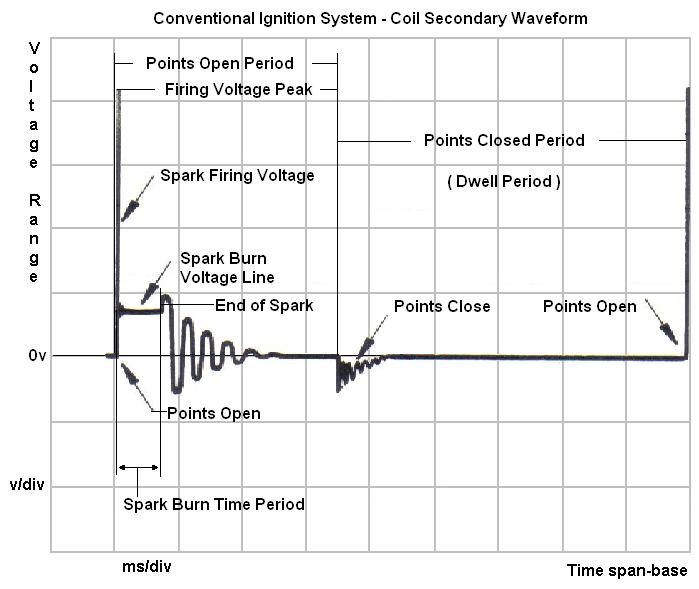
The transformer is actually an ignition coil w/ 8mH inductance. This coil has 14.3v input on the primary side and is clamped to only 5.5A. The Coil - in the diagram from post #8 shows this ("Coil -" in the red section on the left") which then feeds into the zener diodes and the rest of the circuit which ends up at the microcontroller.

Thank you for your help.

S
 

AlbertHall

Joined Jun 4, 2014
12,625
Please find a sample, marked in red, of what my idea for this circuit is attached to this post.

Thanks and please remember I am not a professional but a hobbyist trying to learn and use this forum to do so.

S
Note that this circuit has a 2k resistor between the base and emitter of the transistor.
 

Thread Starter

SoaringFree

Joined Sep 15, 2016
20
Note that this circuit has a 2k resistor between the base and emitter of the transistor.
Thank you for your reply AlbertHall.
I was/ am not sure of the function of this 2k resistor and the .01uF cap before the base of the transistor. All I can think of is that the 2k resistor acts like a voltage divider w/ the four 47k resistors and the .01uF cap acts to store the voltage for a given amount of time when in combination w/ the resistor (RC time constant). Again this is my thought here. Only being a hobbyist I am just trying to figure this stuff out a little at a time as there is a LOT to learn. I appreciate your help.

S
 

Thread Starter

SoaringFree

Joined Sep 15, 2016
20
Have you fitted a 2K resistor and what difference did it make.
AlbertHall,
Yes I added both the 2k resistor and the .01uF, and I saw no change in my trace profile. Just wondering if this was and is intended in the original circuit or is it suposed to be a square wave. I am thinking the latter which makes me ask the question here, is this trace profile correct.

S
 
Top