What does -X(f+Flo) factor mean in this passive downconversion mixer

Thread Starter

asdasd12e12

Joined Nov 24, 2021
48
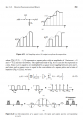
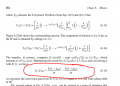
In the images below i underlined one expression in red. There's supposed to be a frequency shift but what does -X(f+Flo)/k*pi mean here and how is Y1(f) equal to the output spectra in figure 2.22 (b) ? How can i compute the gain with that extra factor? Transfer function should be in the form Y=X*H but what i see is Y= (X1 - X2)*H
1.PNG

1.PNG
 

Papabravo

Joined Feb 24, 2006
22,082
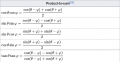
When two sinusoidal frequencies are combined in a nonlinear process, like multiplication. Two new frequency components are created that occur at the sum of the two frequencies and the difference of the two frequencies. In the expression \( f \) is the carrier frequency and \( f_{LO} \) is the local oscillator frequency. This result is well known to students of trigonometry as the following list of product to sum identities:
1667272907954.png
 

Thread Starter

asdasd12e12

Joined Nov 24, 2021
48
When two sinusoidal frequencies are combined in a nonlinear process, like multiplication. Two new frequency components are created that occur at the sum of the two frequencies and the difference of the two frequencies. In the expression \( f \) is the carrier frequency and \( f_{LO} \) is the local oscillator frequency. This result is well known to students of trigonometry as the following list of product to sum identities:
View attachment 279677
Problem is that i just dont understand how can i compute the transfer function of an input signal that has a frequency shift while it performs a subtraction by that same input signal with a another frequency (shift). The definition of transfer function is Y(w) = H(w)X(w).

What would X(w) be in this case? X(f-fLO) - X(f+fLO) ?
 

Papabravo

Joined Feb 24, 2006
22,082
What I think the text is telling you is that to evaluate \( Y_1(f) \) at the intermediate frequency IF, according to Eq. (6.14) you convolve \( X(f) \) with the expression inside the square brackets. That process extracts just the information in the two sidebands, regardless of what information \( X(f) \) may contain anywhere else in the spectrum.

Delta functions are known to have this property of selection using the convolution process,
 
Top