What does TPS on a carburetor do

SamR

Joined Mar 19, 2019
5,494
It's filling at a partial vacuum and then being compressed before being ignited by the plug. With better flow control that partial vacuum can become a partial pressure. Valve sizing, intake port increased sizing and polishing, cam lift and dwell, etc. And then there are additional external compressors. Then when decelerating with the carb plate closed there becomes significant cylinder partial vacuum.
 

shortbus

Joined Sep 30, 2009
10,049
To increase power the accelerator gets pushed opening the primary plate increasing air/fuel flow to the engine. As power comes on RPMs increase causing manifold vacuum to increase. As manifold vacuum increases the vacuum control on the distributor advances the timing and the vacuum control on the carbs opens the secondary plate to increase air/fuel flow.
Your under the same assumptions that most people are. Vacuum advance is a misnomer, ti is actually a vacuum retarder. The advance is all in at low throttle opening, when the vacuum in the manifold is highest. And manifold vacuum is where the vacuum advance gets its signal even though it comes out of a pipe on the carbs base, that pipe is actually open to the bottom of the carb, the manifold. Like I said to Geekof theWeek, that is why back in the day you had to disconnect the vacuum advance when setting the distributor timing. If you didn't when you went to full throttle when driving the timing would be retarded not advanced.

I also used a dual points Mallory mechanical distributor with no vacuum advance. Ignition advance was done by a couple of flywheel cam plates that mechanically advanced timing with RPMs and had to be set up on a Sun Distributor machine using different weight flywheel cam parts and different spring tensions to tune it based on the engine performance.
And the vacuum secondaries work different than you said too. They get there signal to open from up near the venturi of the carb, where the vacuum is highest when at full throttle. The centrifugal advance is needed to overcome the retarding of the timing when the vacuum is lowest in the manifold(when the vacuum advance is retarded) which is when the throttle is close to or full open.

The high vacuum at the venturi is also what brings in more fuel when the throttle is opened and manifold vacuum is low.
 
From Wikipedia:
Air is a mixture of about 78% of nitrogen, 21% of oxygen, 0.9% of argon, 0.04% of carbon dioxide, and very small amounts of other gases.[1][2] There is an average of about 1% water vapour.

And as was stated. the ability to fill the cylinder fast enough. That's why we have multi-valve engines. To increase the opening size and the force required to open the valves.

We only care about Oxygen. That will vary by altitude.

Remember that the "barometric pressure" reported by the weather bureau is normalized to sea level. It's not the actual pressure as measured by the sensor. There is gauge and absolute pressure too. Tire pressure is guage. Atmospheric pressure is ~14.7 PSI absolute and varies by altitude.
 

geekoftheweek

Joined Oct 6, 2013
1,429
Actually not all engines run full vacuum advance at idle. Most carbs also have a ported vacuum that only has vacuum after you crack the throttle and no vacuum at idle. Part of the reason was to raise exhaust temperatures at idle and keep the catalytic converters hot enough. The old Ford likes this connection for the vacuum advance. Even with an ebay HEI distributor built for the engine... the original Duraspark fell in the trash ;)

Other than that I think @shortbus misunderstood what I was getting at.

Of course this was actually about motorcycles to begin with so the concepts should be the same, but the mechanical means may be different... never dug in to a motorcycle.
 

geekoftheweek

Joined Oct 6, 2013
1,429
by the way our example says "This is important as the speed of the flame front in the combustion chamber changes as the load"

so if we consider these two situations;
1) bike is in neutral. rider revs and maintains a steady 5000rpm
2) bike is cruising at 5000rpm

it's true that those two conditions have different throttle positions. but since it's the same rpm ( 6000rpm ), does the piston reaches the TDC in a same speed ? as i understood, apparently it doesn't. that's the reason behind putting a TPS to detect the throttle position and advance the ignition. but since the rpm is same ( 5000rpm ) shouldn't the speed of the piston have to be the same? thank you :)

The piston moves the same. The difference here is how much air and fuel it takes to maintain 5000 rpm. Less mixture needs more advance to burn right since it will burn slower. More mixture will burn faster and needs less advance to get the job done.

An advantage of a TPS on a carb would be to overcome mechanical lags of weights and canisters moving, and at the same time being able to further alter the curve to suit the current conditions. It may actually cause the timing to retard more than a mechanical setup would be able to under heavy load to climb hills, pull hard, or whatever you are in the throttle for.
 

Thread Starter

Autobike

Joined Feb 23, 2018
103
@SamR @geekoftheweek @KeepItSimpleStupid @shortbus thank you very much :)

to be honest i thought when there's more mixture they give more advance timing just to avoid the preignition. but as @Chris65536 and @geekoftheweek said and also according to the google examples, it's the opposite. thx :)

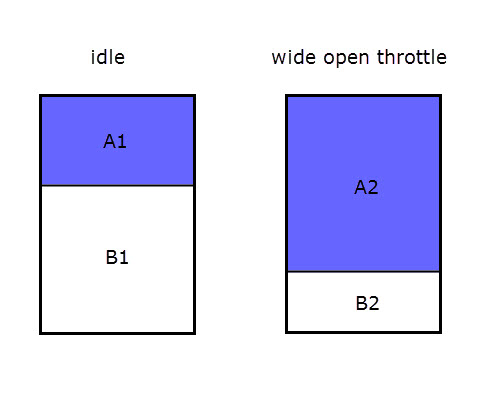
by the way if we check the below simple drawing


as they explain in idle less mixture ( A1 ) enters the cylinder. but is that remaining volume ( B1 ) a perfect vacuum ?
also when it's in wide open throttle more mixture ( A2 ) enters the cylinder. is that "B2" volume also a vacuum ?
coz if "B1" or "B2" are filled with air it will imbalance the mixture ( air + fuel ) created by the carburetor. am i right ? thank you :)
 
Last edited:

Chris65536

Joined Nov 11, 2019
270
You can think of it that way. The combination of air/fuel mixture "A1" and vacuum "B1" is just a partial vacuum at the full cylinder volume. The fraction of the air volume (at atmospheric pressure) over the cylinder volume is called "volumetric efficiency" and is stated as a percentage. At idle it might be 5 or 10%, and at full throttle and near the torque peak, it approaches 100%.
 

SamR

Joined Mar 19, 2019
5,494
You have to understand how the carburetor works and the venturi principle. The throttle plate on the carb controls the airflow. Opening the plate allows more air to flow through the carb. The fuel is sitting at normal pressure in the bowl and drawn into the airflow by the venturi principle. Higher flow generates more "suction" on the fuel and the air-fuel mixture becomes richer. Richer air-fuel mixture generates more power when combusted. Forget about "vacuum in the cylinder", the cylinder is full of the air-fuel mixture. With higher flow/RPMs there is more fuel in the mixture than at low flow/RPMs. To stop the increase in RPMs you close the throttle plate which lowers the airflow which lowers the air-fuel ratio which lowers the fuel content of the air-fuel mixture which lowers the power generated which lowers RPMs. Most newer carburetors have small springloaded piston accelerator pumps. Which will "squirt" a small slug of atomized fuel into the airflow when the throttle is "floored" by a mechanical linkage on the carb to initiate a quick burst of power to start the rpm increase/acceleration process. Think All pale blue to dark navy blue.
 

Chris65536

Joined Nov 11, 2019
270
To stop the increase in RPMs you close the throttle plate which lowers the airflow which lowers the air-fuel ratio
The closed throttle plates reduce the airflow which also reduces the fuel, but the A/F ratio should stay close to stoichiometric. The engine power is controlled by reducing the mass of air/fuel mixture, not by reducing the A/F ratio. A richer mixture doesn't always make more power. Too lean is usually bad though, since it doesn't always ignite and you get a "miss". This is where fuel injection shines, since it can directly and accurately control the A/F ratio. Carburetors will vary more, so they are typically set to the "rich" side.
 

Thread Starter

Autobike

Joined Feb 23, 2018
103
You can think of it that way. The combination of air/fuel mixture "A1" and vacuum "B1" is just a partial vacuum at the full cylinder volume. The fraction of the air volume (at atmospheric pressure) over the cylinder volume is called "volumetric efficiency" and is stated as a percentage. At idle it might be 5 or 10%, and at full throttle and near the torque peak, it approaches 100%.
thank you. very useful.

You have to understand how the carburetor works and the venturi principle. The throttle plate on the carb controls the airflow. Opening the plate allows more air to flow through the carb. The fuel is sitting at normal pressure in the bowl and drawn into the airflow by the venturi principle. Higher flow generates more "suction" on the fuel and the air-fuel mixture becomes richer. Richer air-fuel mixture generates more power when combusted. Forget about "vacuum in the cylinder", the cylinder is full of the air-fuel mixture. With higher flow/RPMs there is more fuel in the mixture than at low flow/RPMs. To stop the increase in RPMs you close the throttle plate which lowers the airflow which lowers the air-fuel ratio which lowers the fuel content of the air-fuel mixture which lowers the power generated which lowers RPMs. Most newer carburetors have small springloaded piston accelerator pumps. Which will "squirt" a small slug of atomized fuel into the airflow when the throttle is "floored" by a mechanical linkage on the carb to initiate a quick burst of power to start the rpm increase/acceleration process. Think All pale blue to dark navy blue.
thx for the explanation.

The closed throttle plates reduce the airflow which also reduces the fuel, but the A/F ratio should stay close to stoichiometric. The engine power is controlled by reducing the mass of air/fuel mixture, not by reducing the A/F ratio. A richer mixture doesn't always make more power. Too lean is usually bad though, since it doesn't always ignite and you get a "miss". This is where fuel injection shines, since it can directly and accurately control the A/F ratio. Carburetors will vary more, so they are typically set to the "rich" side.
this is the answer i was looking for. it's the mass not the ratio :)
i'm kind of familiar with the carb idle, mid & main circuits. so i always wonder why manufacturers make a lean mixture at idle and rich at WOT. well it's misconception i think.
it's the A/F mass not the A/F ratio as you said. coz practically we can make a good mixture in both idle range and WOT using pilot screw settings, idle/main jets etc. thank you :)
 
Last edited:

shortbus

Joined Sep 30, 2009
10,049
to be honest i thought when there's more mixture they give more advance timing just to avoid the preignition.
Ignition advance has very little to do with pre-ignition, that is a problem of hot, glowing spots in the cylinder. And usually is under a higher load at to low of an engine speed.

The ignition needs to be advanced at high RPM to give the mixture enough time to burn. This is also why the term "vacuum advance" is really not a good description of what it does. It actually retards the timing when idling, and advances it as the throttle opens and there is less vacuum.
 

Thread Starter

Autobike

Joined Feb 23, 2018
103
Ignition advance has very little to do with pre-ignition, that is a problem of hot, glowing spots in the cylinder. And usually is under a higher load at to low of an engine speed.

The ignition needs to be advanced at high RPM to give the mixture enough time to burn. This is also why the term "vacuum advance" is really not a good description of what it does. It actually retards the timing when idling, and advances it as the throttle opens and there is less vacuum.
thank you. got it
 

Chris65536

Joined Nov 11, 2019
270
It actually retards the timing when idling, and advances it as the throttle opens and there is less vacuum.
That was the function of the "centrifugal advance". The vacuum advance does increase with higher vacuum, and so adds advance at idle. Then when you floor it, the ignition is suddenly retarded, as the vacuum advance goes to zero, Then as the RPMs climb, the centrifugal advance increases. You could change the slope by changing the weights in the distributor. These things all changed over to electronics during the 80s.
 

Thread Starter

Autobike

Joined Feb 23, 2018
103
my bike has a TCI unit for the ignition and no TPS at the carb. so i think it advances the ignition by just looking at the RPM. thank you :)
 

Thread Starter

Autobike

Joined Feb 23, 2018
103
"volumetric efficiency" is the word i was missing. thx to @Chris65536 . found some explanation in youtube and as said above it's the fraction of ;

actual volume
_________________ %
theoretical volume

apparently the sudden movement/speed of the piston creates that vacuum which will reduce gradually as we open the throttle. means more % volumetric efficiency at WOT.

thx :)
 

shortbus

Joined Sep 30, 2009
10,049
my bike has a TCI unit for the ignition and no TPS at the carb. so i think it advances the ignition by just looking at the RPM. thank you :)
Or it doesn't advance at all. Many small engines run at a set ignition timing point, no advance or retarding at all. What is your bike's model?
 
Top