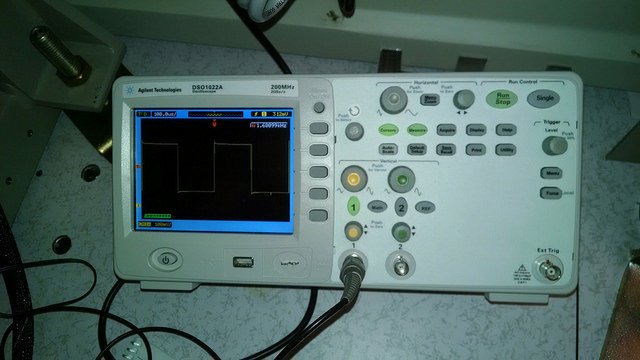
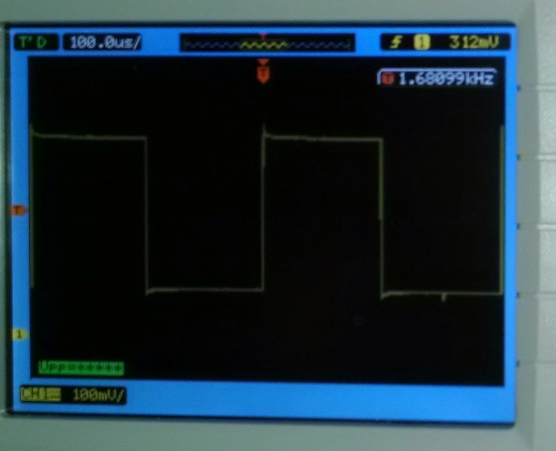
What causes these spikes on this waveform

ian field

Joined Oct 27, 2012
6,536
X1 or X10 probe? If X10 probe is it correctly compensated?
The flat top of the waveform is only about 3.9V. Why is it so much the (assumed?) 5V PIC supply. Is anything else connected to the PWM output (other than the scope probe)?
You beat me to it - it could simply be the compensation capacitor adjustment on the scope probe.

Run of the mill CROs often had a diode clipped sinewave to approximate a square wave. Sometimes that was good enough to adjust the probe compensation by.

If I couldn't adjust it out with the compensation cap - I'd double check with a TTL clock module, they used to be fairly chunky modules with a pin footprint that fit a 14-DIL socket. They started turning up as 8-DIL packages on PC motherboards for a while.
 

Wuerstchenhund

Joined Aug 31, 2017
189
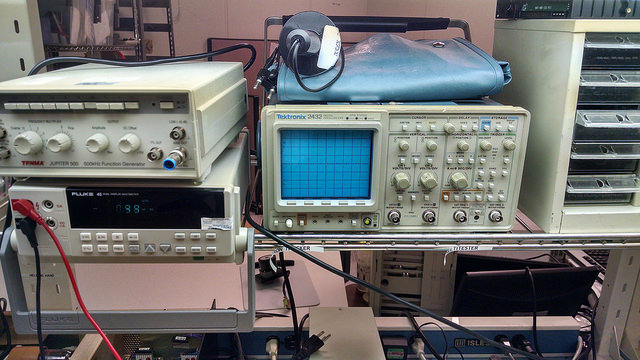
My boat anchor analog (TEK2465DM 400MHz BW) has much better spec's than most of the affordable digital scopes on the market, I'll keep it.
Good for you, but while the 2465 was certainly one of Tek's best scopes back then today it's specs aren't much to write home about (i.e. horizontal time base accuracy is magnitudes better even on the cheapest digital China scopes), there's no memory (so no single shot recording of events), there are no measurements, triggers are pretty basic, and thanks to the phosphor bloom some signal properties like noise may well be hidden from the user's view (which is why analog scopes appear less noisy than digital scopes).

Of course it's debatable as to what "affordable" means but there are many digital scopes with similar BW and better specs on the 2nd hand market at reasonable prices, which also are much younger and generally much more reliable thanks to the lack of mechanical switches and the capability to self-compensate for component aging.

Anyways, the point was that you don't need an analog scope to find out if what you see on a digital scope are artifacts or not.

Ha, boat-anchor. I’d call most of the digital scopes around here, boat anchors.
Why?
 

nsaspook

Joined Aug 27, 2009
16,340
Good for you, but while the 2465 was certainly one of Tek's best scopes back then today it's specs aren't much to write home about (i.e. horizontal time base accuracy is magnitudes better even on the cheapest digital China scopes), there's no memory (so no single shot recording of events), there are no measurements, triggers are pretty basic, and thanks to the phosphor bloom some signal properties like noise may well be hidden from the user's view (which is why analog scopes appear less noisy than digital scopes).
Sure, I've got several modern digital MSO scopes for quantitative accuracy of measurements too but for the qualitative seeing of repetitious analog (or high speed digital) signals I don't always need or want the digital processing chain in the middle to tell me what I'm seeing. There are times when all that digital crap just gets in the way.
 

Wuerstchenhund

Joined Aug 31, 2017
189
Sure, I've got several modern digital MSO scopes for quantitative accuracy of measurements too but for the qualitative seeing of repetitious analog (or high speed digital) signals I don't always need or want the digital processing chain in the middle to tell me what I'm seeing. There are times when all that digital crap just gets in the way.
Not sure I'd call the signal processing in a DSO 'digital crap' as this 'crap' is based on sound physical and mathmatical principles and has proven to work very well. I'm also not sure how this should get "in the way" of a qualitative signal assessment, unless you operate the scope incorrectly (or your have a particular bad scope). For modern high speed signals an analog scope is useless anyways simply because its BW maxes out at around 1GHz, everything else above that right up to 100Ghz is digital.

If you prefer an analog scope for whatever reason then sure, be my guest, but don't fall under the illusion that it will show you a more realistic waveform than a decent DSO or that it won't lie to you.
 

DickCappels

Joined Aug 21, 2008
10,660
It sure looks like a scope grounding issue.

The overshoot occurs on both the rising and falling edges, but the scope is probably missing some of them because they are very fast. Perhaps something in the setup can make both appear consistently. The first thing that comes to mind is to trigger on the rising edge then speed up the timebase for a better look at that edge. A similar inspection of the falling edge should make it all clear.

My Tektronix scope allows switching the display mode between dots and vectors. Might be a good idea to verify that your scope is not in "dot mode" if it has one.
 
Last edited:

nsaspook

Joined Aug 27, 2009
16,340
Not sure I'd call the signal processing in a DSO 'digital crap' as this 'crap' is based on sound physical and mathmatical principles and has proven to work very well. I'm also not sure how this should get "in the way" of a qualitative signal assessment, unless you operate the scope incorrectly (or your have a particular bad scope). For modern high speed signals an analog scope is useless anyways simply because its BW maxes out at around 1GHz, everything else above that right up to 100Ghz is digital.

If you prefer an analog scope for whatever reason then sure, be my guest, but don't fall under the illusion that it will show you a more realistic waveform than a decent DSO or that it won't lie to you.
I don't prefer an analog scope, I just like to use one (a very good one) for some types of measurements because I've used analog scopes for decades and know intuitively what I'm seeing blemishes and all because the scope analog circuits and display integrate fast signals like real hardware physics so you see what's important at the circuits speed not every wiggle. For most measurements I agree with you. Need a scope? Use a DSO but usually the best scope is the one on the bench next to you.


Spikes on the signal on every edge.
 
Last edited:

Wuerstchenhund

Joined Aug 31, 2017
189
I don't prefer an analog scope, I just like to use one (a very good one) for some types of measurements because I've used analog scopes for decades and know intuitively what I'm seeing blemishes and all because the scope analog circuits and display integrate fast signals like real hardware physics so you see what's important at the circuits speed not every wiggle.
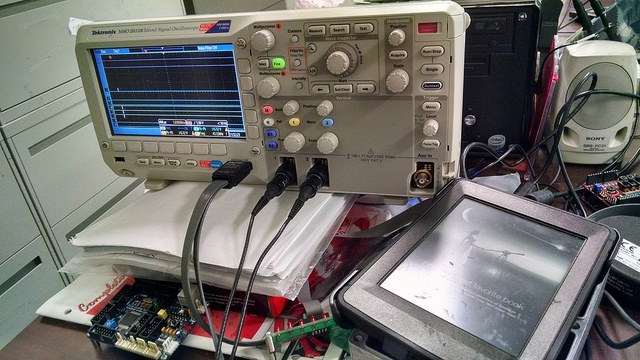
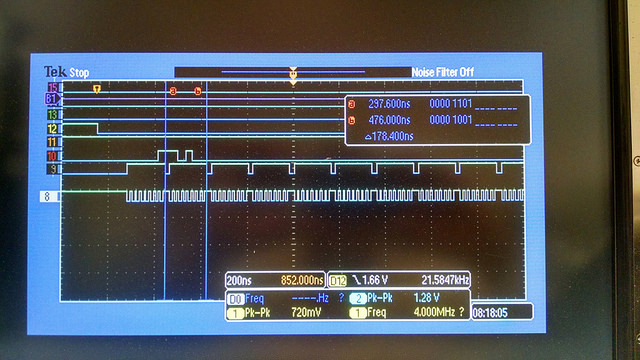
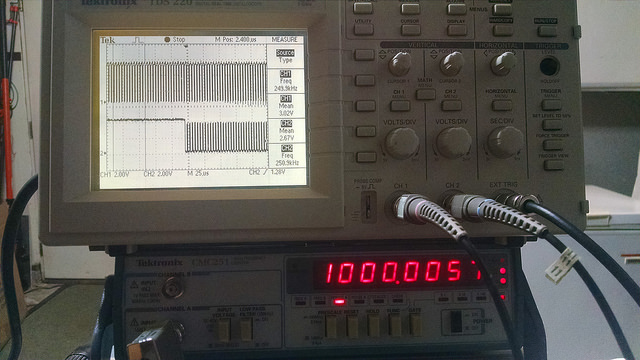
Fair enough, and and after seeing your pictures with the Tek MDO3k and the Agilent DSO1022A I can even see why you prefer the 2465 and why you said that the digital stuff gets in your way. I had a MDO3054 myself, and it's really an awful scope (idiotic UI, slow as molasses processing, locks up when doing something demanding, like pretty much every Tek DSO). It's a real shame that Tek never figured out how to do a digital scope properly, or their business wouldn't have been in pretty much constant decline for many years.

Anyways, as I said my point was that you don't need an analog scope to find out if what you see on the screen are artefacts or part of your input signal. Although the poor low-res screens of the old Rigol DS1000/Agilent DSO1000 can sometimes present a challenge.
 

nsaspook

Joined Aug 27, 2009
16,340

I spec'd the TEK MSO mainly for the embedded signal decoding and external VGA capabilities and you're right as a pure scope it's a dud when matched to the quick operation of a older unit like the TDS 220.
 
Top