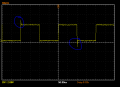
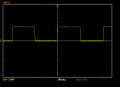
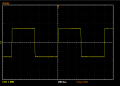
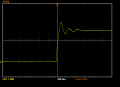
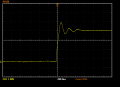
The scope is a Rigol DS1102E. What is causing these spikes? Is it actually something from the pic or an artifact of the digital scope? The spikes appear to pulsate a bit.
X1 or X10 probe? If X10 probe is it correctly compensated?
The flat top of the waveform is only about 3.9V. Why is it so much the (assumed?) 5V PIC supply. Is anything else connected to the PWM output (other than the scope probe)?
X1 or X10 probe? If X10 probe is it correctly compensated?
The flat top of the waveform is only about 3.9V. Why is it so much the (assumed?) 5V PIC supply. Is anything else connected to the PWM output (other than the scope probe)?
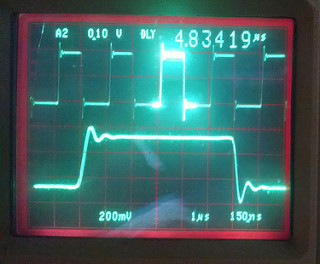
It would appear to be resonance from stray circuit capacitance and inductance.
It may seem to pulsate at slower sweep speeds due to the undersampling of the high frequency transient at that sweep setting.
It would appear to be resonance from stray circuit capacitance and inductance.
It may seem to pulsate at slower sweep speeds due to the undersampling of the high frequency transient at that sweep setting.
That would be my thinking. The leading edge of a pulse waveform contains an infinite number of odd harmonics (think high frequencies here). You are working with a circuit on a breadboard type affair which due to its nature will induce all sorts of capacitance, inductance and assorted parasitic coupling effects. Should you wish to try something interesting while observing the ringing try and touch a few exposed terminals of any components, see what the ringing does with just a finger touch.
You can try as Gopher suggested terminating the signal into a few resistive loads which may smooth the ringing a little but I doubt it will go away.
Try a 10:1 probe with a very short ground connection to the probe (such as a short wire wrapped around the probe ground tip to the ground nearest the signal output).
With 10X scope set to 10X probe. I am not too worried about this. I do not think it will have any effect even if it still shows up on the PCB version. I don't think it will have any ill effects for my purpose. Just wanted to be sure that it was not my scope. And curious as to what is causing it and perhaps how to fix it if possible.
If you try the short ground lead on the 10:1 probe you may find that the ringing is significantly reduced.
If that is the case, then the ringing is due to to ground wire impedance.
Looks like a normal 'transmission line' high frequency reflection (ringing).
That why it's useful to have a good analog scope as a reality check when you see something strange, maybe the missing signal at some edges is an artifact of the digital scope.
That why it's useful to have a good analog scope as a reality check when you see something strange, maybe the missing signal at some edges is an artifact of the digital scope.
I ended up selling my analog scope. Takes up too much space. And mostly when I realized I would need to replace the filter caps someday that was just too much for me. On a previous repair where I was lucky to get it working, I noticed how compact everything was. The PSU especially. Scared the heck out of me!

 Facebook
 Google
 GitHub
 Linkedin