Facebook
 Google
 GitHub
 Linkedin
Hi all
I have an LLC resonant converter with a half bridge and two STD25NF10L MOSFETs, and a LM5109 gate driver:
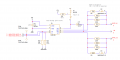
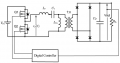
(ignore the "Digital controller")
It runs, but I am having problems when increasing the input voltage V_in. I have "maxed" out the power with 60V @ resonance (6kHz), and it has not exploded yet, but that was only a short period. When testing a lower voltage (50V), but letting it run for a while, the MOSFETs started smoking. I replaced them, and it still "works", but I looked at V_gs on both MOSFETs before increasing the voltage:
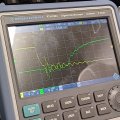
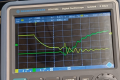
This is with V_in = 15V and 450 ns dead time. Yellow is high-side MOSFET, and green is low-side.
Here's the part I don't understand:
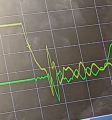
After V_gs has dropped, it spikes up to roughly 6V before going down again, oscillating. The peak of this spike is dependent on the input voltage V_in. Increasing the dead time only increases the "oscillating" period after the spike. This could explain why the MOSFETs started smoking.
What's going on, and what to do about it? Change MOSFETs? Change gate driver? I have thought about this for some time today and can't seem to grasp it.
Thanks!
I have an LLC resonant converter with a half bridge and two STD25NF10L MOSFETs, and a LM5109 gate driver:
(ignore the "Digital controller")
It runs, but I am having problems when increasing the input voltage V_in. I have "maxed" out the power with 60V @ resonance (6kHz), and it has not exploded yet, but that was only a short period. When testing a lower voltage (50V), but letting it run for a while, the MOSFETs started smoking. I replaced them, and it still "works", but I looked at V_gs on both MOSFETs before increasing the voltage:
This is with V_in = 15V and 450 ns dead time. Yellow is high-side MOSFET, and green is low-side.
Here's the part I don't understand:
After V_gs has dropped, it spikes up to roughly 6V before going down again, oscillating. The peak of this spike is dependent on the input voltage V_in. Increasing the dead time only increases the "oscillating" period after the spike. This could explain why the MOSFETs started smoking.
What's going on, and what to do about it? Change MOSFETs? Change gate driver? I have thought about this for some time today and can't seem to grasp it.
Thanks!
Last edited: