I realize that this question is a bit late, but "HOW waterproof" do you want it to be?? Consider that doorbell buttons survive for years in rainy weather.
Or the three basic levels of waterproof: "Rainproof" ( no fault or false trigger during or after rain), or "WASHDOWN PROOF"(No fault after adirect stream of water hits the button) or "Submersible" (No fault or false trigger after being submerged to some depth for a long time).
For a small package outside, I suggest a cover flap of clear vinyl plastic to keep the rain off and allow folks to see the button to press.
Yeap ... size has been the main, non-negotiable constraint in the design. And of course the first thing I did was try to find a commercially available solution. There isn't any, and now I'm opting for a custom made one. Whatever it takes.
OK, now consider that thebutton is a normally open switch. The first two questions for any switch design are what is the voltage and what is the current? Those variables help to define the contacts.
AND, now it appears that this is for production, NOT a hobby one-off build! THAT changes almost everything! Unless I got it wrong.
I have seen a "spring alloy copper" dome sort of part used to contact /connect traces on a PCB, sealed with the rest of thePCB and the button battery, all in a clear vinyl pouch. Everything was visible, and it actually worked. I think it was waterproof until it was cut open to replace the battery.
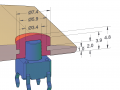
Here's what I'm looking at right now. I've designed a soft silicone rubber cover for the button, which will be installed in my device's enclosure (which is made of PVC) as shown in the following cross-section drawing.
I've already received a quote, and the cover itself is not expensive at all. About 8¢ each . What's a little painful is what they'd be charging for the mold, which is about $850 bucks ... ouch!
Certainly thebutton in the illustration will work. Itwill need to be carefully installed, though, so that may be an issue. The hole will need to be machined from both sides,, or possibly die-stamped. ANDthe panel will need to be thick enough to support that hole.
So question #1: How thick is the panel the system installs into??
Question #2- the enclosurecast, stamped, formrd, or molded??
What material will the button be?? Silicone would work, molded rubber is cheaper, urethane is too stiff to use.
Exactly ... of course I'd love it to be IP67/68 rated (submersible), but there's a practical limit to this design since there are other components in the device that are not rated that far up the IP scale anyway.
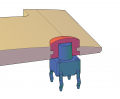
I'm building a small electronic device that will be installed outdoors, and I'd like to weatherproof the only button that it has. I've attached the part's datasheet as a reference.
Among other considerations, I've been thinking about using an o-ring squeezed between the button and the plastic lid as shown below.
To be honest, I'm not convinced this is the best way to go around it. Question, is there a better way to accomplish what I want? ... I'd like arrangement to comply with an IP66 rating, if possible. Also, I'm willing to use different hardware if it solves the problem in a simple way. The only condition being that said hardware must be mechanical, and not of the capacitive-touch type, for instance.
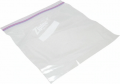
I'm not joking, this is something to at least consider:
Situate the box inside a sealed plastic bag of some kind, then you can activate the switch easily but you and the weather cannot directly contact the box/switch itself.
I'm not joking, this is something to at least consider:
View attachment 367183
Situate the box inside a sealed plastic bag of some kind, then you can activate the switch easily but you and the weather cannot directly contact the box/switch itself.
The mmagnetically operated switches like that which I have seen are not suitable for the TS application, which is some sort of productfor outside application. (that is certainly a vague description, but all that I have)
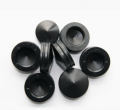
I waterproofed a flashlight's button with a rubber cap of a 3ml syringe's plunger rod. The thing is rubber and bouncy, glue sticks to it well and should be able to get ftee if you are lucky. The rubber cap is dome -shaped and when you push it, it sinks and bounces back.

 Facebook
 Google
 GitHub
 Linkedin