Latching Off-On pushbutton for portable electronics PCBs

Thread Starter

kowshik1729

Joined May 10, 2020
99
Hi guys,

I am writing here after exhausting almost 1.5 days of search for Off-On buttons that are latching. Basically the pushbutton should work like this,

Original state - OFF
When pressed once - switches ON and stays ON
When pressed again - OFF

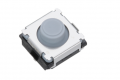
Can someone suggest buttons like these? They have to be very small in size and should act as On/Off switches for dongle type of electronics. I am looking something like this
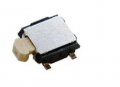
1732998776698.png

Thanks,
Kowshik
 

Tonyr1084

Joined Sep 24, 2015
9,744
Yesterday I asked you to define "Very Small in Size". Today I want to ask "How much current will this switch need to handle, and at what voltage?"
 

Thread Starter

kowshik1729

Joined May 10, 2020
99
@Tonyr1084 To define Very Small in Size - I am looking something like tactile buttons as I've shown in the picture, dimensionally something of size 6(W) x 6(L) x 1.2(H) mm.

> How much current will this switch need to handle, and at what voltage?"
There are not much current constraints, something in the range of 50mA to 100mA is also fine. The reason being I'll use this switch to turn the base of a transistor or MOSFET On and off so all the heavy lifting of conducting the high current happens through the Source and drain pins.
 

Tonyr1084

Joined Sep 24, 2015
9,744
Thank you for the answer. Have you thought of using a Flip Flop? (FF such as a CMOS D type FF). Is space a premium? If you DO go with a FF you'll need to debounce the switch as well. A small cap should do. But all this depends on how much space you have to work with.
 

Thread Starter

kowshik1729

Joined May 10, 2020
99
Thank you for the answer. Have you thought of using a Flip Flop? (FF such as a CMOS D type FF). Is space a premium? If you DO go with a FF you'll need to debounce the switch as well. A small cap should do. But all this depends on how much space you have to work with.
I don't have too much restriction on space.

Can you please provide any circuit references regarding this Flip flop circuit please? I haven't implemented any such circuit.
 

Tonyr1084

Joined Sep 24, 2015
9,744
Here's an AAC Textbook on the subject.
https://www.allaboutcircuits.com/technical-articles/circuit-and-operation-of-a-d-flip-flop/
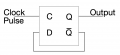
Basically you set /Q (called "Not-Q" which is opposite of Q) as a feedback to D (Data). When the clock pulse goes high the FF sets Q to whatever state D is at the time of the clock rise. If /Q is high then D is high. When the clock pulse occurs Q goes to match D. As Q goes high /Q goes low. At the next clock pulse, since D is low then Q will go low and /Q will go high. This repeats for as many clock pulses there are.

Substitute the clock pulse with a switch and every time you close the switch the FF will change state.

Give me five min's and I'll bang out a drawing.
 

crutschow

Joined Mar 14, 2008
38,322
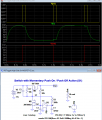
Below is the LTspice sim of an example PB (S1) operated bistable P-MOSFET switch that requires just one added control N-MOSFET:

You didn't answer Tony's question about what is the voltage you are switching?

1733065902841.png
 

Tonyr1084

Joined Sep 24, 2015
9,744
Screenshot 2024-12-01 at 8.08.57 AM.png
At the clock pulse Q will take on whatever level is present at D. /Q will put out the opposite of Q.
At the clock pulse if D is High then Q will go high. Shortly after that, very shortly, /Q will go opposite of Q.

At this moment /Q is Low. So is D.
At the next clock pulse since D is Low, Q goes Low. This changes /Q to High.
At the next clock pulse since D is High, Q goes High. This changes /Q to Low.
At the next clock pulse since D is Low again, Q goes Low. This changes /Q to High.
At the next clock pulse since D is High again, Q goes High. This changes /Q to Low.

This goes on every time there's a clock pulse. As mentioned before, using a switch for the clock pulse will switch the output of Q from ON to OFF to ON to OFF. Every time you push the button it switches state.

This is not a complete drawing, just a basic operation of the FF. The switch may need to be debounced. And the output of Q may not be strong enough to drive whatever you're driving. A transistor or MOSFET will be needed to handle the heavy load.
 

Reloadron

Joined Jan 15, 2015
7,857
I have a pile of Leviton Push On Push Off buttons rated for 1 Amp 250 volts, 3 Amp 125 volts and they work fine for low current DC. Leviton makes them as well as Gardener Bender. They come with 6 inch AWG18 leads. If you are in the US I will mail you one on me. Tis the season. :)

Ron
 

AnalogKid

Joined Aug 1, 2013
12,045
The thing that makes a pushbutton switch alternate-action is a mechanical mechanism. The smaller the switch, the harder it is to have a *reliable* alternate-action. This is why there are so many electronic methods of turning a simple momentary switch into an alternate-action function.

ak
 

crutschow

Joined Mar 14, 2008
38,322
The thing that makes a pushbutton switch alternate-action is a mechanical mechanism. The smaller the switch, the harder it is to have a *reliable* alternate-action.
Also, a momentary PB switch generally takes less force to operate than an alternate-action.
 

Ya’akov

Joined Jan 27, 2019
10,226
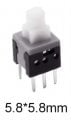
This is the typical form factor of a PCB mount latching pushbutton. They are always cubes, to accommodate the mechanism. This is the smallest I could find on AliExpress. They have various names, including push-on-push-off but Chinese manufactures seem to have settled on “self-locking”.

1733177907256.jpeg
 

Thread Starter

kowshik1729

Joined May 10, 2020
99
. If you are in the US I will mail you one on me. Tis the season. :)

Ron
hi Ron, So generous of you, unfortunately I'm based out of UK. But that's fine I'm thinking of implementing a power latch circuit as shown in this video as I already have a tactile user button that I'm using. So with some tweaks to software and some additional hardware I think I can implement this easily and keep my design easy.


eetech00

Joined Jun 8, 2013
4,704
But that's fine I'm thinking of implementing a power latch circuit as shown in this video as I already have a tactile user button that I'm using. So with some tweaks to software and some additional hardware I think I can implement this easily and keep my design easy.
You might want to check these:
https://na.industrial.panasonic.com...eup/light-touch-tactile-switches/series/79217

1733189980167.png

There are many tactile switches available as Mouser.
https://www.mouser.com/c/electromec...s/?contact form=SPST&switch function=ON - OFF
 
Top