How to make a pushbutton that earths a signal to 0v into one that requires a +voltage ??

Thread Starter

gray-b

Joined Aug 4, 2025
85
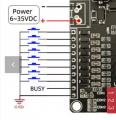
I have a DY-HV20T voice playback module, that has 8 manual pushbuttons that select a different piece of music.

These manual pb's just ground each output signal from the main chip.

I want this to be controlled externally, by automatically running a sequence. But these all have a +v signal as an output.

So how can I use a +v signal to ground each pin. Without using relays.

Maybe already off the shelf ??
 

Thread Starter

gray-b

Joined Aug 4, 2025
85
I have no ideas what the voltage levels are, assume no more than 12v. But the psu I got it for don't work. Got to order another one. that's my plans for weekend out the window.

Just for info here's the 8 signals

Screenshot 2025-08-08 172825.png
 

eetech00

Joined Jun 8, 2013
4,704
I have no ideas what the voltage levels are, assume no more than 12v. But the psu I got it for don't work. Got to order another one. that's my plans for weekend out the window.

Just for info here's the 8 signals

View attachment 353880
Each input is probably pulled up to +V when the button is not pressed.

So, Apply power to the unit, them measure the voltage at the input pin without pressing the button. That should indicate the input voltage level being used.
 

MisterBill2

Joined Jan 23, 2018
27,173
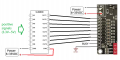
OK, one way to do it is with CMOS inverters. That does depend on the voltage present on the button circuit when the music system is waiting for a button press. A CD4049 will provide six independent lines of inversion. And it can work from 15 volts down to 4 volts.
 

Tonyr1084

Joined Sep 24, 2015
9,744
Lots of others faster than me.
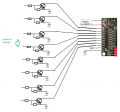
Here's my contribution:
View attachment 353893
The control voltage can be anything you want. Mine is using a 3.3V source. That would yield 6mA current through the diode inside the Opto. Higher voltages will require a much larger resistor. Obviously this will need to be repeated for every line of control. If you have 10 outputs then you need 10 Opto's. (Opto is short for Opto-Isolator)

[edit] Pin 3 is supposed to be a ground. The drawing didn't render when shrunk down like that. [end edit]
 
Last edited:

Thread Starter

gray-b

Joined Aug 4, 2025
85
Some good responses there. I must admit I was beginning to look at a row on NPN. But got wound up trying to sort out the resistors.
So which would be the best with the lowest current consumption, assuming each will be only on individually, and for only 30 secs max.
Maximum 10 mins total run time, so it may cycle though all 8 only 2.5 times.
 

Thread Starter

gray-b

Joined Aug 4, 2025
85
Anybody know of an 8 bit invertor cmos chip?

My chip books from 25 years ago say most are out of date now ?? that proves how old I am.
 

ElectricSpidey

Joined Dec 2, 2017
3,312
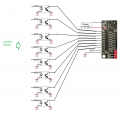
None that I know of, the load driver mentioned in post #2 is your best option. IMHO

8 channel, low side switches in one convenient package. If you choose the right one...no need for resistors.

I would leave the "com" pin open because you are not dealing with inductive loads.

If you are concerned about power consumption you could probably use the 2804 instead of the 2803.

But if you are "really" concerned about power consumption than MOSFETs are the best bet.
 
Last edited:

MisterBill2

Joined Jan 23, 2018
27,173
The CD4049 has six inverters, BUT you can stack a second one on top and have 12 inverters. NO extra resistors required. BUT, do we even know the open circuit voltage on the music device module input?? OR the output voltage of the digital device to control it???
 

Tonyr1084

Joined Sep 24, 2015
9,744
If a resistor is needed you can tie all the grounds together and through a single resistor tied to actual ground. One resistor rather than 8.
 

ElectricSpidey

Joined Dec 2, 2017
3,312
Some good responses there. I must admit I was beginning to look at a row on NPN. But got wound up trying to sort out the resistors.
So which would be the best with the lowest current consumption, assuming each will be only on individually, and for only 30 secs max.
Maximum 10 mins total run time, so it may cycle though all 8 only 2.5 times.
Does that module require the input to be held low continually while the sound plays?
 

panic mode

Joined Oct 10, 2011
4,864
ULN2803 draws nothing when no input is active. the only current draw is by active inputs. current draw is about 1mA per input that is active. in your case only one input is active si total draw is about 1mA and only for duration that input is on. so that is 3-6mW depending on input voltage. if you want lower consumption than that you can use set of logic level mosfets.

at any rate, for any answer you want, you need to provide numbers. that is how engineering works. state voltage current, power limit, signal duration etc.
 
Top