Wattage in voltage devider

BobTPH

Joined Jun 5, 2013
11,521
This one:

http://www.fort777.co.za/index.php?main_page=product_info&cPath=715_1066&products_id=9886

It gives no thermal resistance spec, but I looked up ones of similar size and shape and they came in right around the 7C/W that you need. At 20C ambient and 7W it would run at 69C. Hot, but not outrageous.

My first power supply was built when I was in my teens, it had a 7805 bolted onto the outside of its metal case, and it is still working today, 40 years later.

Bob
 

Thread Starter

Chillum

Joined Nov 13, 2014
546
Ok Bob, then I'll build that one aswell, learning everywhere. Bob, could you verify my vero board design, am I an idiot or could that actually work?
 

Thread Starter

Chillum

Joined Nov 13, 2014
546
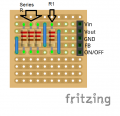
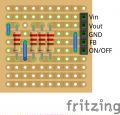
but R2 doesn't go to ground (page 13 first post) it goes to V+ of Vout; R1 goes to ground. and they both connect to pin4, if you shift your resistors down to the 5th track, won't that be the same as connecting them both to pin 4 (R2 low connect to 2 things R1 high and pin4, R1 connects to 2 things R2 low and pin 4) or am I being an idiot here? (stupid redundant question I have to ask: you are looking at v1.4?)
 

ISB123

Joined May 21, 2014
1,236
You are right I kept thinking that R1 goes to Vo because its named R1 o_O.
So good job,you are learning since you managed to spot my mistake and that means that you are using your brain rather then just copying everything I would tell you!;)

stripboard.png
 
Last edited:

Thread Starter

Chillum

Joined Nov 13, 2014
546
i connected Vin to Vout in v1.5, now Vout is connected to Vout

why do you need the link? if its on the same track it's automatically linked?

the conductancy is the same isn't it? does the link isolate them?

Both sides of resistors just flow to feedback through the link, the track is the link

If you move up your resistors, shrinking the link with the connecting points as you go, when the resistors comes inline to pin4 the link will just be a conducting dot
 

Attachments

Last edited:

ISB123

Joined May 21, 2014
1,236
Which pin is Feedback on your schematic pin 4 or 2(From top to bottom)?Can you trace all the connections in different colors like Vo is red,Vin is blue,GND is black.
 

Thread Starter

Chillum

Joined Nov 13, 2014
546
Which pin is Feedback on your schematic pin 4 or 2(From top to bottom)?
pin 4 from the top; ok, i'll do the colours, if I can

EDIT: pos diode connect to pin2 and L1, L1 connect pos C2 and pos C2 connects to Vout so L1 ALSO connects to Vout. Needed another break track 4 pin 14, pos C2 DOES NOT connect to pin 2

still intact, but going through it

Vout connects to 2 things, D1 pos and L1
 

Attachments

Last edited:

ISB123

Joined May 21, 2014
1,236
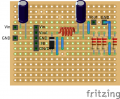
I think that you didn't really think out how are you going to place components on the stripboard so you got yourself confused and made a lot of jumper connections so its confusing right now.Do it something like this.
stripboard.png
 

Thread Starter

Chillum

Joined Nov 13, 2014
546
If you wanted diodes and capacitors as close to the ic and ground as possible, then yes, I did think alot: I'm too scared too say "thinked it through"... My design makes alot of sense to me, my rule is check what connects at one point and get them connected preferably on the same track, but otherwise theres jumpers. You're design makes no sense at all, what connects where? I'm still busy with your colour flow diagram, hopefully my skill is high enough to have completed a successful design, otherwise it was a learning excersize
 

Thread Starter

Chillum

Joined Nov 13, 2014
546
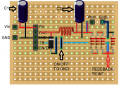
Looks like I had one jumper wrong
switchingRegulatorColoursv1.1.png
edit on image, connected green ground from Vin ground to Vout ground, the jumper was there, I just didn't show it with my highlights

as close to ground as possible D1 and C1 and C2; that was the design question wasn't it? That I did first and built the rest around it

C1,C2 and diode need short ground path as close as possible to the ground pin of the regulator.
unless I miss something big, this design works!
 

Attachments

Last edited:

Thread Starter

Chillum

Joined Nov 13, 2014
546
Ok,after checking everything it seems to be connected right.
Now you just need to build it!
You have no idea how happy it makes me to hear you say that! I'm on a *high*. BIG confidence booster, and yeah, I will build it. Chances are very good I'll get to Mantech Friday, and then I'll build it. Now *fishing for more ego!* could I have gotten the D1,C1,C2 any closer to ground?

Now I'm always going to highlight my paths before I print the mask, it made it very easy to see my one out of place jumper, helps alot thx!

I'd like to thank everyone who contributed to my originally very uninformed question about using a voltage divider as a power supply, we went through lots of options LM7805 LM350, variable and fixed outputs, heatsinks, whether it's for bench or application, then switching mode power supplies, circuit diagrams and now at the end vero board masks. I think I learned quite a bit and am probably still going to build most of the ideas on the forum, not just the last one, the switching one, but the rest aswell. We've covered the theory now, now its implementation time, will let you know on this thread how it went, depends when I'm working when I'll get to building THX! - Chillum (that's really my nickname, what my friends call me, and hopefully the future friends I'll make on this friendliest of all forums)
 
Last edited:

studiot

Joined Nov 9, 2007
4,998
I don't believe folks in Cape Town can't fashion heatsinks from scrap.
Here is a very nice lion my recently daughter sent to me from cape town.

lion1.jpg

He was made from a pepsi tin.

Half a tin would make a more than adequate heatsink.

You can make heatsinks by cutting rectangular strips of aluminium from a tin and bending them into U shapes, one inside the other and fixing by drilling through the lot and clamping with one bolt.

Or just cut into a petal shape like a flower.

Incidentally have you ever used Veroboard?

I think your layout is very tightly packed, are you quite sure of the sizes and have you left enough space to bend the wires?

Most folks I know only draw a VB layout after they have built it, when they want to tell someone else.

How will you make your track breaks?
 

Thread Starter

Chillum

Joined Nov 13, 2014
546
I don't believe folks in Cape Town can't fashion heatsinks from scrap.
Here is a very nice lion my recently daughter sent to me from cape town.

View attachment 75975

He was made from a pepsi tin.

Half a tin would make a more than adequate heatsink.

You can make heatsinks by cutting rectangular strips of aluminium from a tin and bending them into U shapes, one inside the other and fixing by drilling through the lot and clamping with one bolt.

Or just cut into a petal shape like a flower.

Incidentally have you ever used Veroboard?

I think your layout is very tightly packed, are you quite sure of the sizes and have you left enough space to bend the wires?

Most folks I know only draw a VB layout after they have built it, when they want to tell someone else.

How will you make your track breaks?
well, the design question called for tightly packed
C1,C2 and diode need short ground path as close as possible to the ground pin of the regulator.
, and I pack my full board from the mask before I begin soldering and then make adjustments where needed. I have used vero board, and twice I failed (twice I tried). well maybe people do fashion scrap heatsinks, just this noob not! (yet), I could probably drill a hole through a can with my Stanley Hand (powered) Drill!
 

ISB123

Joined May 21, 2014
1,236
You can drill a hole with nail through tin can:D.
and if I could etch, how do I learn that?
You would need to buy ferric chloride and a permanent marker if you cant print PCBs using an inkjet printer and that hand drill can drill through metal.To cut the strips on stripboard you can use linoleum knife like this one.
 
Last edited:
Top