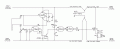
What I have coming in the mail right now is 100uf caps and 200K trimmers. If I had gone through all of this before hand I would change to the way the circuit is drawn, but I don't see how that setup is going to cause any issues seeing how its on the transistor side now?
I actually feel really good about the circuit. Good enough to put it into work and then see how it does. That will be the nice thing about this, I will be able to monitor it 8 hours a day, 5 days a week, and its not going to be doing anything critical till its proven itself reliable.
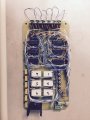
Now I just have to fit everything nice and neat on the board.
I guess I had not been specific in this thread about it(had another thread going which was focusing on a different circuit which I quickly abandoned).
I work at a water treatment facility. Fresh water, not waste water. We have filter beds that are the final step in the process before sending it out to customers. We have had a heck of a time finding an accurate way of measuring/indicating the specific level of the water during a wash cycle. Normal filter run level indication is done with ultrasonic transducers, but once a filter wash cycle is started the turbulence/mist/vapor caused by the air blowers disrupts all forms of level indication we have tried except for Radar.
Radar is nice, but VERY pricy. To the tune of a couple of grand per filter at the minimum(I think its more than that). The one thing that does work through the process is one lone capacitance probe we use for the low level indication. We could put more of those probes at the different levels needed for the filter wash cycle(6 total) but they work off of digital inputs to our PLC control panel. We do not have that many inputs available(nor the space to put any more cards/wire into the panels) to put that many points into each of the filters.
So my idea was to build a rod with the different points set according to the 6 different levels we need to monitor. In the box that the board I am building will go into I will have 6 different analog circuits(already built) that will be running through the relays this circuit will be controlling. Each relay will have a specific mA current run through it which will be additive in the total. That way we can use the current 3 wire setup, and 1 single analog input to the PLC.
It could be done the same way with those capacitance probes, but again, they are pricy in and of themselves. I figured if I could come up with a way to build a circuit that performed the same function, at a fraction of the price, then we will be good to go. There are some products on the market that perform the same way, but they would have to be customized and special ordered.
Thanks! For future reference, when you post a potential project, include all that it involves, like you just did.
"It's often easier for us to help solve your problem, help than solve your solution."
Keep up the good work.
Thank you! I will remember to do so. I used to(still do) love to work with stuff on this level. Always found it interesting even if I did not fully comprehend what I was doing. I plan on getting my boy set up to start working on small projects so that when he is my age he will have a better grasp of how components work.
I know he would love a metal detector, so I think that will be the first project we work on. Just so happens I have found quite a few circuits that include the use of 555 timer.....which I have some now that will not be used. lol
I am putting together the board and ran into another question. I would think that it would not matter, but figured I would ask anyways. The board is going to have 6 of the circuits on it. Can I use a common ground and 12v for them all? What made me think of it is I was soldering the emitter on the npn to another one and then from there to ground.
Is there any known issues with doing this kind of stuff?
That will work. Additional component that I didn't include is a 0.1uF/16V capacitor between the #14 and #7 (as close as possible) on each CD4093 you use. This is a standard practice on most digital chip circuits to reduce changing states due to voltages transients from switching relatively "high current" devices such as relays. There is a technique of keeping low current and high currents separated and brought back to the power supply input. I'll rearrange my schematic to show this...if I have time tonight.
Note that I've separated the low current +12V and common lines from the high current +12V and common lines. These are brought together only at the two lines of the power supply. Note that the C6 capacitor is connected directly to the #14 and #7 pins on each 4093, not to the general daisy chained +12V and common low current lines.
Thank you very much again. I really appreciate your help with this. I'm glad you went ahead and drew it out because I was visualizing the cap in a totally different location. But it all makes sense now.
I'll have to redo a few of my solder placements this morning to coincide with the separation of high/low current lines. I can see how that would 'help' to keep things separate.
I was more unsure of leak back voltage(if that is even a real thing) with the C5 cap and others causing issues with the other circuits sharing the same common/power. I am an electrician by trade and know that sharing a common is ok for the most part, but every now and then it can cause weird issues. Of course, I deal mostly in AC.
I'll be at the desk again in just a bit. If my trimmers come in the mail today I might just have it built by the end of the day. If not, tomorrow I'll have it done and be sure to post some pictures and such. Can't wait to try it out. I have just about everyone here at work doubting that it will work. Bunch of pessimists.....
Three letters come to mind after today...PCB. What I wouldn't give to have a printed board that had traces already in place. Besides being time consuming, you have to not loose track of where your at.
I'm about there though. Trimmers and caps are coming in the mail tomorrow and I'll be at that point by then. I sure hope I have not burned a component or have a bad one. It would stink to have to trace out what's bad if something doesn't work.
I'm having a good time though. I might have to invest in a better iron and tools in the future.
Here it is. I think I goofed and put .01uf caps between 7 and 14. I had applied power, got nothing, saw them and cut them out. Then I applied power and still nothing. Then realized that I had not connected the high/low common.
Connected it, but now it's acting funny. 1 stays on, a couple of them come off/go on randomly. Probably because no cap between 7 and 14?
I'll get some correct ones to put in. Some more 4093 in case I fried those.... Man, I need to learn to slow down.
Is there a method of checking one of these CD4093? I'm pretty much done with it for this week though. I'm off this weekend, but I'll start back on the project Monday morning.
Glad you socketed the ICs. Take all the ICs out. Remember that CMOS ICs are static sensitive and can be blown by a static charge on you. Put the caps back across the 7/14 pins. I usually use 0.1uF caps across the 7/14 pins. Then check (very thoroughly) the wiring on one section. If OK, plug one IC in there. If it works OK, move to the next section. If not try a different IC. If you get one section working, do the same process on the next, leaving an IC in the working section. Continue the operation of one section at a time.
Have a good weekend!
Glad you socketed the ICs. Take all the ICs out. Remember that CMOS ICs are static sensitive and can be blown by a static charge on you. Put the caps back across the 7/14 pins. I usually use 0.1uF caps across the 7/14 pins. Then check (very thoroughly) the wiring on one section. If OK, plug one IC in there. If it works OK, move to the next section. If not try a different IC. If you get one section working, do the same process on the next, leaving an IC in the working section. Continue the operation of one section at a time.
Have a good weekend!
Yes, they are all connected and actually being used as a whole for each circuit.
I did add green LED at the relay coils to show when each one was energized. They all worked except one, but I quit Friday before testing to see if it was the LED or circuit.
After reading more this weekend I'm leaning heavy to the decoupling caps being the issue. I highly doubt that static discharge was the cause as I was sure to wear a discharge strap during the entire build. I was extra careful when it came to the insertion of the ICs.
I hope they work still and not fried because of the small caps. I'll go over the circuits one more time, run a few more ground wires so that they are not being shared, and add some proper capacitors.
I know the base circuit works as I tested it before proceeding. It's just now that there are 6 of them working at the same time that seems to be the issue. The one worked even before I separated high/low current power sources.

 Facebook
 Google
 GitHub
 Linkedin