Water level project circuit help needed

Thread Starter

TwoTon

Joined Aug 6, 2015
119
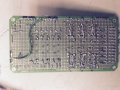
Ok. Back at it. Took off the ground and power jumpers, now each chip goes directly to power source via its own wire. Figured out why #1 did not work...if you look at the second picture you'll notice a single pin by itself in the upper right hand. That's #1 22k resistor that should have been connected to 12v low. Fixed that. Also added .1uf caps.

1,2,3,and 4 work perfect. 5 still does nothing, and 6 acts squirrelly. 6 comes on, and goes off, but sometimes comes back on and sometimes goes off. Switched out the ICs with new ones, still nothing. So now I have to diagnose what part may be bad. I'm leaning toward transistors?

I think I may know how to start troubleshooting, but any pointers would be GREATLY appreciated.
 

Thread Starter

TwoTon

Joined Aug 6, 2015
119
Since you have some working, compare voltages/waveforms at like points in the good and bad ones to spot the likely source of the problem.
Ok. That's what I'm doing, sounds like I'm on the right track. Not that I'll know exactly what is the cause of it in the end though. Lol

Figured out #5. Bad 0v connection to coil and LED. It had the same voltages as the rest so it was throwing me off on why it was completely dead.

So now it's just #6. Here is what I know is happening, but not sure what to look at as the cause. The Q1 transistor has weak voltage at its base. Coil on it has 12.13 where as the rest have 12.94(this all is done with probes making contact).

When it goes off for a second, if I can catch it in time, I'll get a reading of 12.46 at the transistor base. So obviously, I think, it's getting a weak signal. But I'm not sure what to look at before it to know why the weak voltage.
 

Thread Starter

TwoTon

Joined Aug 6, 2015
119
Just found this. When 6 coil is on, the rest of the transistors have 12.95. It has it also at its emitter. When it's off(like it should be) it has 12.45 at the emitter as well as the rest.
 

Thread Starter

TwoTon

Joined Aug 6, 2015
119
Tracing it back I'm finding something interesting. The point where D2,D1,C4,R1, pins 5&6 meet has 13.72 volts when relay is on. The other circuits have 11.96, but their relays are off.
 

Thread Starter

TwoTon

Joined Aug 6, 2015
119
Ok, I'm next to positive the issue is somewhere between output of pin 3 on the IC and input of 4&5. Bad cap, resistor, or diode.
 

Thread Starter

TwoTon

Joined Aug 6, 2015
119
Ok, update time. I trace it down to what I thought was the C4 cap. So I put another one in parallel on the backside. It did nothing to help. I then took it off and did more testing. Found that I had no voltage on R1, whereas the other circuits had 11.96. Flipped the board over and realized I had a bad connection there where they are all tied together(furthest most solder group to the left in picture 2, at the bottom**hope that makes sense, I can edit photo if need be).

Anyways, I made the joint better, turned power on, and all is well.....:)

Well....almost. After testing a bit, I decided to leave them all on(probes in open condition). After a bit the relays start flickering. I started testing and realized my voltage is dropping. Felt my voltage regulator, and it gets quite warm.

So, now I'm stumped. The regulator is a 3A 12v LDO. Fairchild KA378R12CTU. I tested amperage inline at the fuse and get 5mA with all relays off. With them all on I get 312mA. I would not think that a 3A rated regulator would heat up and cause an issue like this with less than half an amp draw. Am I incorrect? Is there something I should look at?

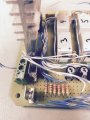
Only thing I can think of is the heat sink, you can see from the first picture what I have. Would a bigger heat sink help the issue? I will try one and see.

Any other thoughts/suggestions here? I am almost there....can smell the sweet fragrance of putting their pessimism in the grave. :)
 

Thread Starter

TwoTon

Joined Aug 6, 2015
119
Yes. It is a 24v supply.
Can you post a schematic (or sketch) of how you have the regulator wired...and what is your source voltage to the regulator?

Ken
I'll take a picture tomorrow of it, and mark it up to show how I have things. But I have 24v coming in on pin 1, 12v going out pin 2 on a wire to the fuse. Then from the fuse it breaks down to the 12v low lines and a wire going to the 12v high lines. The ground goes right above it to the 0v high lines and then a wire going to 0v low lines. At first I had the 0v line as a single piece of wire. I have now beefed it up to a much larger trace, and an even larger wire going to the 0v low side. But I have not beefed up the main feed to the fuse, although I figured since its less than half an amp 22 awg should handle it?

I put a bigger heat sink on it and then powered it up. I had not beefed up the 0v line yet and it was interesting as the LED's just sort of dimly glowed. Turned it off and beefed up the line, power on and it ran fine. I did not leave it on for a real long time, but longer than I had before and the relays did not drop out like before. However, the heat sink is still getting very hot.
 

Thread Starter

TwoTon

Joined Aug 6, 2015
119
Top picture, blue wire on left is the 24v going to it, and the one on the right is 12v going to fuse holder.

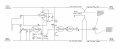
Bottom picture, pin 1 is at the top.
 

Alec_t

Joined Sep 17, 2013
15,119
If the regulator has 24V in, 12V out and is passing 312mA then it is dissipating over 3.7W. Not surprising it gets hot.
 

Thread Starter

TwoTon

Joined Aug 6, 2015
119
If the regulator has 24V in, 12V out and is passing 312mA then it is dissipating over 3.7W. Not surprising it gets hot.
Is there a better solution to it, or is it just something I have to deal with? I suppose I could mount a 12v power supply in the cabinet and use it instead of running 24v out. I guess I never thought about the heat being that big an issue.
 

Thread Starter

TwoTon

Joined Aug 6, 2015
119
Here is my ignorance again, but how do 'wall warts' not melt from heat? Is converting AC to DC and regulating it down not like just regulating DC down?

That's really just more curiosity than not. I couldn't use AC for source even if I wanted because of the mA signal I'm sending back.

In reality, while the idea of having a device that could accept 24v would be nice, having my board without a regulator/heat sink would be just as nice.

I'm sure I have a wall power supply I can use interm. Now on to building the probe stick.

I cannot, in any words, thank you (and this forum site) for the help. I NEVER thought it would go this deep. But I have learned a lot, and am sure more is to come.

I'll keep this updated with my progress. I think that I will probably be designing(or have one designed) a PCB for the complete circuit(there is one other part, the mA signal). It would be nice to have a pretty board without wires :)
 

Thread Starter

TwoTon

Joined Aug 6, 2015
119
Just thought of something. I'm not sure exactly how far I have to run the supply wires yet, but at most probably 50'. Anyways, there would be some voltage drop, but not too much I don't think.

It got me thinking though, would it make sense to put two regulators in the circuit? One for the high side and one for the low? I was looking at the LM2575.

Or is this being silly, and if I have the capability it's wiser/better design if I just use a single supply in the PLC cabinet where power originates anyways?

Just a thought. I know it's my project, but you all seem to be wiser about these things. Would there be pros/cons about the two to be worth debating? I'm leaning heavy to the single supply in the cabinet idea.

I forgot to mention, that if this works as expected, there will be 4 of these put into work that come back to a central PLC/cabinet.
 

Thread Starter

TwoTon

Joined Aug 6, 2015
119
Need help again. I've tried some different things, and even changed a few things(for the better), but one thing has got me stopped still.

First thing this morning I put a 1 amp 12vdc power supply to the regulator. Its putting out between 16v and 17v. With no load, the regulator knocks it down to 12.5v. That fixed my over heating issue for sure.

Then, I thought to myself, why am I using relays? Seems kind of redundant for what I am doing to have a transistor controlling a relay, when the MAX load is around 5mA. So, took the relays out, wired my mA card in. Now, instead of having 312mA total in the circuit(that was even before the mA card was in place which would have added ~10mA) I now have a total circuit load, with the mA card, of 84mA. Excuse me, I should say that the current measurements come inline with the fuse, which is after the regulator. I did not look at current before the regulator, I will do that next time around.

So, it works very nice. However, I put some long leads, 45' to be exact, on the terminals to test how it would react. One lead connected, circuit acts normal. Soon as you connect the other lead, the circuit acts like your making contact. I thought that maybe the leads were too close together, actually I started out using a twisted pair. So I got some heavy insulated 22awg wire and completely separated the leads. Same thing happens. Doesn't matter if they are straight, or coiled up.

Not sure how to test, or what to test for, to be honest. I do know, the only thing that I could think of testing is that there is voltage on the one lead before connecting, then no voltage after the second is connected. So that would indicate that the leads are sucking(for lack of a better term in my vocabulary) the voltage down to nothing.

Thoughts?
 

Thread Starter

TwoTon

Joined Aug 6, 2015
119
Its the same circuit. I quite literally de-soldered the coil from Q2 and just am running the mA signal through there now. Once I'm done with my changes I'll refresh all the pictures and schematics. At this point its turning back into a project board, lol.

The flaky long lead issue was happening before the relay removal.

I just went and tested some more. Its definitely a random thing. I have tried several different things, suspending in the air, coiled up, straight, you name it. Sometimes it works, other times it acts like the ends are touching. I even at one point had both leads coiled up and laying on top of each other, on the ground(all things that even done by themselves would make the circuit) and it was behaving as it should. Touched the ends together, the circuit worked, pulled them apart, worked great. Off and on like that for a bit and could not make it not work.

Put the leads on another input, flaky again..... Its all very random and hard to duplicate. I guess the only thing I have not done is to start to cut back wires to see at what length the problem might go away. I know with short leads there is no issue at all. But I really need to figure this out with long leads.

Could the AC wave being generated be too slow or something? I am not sure where to even start researching something like that.
 

Thread Starter

TwoTon

Joined Aug 6, 2015
119
Not much changed, I don't think? Put the LED in a different spot, and removed the power going to the Emitter from the high current and brought it through the mA circuit.

Things work great, like before, with short leads.
WaterLevelWithDelay3 edit.jpg WaterLevelWithDelay3 edit.jpg
 
Top