Facebook
 Google
 GitHub
 Linkedin

Hi,
I'm analyzing this water detection circuit and have a couple of questions.
As I understand it, the circuit is intended to drive the speaker when the two prongs detect water. A small current through the water should switch on the Darlington transistor (T1). Once T1 is on, there should be no current flowing to IC1's reset pin, allowing the oscillator to run and the output to turn on.
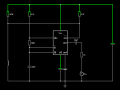
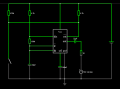
However, in my simulation, it seems to work in the opposite way. The output is on until water is detected.
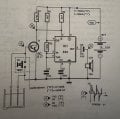
I'm analyzing this water detection circuit and have a couple of questions.
As I understand it, the circuit is intended to drive the speaker when the two prongs detect water. A small current through the water should switch on the Darlington transistor (T1). Once T1 is on, there should be no current flowing to IC1's reset pin, allowing the oscillator to run and the output to turn on.
However, in my simulation, it seems to work in the opposite way. The output is on until water is detected.
- Is there an error in my simulation, or is a NOT gate needed between R2 and IC1's reset pin?
- I'm also confused about the purpose of R4. Is it simply there to limit the current into T1?