Detection and turn on water pump

Thread Starter

christiannielsen

Joined Jun 30, 2019
389
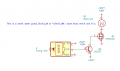
Okay, look at this mess (PDF)
Gotta start somewhere right...

So I'd like the sensor (Flying-fish) to detect an obstacle and make the small toy water pump run.

The flying fish outputs voltage when not detecting. That is why I thought of a PNP transistor to reverse that function.

The reason why I have a MOSFET is that I tried to have the BC557 run the water pump, but it didnt work due to lack of amp i think.

So now I was thinking that you could help me to finish this circuit.

thank you all in advance, hope its not to awful...
 

Attachments

AnalogKid

Joined Aug 1, 2013
12,043
Add a base current limiting resistor between Q2 and U.

The available gate voltage is so low that you should use a logic-level MOSFET.

Separate from that, a clear schematic that conforms to expected norms is not any more effort than one that is difficult to read.

All grounds point down.
Positive voltages to the top, negative ones to the bottom. (Flip over U.)
Inputs to the left, outputs to the right.
Always use dots at wire-to-wire connections.
Never have a 4-way connection. Stagger it to two 3-ways. This has to do with a false dot being caused by printer or copier crud. 3-way connections are unambiguous.

You get a gold star for including some reference designators. Add a number to the U ref des.

Are there two separate battery sources or just one?

ak
 

Thread Starter

christiannielsen

Joined Jun 30, 2019
389
thank you so much for your reply. I appreciate it a lot.

What should I search for if I want to buy a "all-around" 3-pin logic-level mosfet? and does it come as a PNP?

There are 1 battery in this circuit.

Should I do anything to make the motor run smoothly or how do I know if that is necessary and how do i do that?
 

ericgibbs

Joined Jan 29, 2010
21,390
hi C,
What is the output voltage from the FFish module.? is it 0V to +4.5V
The circuit diagram has errors.
E
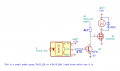
Please don't draw circuits upside down, convention is usually +rails at the top and 0V/Common at the bottom. [I have rotated parts of your image]

chris1.PNG
 

Thread Starter

christiannielsen

Joined Jun 30, 2019
389
hi C,
What is the output voltage from the FFish module.? is it 0V to +4.5V
The circuit diagram has errors.
E
Please don't draw circuits upside down, convention is usually +rails at the top and 0V/Common at the bottom. [I have rotated parts of your image]

View attachment 181193
Yes. The output is according to seller 5v. I think I meassured 4.7 Volt.

okay thanks i didnt know that.

Could you please tell me which error you see? I cant point out the difference between my diagram and yours.
 
Last edited:

ericgibbs

Joined Jan 29, 2010
21,390
hi C,
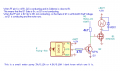
Look at this option, when FF output is Low then Pump is powered, is that what you require?
Note NPN transistor
E

chris1.PNG
 

Thread Starter

christiannielsen

Joined Jun 30, 2019
389
hi,
Look at this image, it has a description, ask if you have aproblem.
E

View attachment 181248
Thank you, thats also what I understood, but I might have misunderstood the difference between NPN and PNP.
I thought the PNP was normally open and NPN normally closed.

Also I dont understand the 4k7 resistors function and why it is there. But I have noticed in some time now in other circuits that I didnt understand its function there either.
 

ericgibbs

Joined Jan 29, 2010
21,390
hi C,
The transistor types NPN and NPN do not refer to normally open or closed.
Basically the NPN is designed to work with positive voltages applied to the Collector and Base in order to control the transistor.
PNP uses negative voltage supplies for Collector and Base for controlling the transistor.

I would recommend that you look through some transistor basic tutorials.

Reference @bertus point for a lower Gate voltage N MOSFET, as I understand your project the motor current is only 180mA, so with a Gate voltage of 4.5v it may just be enough current to drive the motor.

Why did you choose a 55V, 29Amp MOSFET that requires say 12V on the Gate to fully turn it On.?

Look at the IRL520

E
 

Thread Starter

christiannielsen

Joined Jun 30, 2019
389
I have looked at many tutorials and what you say is also what I have understood, but I thought you used them for the function NO/NC.

So I still dont understand the circuit with the 4k7 resistor and how Q2 works. Its not what I have seen in videos.

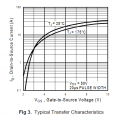
I thought this mosfet would be fine because I read in the datasheet that Gate-to-Source Voltage is +/-20volts datasheet
I thought anything from -20 to +20 volts would to turn it on.
 

AnalogKid

Joined Aug 1, 2013
12,043
I thought the PNP was normally open and NPN normally closed.
Your understanding of things is the result of reading things that have been oversimplified without any explanation of what was left out. In the very narrow sense of one way a bipolar transistor can be used - as a saturated switch - and one control method - digital logic signals - then it is true that a signal that will "turn on" one transistor polarity will "turn off" the other polarity. But this description applies to a very small number of application circuits (compared to all of the other things transistors can be used for).

For example:

IF you have a 5 V circuit with a NPN transistor as a switch pulling a load to GND (emitter tied to GND, collector to the load, load to +5 V)
AND IF you have a PNP transistor acting as a switch pulling a load up to the +5 V (emitter tied to +5 V, collector to the load, load to GND)
AND both transistors have base current limiting resistors connected to the same logic signal

THEN when the signal is high, the NPN will be on and the PNP will be off
AND when the signal is low, the NPN will be off and the PNP will be on

So if the resting state of the logic signal is high, the PNP could be described (correctly, sort of) as normally open (off), and the NPN normally closed (on). But as I hope you can see, this is a very limited description of what is going on. Experienced users talk about transistors being on and off without going into the background context that most other experienced users already know about and know how to apply. Keep reading and keep asking questions, and eventually you'll get a feel for how these things work.

ak
 
Top