Facebook
 Google
 GitHub
 Linkedin
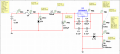
You must be careful putting an inductor in the input circuit of a regulator. Properly done it will do a good job of eating short fast transients. However, there is a risk of producing a high-Q resonance that can generate an over-voltage what would not otherwise exist. The greatest peril is generally when the input voltage is applied abruptly (e.g. switched from a low-impedance source - like a car battery) and the capacitance at the input to the regulator is small and has good high-frequency characteristics. Even the inductance of long input wires can be a killer. The solution is to "spoil the Q" (dampen) the resonance. This is usually readily accomplished by using electrolytic in parallel with the ceramic. The large capacitance along with the ESR of the large cap is usually quite effective in damping the resonance. If an electrolytic is not allowable, an RC in parallel with the main ceramic cap might do if the inductance is not too large. The same sort of problem can arise anywhere LC filters are used in power circuits.
The other thing that must be considered when using a discrete inductor is that the energy stored there-in has to go somewhere if the load on the output of the regulator drops abruptly. Again, a bulk cap can prevent over voltage.
===
The 7800 series originated as the µA7800 series from Fairchild. National introduced their LM340 series after that.
The other thing that must be considered when using a discrete inductor is that the energy stored there-in has to go somewhere if the load on the output of the regulator drops abruptly. Again, a bulk cap can prevent over voltage.
===
The 7800 series originated as the µA7800 series from Fairchild. National introduced their LM340 series after that.
 . If my CAD (Altium) had not died I would be using schematics more and the details would be there.