Facebook
 Google
 GitHub
 Linkedin
Hello, can anyone critique what I am about to say? This is my understanding of what I have been reading in an Introductory EE textbook using conventional flow. I want to see if there are any flaws in my understanding.
Voltage can be thought of as the amount of energy measured in Joules to move 1 Coloumb of charge. So, an 8V battery would use 8 Joules of energy to move 1 Coloumb of charge where 1 Coloumb is 6.25x10^18 electrons.
Watts are the amount of Joules that are used up every second, so Watts is similar to Volts except that Watts adds a "time dimension". So 16mW would be less than 1 Joule of energy per second that is being used.
--------------------------------------------
Now if I am correct about what I said about, I am confused about the following matter:
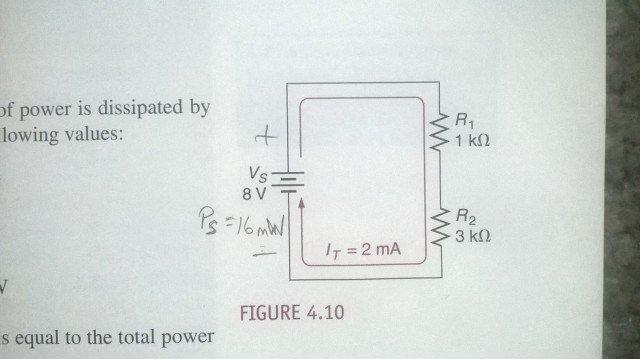
In my book, there is a simple circuit diagram that lists an 8V battery with 2 resistors hooked up. So I thought that the circuit is using 8 Joules to move 1 Coloumb. But then it says the Power at the source is 16mA. This is confusing me because how could the circuit be using 8 Joules of energy when there is only 16mA of energy being used every second?!
Voltage can be thought of as the amount of energy measured in Joules to move 1 Coloumb of charge. So, an 8V battery would use 8 Joules of energy to move 1 Coloumb of charge where 1 Coloumb is 6.25x10^18 electrons.
Watts are the amount of Joules that are used up every second, so Watts is similar to Volts except that Watts adds a "time dimension". So 16mW would be less than 1 Joule of energy per second that is being used.
--------------------------------------------
Now if I am correct about what I said about, I am confused about the following matter:
In my book, there is a simple circuit diagram that lists an 8V battery with 2 resistors hooked up. So I thought that the circuit is using 8 Joules to move 1 Coloumb. But then it says the Power at the source is 16mA. This is confusing me because how could the circuit be using 8 Joules of energy when there is only 16mA of energy being used every second?!