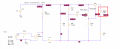
I would like to construct a circuit that measures the differential voltage on the load of the circuit depicted below :
I think about something with an op-amp. Could please anyone help?
You will need to look at an IA. There are lots of caveot to worry about. generally IA's measure very low voltage signa;.
Power supply, commn mode range, frequency response, isolation will get you.
You will need to look at an IA. There are lots of caveot to worry about. generally IA's measure very low voltage signa;.
Power supply, commn mode range, frequency response, isolation will get you.
Why?
You already said you could us an opamp, which is an integrated circuit.
What's the difference between that and an instrumentation amp integrated circuit?
You can design a differential amp using one op amp and four matched resistors, but it will have inferior performance compared to an instrumentation amp.
Why?
You already said you could us an opamp, which is an integrated circuit.
What's the difference between that and an instrumentation amp integrated circuit?
You can design a differential amp using one op amp and four matched resistors, but it will have inferior performance compared to an instrumentation amp.
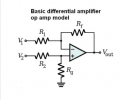
Ok, i understand what you mean and i will consider the solution of and instrumentation amp IC. When you say a differential amp using one op amp and four matched resistors you mean something like this? :
If yes, do you know how should i choose the resistors values?
Also in refer to instrumentational amplifier, i want one which is able to measure 0-4V load voltage , and can operate with 3.3 or 5V supply. Also, its output should not be over 3.3V
Ok, i understand what you mean and i will consider the solution of and instrumentation amp IC. When you say a differential amp using one op amp and four matched resistors you mean something like this? : View attachment 245799
If yes, do you know how should i choose the resistors values?
Also in refer to instrumentational amplifier, i want one which is able to measure 0-4V load voltage , and can operate with 3.3 or 5V supply. Also, its output should not be over 3.3V
If you want a difference amp all four resistors have the same values. If you want a difference amp with amplification, then Rf and Rg must have the same values and R1 and R2 must have the same values. Under these conditions the output is (Rf/R1)*(V2-V1).
The circuit will always be inferior to a true chip designed for that purpose because you must match all four resistors very accurately, at least 0.1% or better tolerance parts. These will be more expensive than just using an instrumentation amp. Not to mention will requires more parts.
Also notice the non inverting input impedance is R2+Rg and the inverting input impedance does not match it at just R1. The InAmp has built in followers with extremely high input impedance along with a single external resistor that sets the gain.
Ok, i understand what you mean and i will consider the solution of and instrumentation amp IC. When you say a differential amp using one op amp and four matched resistors you mean something like this? : View attachment 245799
If yes, do you know how should i choose the resistors values?
Also in refer to instrumentational amplifier, i want one which is able to measure 0-4V load voltage , and can operate with 3.3 or 5V supply. Also, its output should not be over 3.3V
There are plenty of InAmps on the market that can meet those requirements. Here is over 34,000 choices many that meet your requirements. You can refine the parametric search:
You can't get the performance of an IC IA with discrete parts because performace depends on matching/ratios and temperature. Laser trimming really helps in this case.
Peter523 (TS) has not mentioned gain or CMRR requirements so we cannot tell whether the advantages of an integrated instrumentation amp is worth the additional cost, sourcing issues, etc.
If you want a difference amp all four resistors have the same values. If you want a difference amp with amplification, then Rf and Rg must have the same values and R1 and R2 must have the same values. Under these conditions the output is (Rf/R1)*(V2-V1).
The circuit will always be inferior to a true chip designed for that purpose because you must match all four resistors very accurately, at least 0.1% or better tolerance parts. These will be more expensive than just using an instrumentation amp. Not to mention will requires more parts.
Also notice the non inverting input impedance is R2+Rg and the inverting input impedance does not match it at just R1. The InAmp has built in followers with extremely high input impedance along with a single external resistor that sets the gain.
Thank you, with a quick simulation with these values it seems to work. But, of course you are right the circuit is inferion to an IC for this purpose so i may search and select one of this kind.
Peter523 (TS) has not mentioned gain or CMRR requirements so we cannot tell whether the advantages of an integrated instrumentation amp is worth the additional cost, sourcing issues, etc.
Hello again,
finally i will follow the solution with the instrumentation amplifier. But as i know each IC has limits in regard to the range of differential voltage it can measure. For example, can i use the same instr amp IC to measure the differential voltage on different loads (the one with 12V on it, the other with 5V on it etc.)? I found this IC and it refers in page 2(at maximum ratings) :
Could anyone explain please?
Thank you.
It means that input signals can be in the range of 0.5 volts below ground to 0.5 volts above Vcc. This suggests clamping diodes on the input terminals which can dissipate some current but not a great deal as the diodes are probably "small" in terms of die area.
It would be handy to know what limits there are on the supply pins. Fragments of a datasheet can cause one to jump to unsubstantiated conclusions.

 Facebook
 Google
 GitHub
 Linkedin