Voltage Divider on a fuel gauge in a car #2

Thread Starter

contacttodd

Joined Sep 11, 2020
2
I have a similar scenario and just can't seem to overcome the concern I have about the design of the circuit and the introduction of any voltage around or in a container that holds gasoline. I would love to see some discussion around the safety aspect of this. Of course, I know that any fuel gauge uses essentially the same circuit to read the fuel in the tank AND it would be impossible to read the resistance of the potentiometer without it being in a circuit. Just concerned about the concept or if someone inadvertently connects the fuel sensor to a higher voltage source by accident.


Mod: link to old Thread.
https://forum.allaboutcircuits.com/...-on-a-fuel-gauge-in-a-car.128248/post-1049595
 
Last edited by a moderator:

geekoftheweek

Joined Oct 6, 2013
1,429
Interesting thought really.... never considered it myself. Basically anything manufactured for an explosive environment has to be more or less fool proof, sealed, or whatever it takes to not turn in to an ignition source. Even more when it comes to moving equipment. Most older fuel sending units are relatively low resistance to start with so maybe there isn't really any chance of causing trouble other than something like shorting it with 10 gauge wire directly to a battery.

I actually have a divider circuit myself on an old truck (1976 old) that is connected to an ADC pin on a PIC. I haven't connected 12 volts to it direct, but I did loose a ground at one time that essentially turned the sensors into grounds and killed the first board I tried. Nothing actually melted or even smelled burned, but one of the two PICs I had connected failed and the USB charger I tore apart for a power supply was dead. The PIC was connected to the fuel, oil pressure, temperature senders, and a MAP sensor. All the sensors survived.

Maybe others will have some encouraging thoughts also.
 

Thread Starter

contacttodd

Joined Sep 11, 2020
2
Interesting thought really.... never considered it myself. Basically anything manufactured for an explosive environment has to be more or less fool proof, sealed, or whatever it takes to not turn in to an ignition source. Even more when it comes to moving equipment. Most older fuel sending units are relatively low resistance to start with so maybe there isn't really any chance of causing trouble other than something like shorting it with 10 gauge wire directly to a battery.

I actually have a divider circuit myself on an old truck (1976 old) that is connected to an ADC pin on a PIC. I haven't connected 12 volts to it direct, but I did loose a ground at one time that essentially turned the sensors into grounds and killed the first board I tried. Nothing actually melted or even smelled burned, but one of the two PICs I had connected failed and the USB charger I tore apart for a power supply was dead. The PIC was connected to the fuel, oil pressure, temperature senders, and a MAP sensor. All the sensors survived.

Maybe others will have some encouraging thoughts also.
I appreciate the details, thanks for sharing. I have a very similar project to yours and the additional connections you referenced (oil, for example) is encouraging for me to push a little farther into things. I have been playing with the new ESP32 that has WiFI and Bluetooth, it is a bit entertaining to give some of these old machines a bit of an upgrade. Thanks again for the reply and for any others who chime in too.
 

geekoftheweek

Joined Oct 6, 2013
1,429
I don't have the numbers anymore, but aftermarket GM sensors for ECU engines with pigtails can be found online. The higher resistance curve worked better for me versus a standard gauge sender, and they have ground wires to run to your microcontroller instead of engine ground to help with noise.
 

MisterBill2

Joined Jan 23, 2018
27,258
There does exist a whole class of standards for circuits that are "intrinsicly safe," which means that they can not supply enough energy to ignite those vapors. So investigating those standards will provide an understanding about how to have power in an explosive atmosphere safely.
 
I've designed electronics used in hazardous locations with flammable/explosive gas or liquids, and put circuits through safety-approvals. The spark tables in IEC 60079-11 (Intrinsic Safety) are used for the ignition (energy) limits which list voltage/current/capacitance/inductance safe limits for various gases. I design to worst-case hydrogen/acetylene just for extra safety, if I can.

For a car gasoline tank, there are no vehicle IS standards I know of- perhaps SAE. Note the fuel pump is a brushed DC motor immersed in the fuel which also acts as a lubricant. That seems scary but apparently the mixture in a fuel tank is too rich to ignite and blow up due to motor's brushes arcing on an empty tank.

With a fuel gauge the danger is supplying unsafe energy to the tank potentiometer. Applying 12VDC to the tank potentiometer, or large capacitance/inductance or burning the element kind of bad scenario.
Older senders, like Corvette '68-'76 used a 90R sender I think for ~250mA or 3W for the gauge coil. Even older '30-'64 GM cars were 30R senders. So several watts going through the sender to drive the dashboard gauge.

It is fine to connect an A/D converter channel to the tank sensor, if you add a resistor to keep short-circuit current low. 1k5 would limit to 9.3mA at 14V/0.2W so a 1/4W resistor is fine. Assuming the stock gauge is in place.
If you were looking at a 5VDC A/D you still assume things fail and 14VDC appears at that A/D pin. So the 1k5 limits current to below ignition limits for tank vapours- which are harder to ignite, if at all for gasoline compared to say methane etc.
 

MisterBill2

Joined Jan 23, 2018
27,258
I suggested investigating the standards because they contain information on limiting power. Not because of a directly applicable standard. Knowledge and insight can be very useful even when the rules are not, and my pointing was for the knowledge.
 
Unfortunately, you have to pay for safety standards, 60079-11 intrinsic safety is USD$370. It makes learning even more difficult, on top of the standard not explaining much.
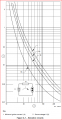
This graph shows that in a resistive circuit at around 12V, you need several amperes to ignite Group IIC gases. Note you have to also include/consider capacitance/inductance for that stored energy, on other spark tables. The next issue might be the thermal test for rise on the tank potentiometer, if it can be made to heat up and burn.

Point is, using a resistor limits the current and gives coverage in an automobile fuel tank.

Airplane fuel tank level sensors are a problem, there was an explosion due to short-circuits in TWA Flight 800. Even today, Boeing argues that nitrogen-filled fuel tanks do not require anything special for their wiring and sensors...FigA1_resistive circuits.PNG
 
Top