Facebook
 Google
 GitHub
 Linkedin

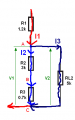
Try to think in terms of current flow in this circuit, and when it begins to split.

Now notice that at node A the I1 current splits into two individual currents I2 and I3. And at node C the currents join again into one current I1 = I2 + I3.
So to find VA voltage we need to find equiv resistances.
Rt = (R2 + R3)||RL2 = 2.126kΩ
And we can find VA voltage using ohms law and Kirchhoff's laws.
Itot = 35V/(R1 + Rt) = 10.5mA and VA = 35V - Itot*R1 = 22.4V
Now notice that Rs = R2 + R3 and RL2 are connect in parallel.
And this means that V1 = V2 = VA = 22.4V
So
I2 = VA/(R2 + R3) = 22.4V/3.7kΩ = 6.05mA
I3 = VA/RL2 = 22.4V/5kΩ = 4.48mA
And finally VB = I2 * R3 = 6mA*0.7kΩ = 4.23V
I hope you see know that I2 current don't splits into other branches.
And this is why we can use this VB = VA * R3/(R2 + R3).
Now notice that at node A the I1 current splits into two individual currents I2 and I3. And at node C the currents join again into one current I1 = I2 + I3.
So to find VA voltage we need to find equiv resistances.
Rt = (R2 + R3)||RL2 = 2.126kΩ
And we can find VA voltage using ohms law and Kirchhoff's laws.
Itot = 35V/(R1 + Rt) = 10.5mA and VA = 35V - Itot*R1 = 22.4V
Now notice that Rs = R2 + R3 and RL2 are connect in parallel.
And this means that V1 = V2 = VA = 22.4V
So
I2 = VA/(R2 + R3) = 22.4V/3.7kΩ = 6.05mA
I3 = VA/RL2 = 22.4V/5kΩ = 4.48mA
And finally VB = I2 * R3 = 6mA*0.7kΩ = 4.23V
I hope you see know that I2 current don't splits into other branches.
And this is why we can use this VB = VA * R3/(R2 + R3).
Attachments
-
 8.6 KB Views: 23
Last edited: