Voltage cut off switch

Thread Starter

Ctenom

Joined Nov 1, 2010
59
Hi I was just browsing the internet when i came across your website and was hoping someone here could help me out with something. I need something that can take up to 4V in and out at around 50mA but would switch off if input voltage drops below 3.6-3.7.

Thank you for your time in reading this.
 

Thread Starter

Ctenom

Joined Nov 1, 2010
59
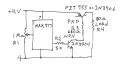
Thank you for your response (a speedy one at that). That diagram looks a little much to modify for my experience level however i shall attempt it any way. I learn best by doing :). I was hoping the answer would be a single component like a transistor or something lol. once again thank you for your speedy response.
 

Kermit2

Joined Feb 5, 2010
4,162
True, that would not be a beginners circuit, but would not be impossible for a beginner either. If you have the determination to try and make it work, many here would try just as hard to help you along. But with that in mind, wait just a few hours more until more people chime in with more ideas. There will undoubtedly be more ways to 'skin this cat' than the quick Google lick I just gave.
 

Thread Starter

Ctenom

Joined Nov 1, 2010
59
Hi i have continued doing some research and was wondering if i could use this at all? Its a ICL7665 made by Maxim. Would you configure the cut off with resistors? Maxim says "Externally Programmable Trip Point" Not sure what that means.

Thank you once again for your continued support
 

retched

Joined Dec 5, 2009
5,207
You can use a simple zener diode.

Use a 3.6v zener diode or combination of, then once the voltage is above the zener voltage, then it is conducting. Below the zener voltage, it stops conducting.
 

Thread Starter

Ctenom

Joined Nov 1, 2010
59
Hi thank you for your response

Am i right in saying they would be used in reverse? and is there a difference between the glass and ceramic ones other than wattage and size. also would it be OK to put them in parallel to increase the wattage if i decided to upscale

Thank you again for all your help
 

sage.radachowsky

Joined May 11, 2010
241
I think that a very simple circuit would do the job, using a low-power op amp as a comparator, a low-power voltage reference, a voltage divider to sense the voltage, and a MOSFET with a suitable to switch on 50 mA with 3V gate charge.

I'd recommend an MCP6041 for the op amp, an ISL60002 for the voltage reference, a voltage divider with a 10 MegaOhm impedance, and a ZXMN2B14 for the MOSFET. It's very simple -- I would draw it if I had time right now.
 

Thread Starter

Ctenom

Joined Nov 1, 2010
59
Thank you for your response

I believe i am going to try the zener diodes route first as i can find loads of references for low battery indicators that can easily be modified. also its the only idea so far i have fully understood plus i can source zener diodes easily. I am then going to do some reading up and see if i can get some understanding of the more complex and powerful designs and build them. Thank you all for your help its been much appreciated and i am still open to ideas.
 

retched

Joined Dec 5, 2009
5,207
Hi thank you for your response

Am i right in saying they would be used in reverse? and is there a difference between the glass and ceramic ones other than wattage and size. also would it be OK to put them in parallel to increase the wattage if i decided to upscale

Thank you again for all your help
Yes, use in reverse.
And Yes is ok to parallel to increase wattage.
Remember to watch for the required current to reach the zener voltage.

For instance, if you have a 5v zener, its only 5v at 49ma. at 4ma it may be 22v
You WILL know this WHEN you read the data sheet for the zener you are thinking of buying.

Many companies websites, like mouser and digikey, show this current in their parametric search. Keep yours at or under your operating current and all will be good.
 

iONic

Joined Nov 16, 2007
1,662
Hi I was just browsing the internet when i came across your website and was hoping someone here could help me out with something. I need something that can take up to 4V in and out at around 50mA but would switch off if input voltage drops below 3.6-3.7.

Thank you for your time in reading this.
What exactly is the intent of the circuit... how do you plan to use it?
It's a curiosity question that might possible leed to a different suggestion is all...
 

Ron H

Joined Apr 14, 2005
7,063
You can use a simple zener diode.

Use a 3.6v zener diode or combination of, then once the voltage is above the zener voltage, then it is conducting. Below the zener voltage, it stops conducting.
I think you've gone off half-cocked. Show us how a zener can take 4V in and pass 4V out at 50mA, and then cut off when the voltage drops to 3.6 - 3.7V.
 

Ron H

Joined Apr 14, 2005
7,063
Yes, use in reverse.
And Yes is ok to parallel to increase wattage.
Remember to watch for the required current to reach the zener voltage.

For instance, if you have a 5v zener, its only 5v at 49ma. at 4ma it may be 22v
You WILL know this WHEN you read the data sheet for the zener you are thinking of buying.

Many companies websites, like mouser and digikey, show this current in their parametric search. Keep yours at or under your operating current and all will be good.
Zener voltage is less at lower current.
 
Top