Voltage conversion 100V to 120V

MisterBill2

Joined Jan 23, 2018
27,572
Rather than guess and be wrong and do damage, being safe in this instance is the better choice. If the ting becomes damage getting a similar replacement will be a pain. That is why I suggested the diode. it provided an adequate safety margin. And a light dimmer can easily be set too high.
 

DickCappels

Joined Aug 21, 2008
10,661
20% difference in the resistance of a heating element that has a positive temperature coefficient of resistance should not amount to much of an increase in current.

The best way to find out is to just measure the current and calculate the powers at the two voltages and compare.
 

Ian0

Joined Aug 7, 2020
13,132
And I think it is unlikely to be damaged or malfunction running on 120, but nobody else seems to agree.
I do!
If it were designed for Japanese voltage which is 100±10V it is designed to function correctly at 110V, so the overload isn't a big as you might think.
 

Ian0

Joined Aug 7, 2020
13,132
20% difference in the resistance of a heating element that has a positive temperature coefficient of resistance should not amount to much of an increase in current.
They tend to be nichrome which has a temperature coefficient of resistance of 0.04%
 

Pyrex

Joined Feb 16, 2022
503
A diode in series is the worst solution as DC voltage is generated in the mains.
A triac ligh dimmer may be used, on the other hand wires may start to hum faintly at mains frequency and that can interfere with the tea-drinking ceremony, I think:).
A 20V 5A transformer is a good solution, too.
Feeding a 120V to a 100V heater is not a good idea, as they are usually made as cheaply as possible.I saw a few kettles broken , although it would seem that the heater is well water-cooled, but it did not help
 

MisterBill2

Joined Jan 23, 2018
27,572
I would be really interested in seeing the description of how a series diode will produce a DC voltage in the mains circuit. An explanation of how the DC voltage will be created will educate all of us!

Consider that EVERY AC/DC tube-type radio and TV used a series diode half wave rectifier for the DC power for the tube circuits. And those radios, especially, were played for many hours, rather than just ti heat water for tea.
 

AnalogKid

Joined Aug 1, 2013
12,143
You mean 20 Volt Diode.....
Nope. You might be thinking of a zener diode as a series voltage dropper, but that will not work well. You would need two diodes, in series back-to-back, and they would dissipate over 80 W.

He is suggesting a half-wave rectifier to cut the RMS *power* <typo> to the load by 50% with relatively little heat dissipation, only about 2.4 W.

ak
 
Last edited:

ElectricSpidey

Joined Dec 2, 2017
3,335
Seems to be some debate on-line as to whether placing a half wave rectified load on a transformer will saturate the core or not.

My transformer physics is weak, so I can't tell who is correct.
 

nsaspook

Joined Aug 27, 2009
16,330
I would be really interested in seeing the description of how a series diode will produce a DC voltage in the mains circuit. An explanation of how the DC voltage will be created will educate all of us!

Consider that EVERY AC/DC tube-type radio and TV used a series diode half wave rectifier for the DC power for the tube circuits. And those radios, especially, were played for many hours, rather than just ti heat water for tea.
It's a good way (with fast semiconductor diodes, old tube rectifiers were slow so they caused less noise) to generate hash and harmonics on the internal home power wiring unless it's filtered. Where the diode is placed can be important. External to the hot pot will result in DC (pulsed) switching on a ON/OFF switch likely designed only for AC. If that's true, the switch likely won't last very long as the DC component is likely to cause more arching when switched off.

Use a proper transformer or dimmer with good power line filtering.
https://forum.allaboutcircuits.com/threads/inrush-current-limiter.199769/post-1897704
 
Last edited:

Ian0

Joined Aug 7, 2020
13,132
Nope. You might be thinking of a zener diode as a series voltage dropper, but that will not work well. You would need two diodes, in series back-to-back, and they would dissipate over 80 W.

He is suggesting a half-wave rectifier to cut the RMS voltage to the load by 50% with relatively little heat dissipation, only about 2.4 W.

ak
A half-wave rectifier cuts the rms voltage to the load by 29%, because it cuts the power to the load by 50%.
 

crutschow

Joined Mar 14, 2008
38,526
I would be really interested in seeing the description of how a series diode will produce a DC voltage in the mains circuit.
It's the same way a rectifier generates an average DC current in a power supply.
This average current is seen by the magnetizing inductance of the transformer
If it generates enough current to cause the transformer to saturate on the peaks its input voltage, this can then generate high peak input current and heating of the transformer.

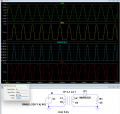
LTspice sim below:
I used a 1:1 transformer for simplicity.
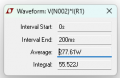
The average power to the load is 277W and the average DC transformer current is 1.67A.

1725381000461.png1725381073704.png
Seems to be some debate on-line as to whether placing a half wave rectified load on a transformer will saturate the core or not.
It depends upon how much DC current the transformer can tolerate before it saturates.
So perhaps the 1.67A I simulated would not be enough added to the normal magnetizing current of the transformer, which I have seen stated as 2-7% of the maximum load current, to be a problem.
 

MisterBill2

Joined Jan 23, 2018
27,572
Considering that the only transformer nearby that is feeding the tea heater is supplying at least four homes with 100 amp mains service, it does not seem likely that adding a 100 watt load, half wave rectified, will notice the difference. That would not be the case if I were suggesting use a cheap 100 watt isolation transformer
 

Pyrex

Joined Feb 16, 2022
503
The power transformer on the pole is not the only device sensitive to DC . Small toroidal transformers are very sensitive to DC, too. Toroidal transformers are often used in audio amplifiers, and they start to hum. The transformer can be silenced if a nonpolar electrolytic capacitor is connected in series with the primary
 

MisterBill2

Joined Jan 23, 2018
27,572
The power transformer on the pole is not the only device sensitive to DC . Small toroidal transformers are very sensitive to DC, too. Toroidal transformers are often used in audio amplifiers, and they start to hum. The transformer can be silenced if a nonpolar electrolytic capacitor is connected in series with the primary
I do not recall any small torroidal transformers as being part of this discussion. Nor audio amplifiers.
 

olaney

Joined Sep 15, 2020
5
Our local pole mounted mains transformer feeds four households having 100 amp 235 volt service. A non-symetrical six amp load is not likely to be noticed, or to cause any issues.
Yes, but the power company hates it because DC causes electrolysis issues where connections are exposed to weather (for instance the local ground rod), which in turn causes reliability issues. They have rules against net DC current for that specific reason.
 

crutschow

Joined Mar 14, 2008
38,526
Still like the idea of using a Triac light dimmer, which can be adjusted to the exact RMS voltage needed.
Removing the control knob, or using tape to prevent the knob from turning should minimize the chance of accidentally changing its setting once the right voltage is obtained.
 

Ian0

Joined Aug 7, 2020
13,132
Another possibility would be a proportional control circuit which switch the output on for five cycles in every six.
 
Top