Vintage Turn Signal Switches vs Auto Canceling...

tcmtech

Joined Nov 4, 2013
2,867
There is always someone. It never fails. I do not want an indicator! Not interested in half fasting it! There are too many different kinds of vintage vehicles to customize everyone's indicators and most people do not desire indicators. We just want the blinker to stop after the turn. It's called self canceling. Can we stick on point here? Indicators can be incorporated as PART of the solution after we figure out the hard part.
Yes. its a real pain in the ass when people with engineering backgrounds or mentalities start helping on a project. They continually see all sorts of flaws in the design stage that will cause problems in the manufacturing stage and beyond. :rolleyes:

It's a real nuisance I tell you that ruins the whole 'lets just throw some unspecified bits together and have a fully functional system already.' process. :oops:

Its also why I normally drop out of these types of classic and or antique whatever's threads early because almost everyone who owns such a item wants it to be both 100% stock original to the tiniest detail yet also custom modified to suit their wants and it always us not them who can't see why meeting those two aspects is not possible.

BTW. I got a buddy who's in that exact same boat and has been for years now so, does anyone have a factory stock 1968 Chrysler Imperial AM only 4 channel radio head unit with factory equipped USB based MP3 player capability? Not an aftermarket one but a 1968 original production unit?o_O

Yea I know but apparently he does not being 100% OEM age matched and recent modern tech should somehow work together for people who feel that 100% vintage stock yet modern customized has to be doable somehow with OEM parts.:confused:

Also I need a OEM original EFI and HEI ignition system for my 1920's hit and miss engine. It has to be serial numbers matching so aftermarket refit won't do :p
 
Last edited:

jkwilborn

Joined Jan 26, 2016
32
If you don't want an information stream, don't post to technical boards with open question about technology.
And you're right, so much for antique.
 

Thread Starter

Deve

Joined Dec 28, 2015
95
The only requirement after floating the idea on many forums related to our vintage auto craft is to keep the current turn signals. They were adamant about it and said even if the lever is in the wrong position, they would rather see that than have yet another modern looking switch somewhere in already cramped space. So after researching EXACTLY what we want, THEN we come here to see if there are any good engineers willing to pass on their knowledge, which last time I checked was what this whole forum is about? Turn signal schematic is forthcoming. Maybe you didn't drop out soon enough? (Gets tiring real quick wasting time when these same people, if you were standing in front of them would spend hours helping with no reservations. The internet is evil that way. How about lets all get on the same channel?)
 

ian field

Joined Oct 27, 2012
6,536
The only requirement after floating the idea on many forums related to our vintage auto craft is to keep the current turn signals. They were adamant about it and said even if the lever is in the wrong position, they would rather see that than have yet another modern looking switch somewhere in already cramped space. So after researching EXACTLY what we want, THEN we come here to see if there are any good engineers willing to pass on their knowledge, which last time I checked was what this whole forum is about? Turn signal schematic is forthcoming. Maybe you didn't drop out soon enough? (Gets tiring real quick wasting time when these same people, if you were standing in front of them would spend hours helping with no reservations. The internet is evil that way. How about lets all get on the same channel?)
If the internet is evil.................just don't use it!
 

jkwilborn

Joined Jan 26, 2016
32
Maybe a simple solution, at least to start is to modify the turn signal to only be a soft contact. In other words make it push up, turns on, push down turns off... You'd just have to figure how/when to turn it off. That would keep the original look, you'd just have to stash the electronics elsewhere. Is this a 6 v vehicle? Just curious.
 

shortbus

Joined Sep 30, 2009
10,049
There is always someone. It never fails. I do not want an indicator! Not interested in half fasting it! There are too many different kinds of vintage vehicles to customize everyone's indicators and most people do not desire indicators. We just want the blinker to stop after the turn. It's called self canceling. Can we stick on point here? Indicators can be incorporated as PART of the solution after we figure out the hard part.
ALL of those type turn signal switches I've EVER been involved with,over the years of building and restoring old cars have had a self cancel built into them. It's that small rubber wheel in the base of the switch. As I've said a couple of times. Haven't seen one that didn't. Your going to have to cancel the switch(bring back to middle position) so a purely electronic solution won't work. But good luck.
 
The "clever turn guy" is aware of the non-momentary request. We did have a little chat. So, it could become a reality.
I did not realize that the "clever turn" will manually cancel if you "briefly" go the other way.

In a 1968 vehicle and a 1965 vehicle are the only ones I had the center of the steering column out. Now we have air bags in that location.

The point I want to make, is that in the 1968 vehicle, that's how the turn signal broke. It became momentary in both directions, so it could be easy to mechanically convert to momentary.
 
Here https://www.elmelectronics.com/ic/elm409/ is a chip that "might" help do the conversion. There are a lot of unknowns and knowns:

1. Unknown - what minimum pulse width is needed to activate.
2. Known - This chip has 5 V power (likely a programmed PIC)\
3. Autotomotive electrical environment harsh. The Linear Technolgy surge stopper technology is very good.

You would probably want 12 V in 12 V out both positive and negative. Have go back to the original specs
 

Thread Starter

Deve

Joined Dec 28, 2015
95
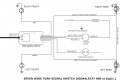
Gary is a very nice guy and has already done the hard work. (The inventor of Clever). I have no problems at all working with him to make this a reality. He is working on it as he has time. I wanted to include you all so if there are improvements that can be made, we can all benefit. Meanwhile, figuring out a simple thing like fooling a system that requires momentary into thinking it is getting what it needs with an old vintage switch is something I was hoping we could help him out with. Here is the schematic for the SignalStat 900. This is the most reliable and common switch available. They still make them because they are used on big rigs. Also there is a chinese knockoff that is the very same as the original, so lots of them out there. If any ideas come up, its a worthwhile project and I hope even the skeptics will agree. Thanks!
TurnSignalSchematic.jpg
 

tcmtech

Joined Nov 4, 2013
2,867
I'm pretty sure both of our old grain trucks have the exact same Signal Stat units you are referring to. Ill have a look tomorrow and see how they work exactly.

I don't see any reason that the little wheel mechanism cant be replaced with a solenoid that's triggered by a hidden or remote switch, of one variety or another, someplace else that makes it cancel when the steering wheel goes to center.

Or you could just put one of those really loud turn signal clickers in like my grandpa used so he could hear when the turn signal was on. Well, he still couldn't hear that but Grandma could and that was enough to get someones attention to tell him it was on. :p
 
So, if a 50 mS output pulse will work on the Clever thing, your in pretty good shape. If 5V and 12 V are available; all the better.

Ideally, it should basically be done in software. But, it could "screw up" his manual cancel circuit. So, could this. There's no way of knowing without his timing info or try, because the ELM parts don't really have adjustment. I don't see why not.

Mechanically converting the SignalStat might be easier. e.g. LED and photo-transistor.

The signal stat may not flash immediately - again, a possible issue. (you have to wait for a flash before returning it to neutral). Access to the naked switch might be required.

But initially, connecting optocouplers to the front turn signal lamps on the Signal stat, gives you something to start with.

His momentary switch input isn't defined. Is it a pull up and switch to ground (likely). Can a transistor pull it down, can an opto pull it down.
Not having one measuring open circuit voltage and short circuit current and then varying a resistor to determine the logic thresholds.

I have a Pet Peeve with anything that doesn;t give the equivelent circuit of what your connecting to or from. Automotive service manuals at least try.

With the signal stat you might not need any debouncing, since it's not coming from a real switch. The "real switch" adds issues.
Possibly even grounded or +12 especially if it's a FORD. The FORD I had switched positive for the doors and nearly any other car, negative.

The CD4528 and or the 4538 are possible alternate parts to use. http://www.ti.com/lit/ds/symlink/cd4528bc.pdf

So, the issues are interfacing to the PB circuit of the clever turn signal. Big help if we knew that. Gary happens to know me as my real name.

The next issue is are we interfacing with any car or the signal stat? Do you have to support negative logic? Naked switches?

In any event, something like OPTO, (debounce-monostable), OPTO is a topology. Probably with a 5V supply.
The dual monstables, the ELM part or even a processor (the clever's) could work. Manual cancel would depend on the logic and might require another input.

I made a couple of comments that Ill repeat, modified, here:

1) Use a recorded click rather than a piezo. That thing is annoying.
2) An accelerometer may be able to do distance auto cancel - Just that programmming is nuts.
3) Use on existing turn signals.
a) There is retro (Signal stat)
b) There is retro - with a modified signal stat - just to get momentary switches. Some clever person might 3D print a holder for an opto etc. as an example.
c) Use existing signal stat and connect to front blinker circuit.
d) support positive and negative logic for existing systems up to a point.
Why do i say up to a point? Because in one car which has working light, the hazzard switch urns out to be the key block.
It actually was responsible for making the turn signals intermittent. Stalk controls are typically low current. You might not be able to add it to a 2016 vehicle no matter how much you tried because the lamps may actually be on the CAN bus.
 

Thread Starter

Deve

Joined Dec 28, 2015
95
The most common, the 900 model has a single light bulb that moves with the handle for an indicator.
 
Last edited:
The 900 looks like an add-on anyway, so I'm with TCM. It's not stock, is it? Here's the manual http://forum.aths.org/Attachment11161.aspx for the 900. The 900 doesn't have a ground and I suspect its the column connection.

The thermal flasher may get in the way too.

The 900 on the surface looks like a complex switch and some lights.

Guessing if the 4-way was replaced by a short (the right two pins) and each lamp replaced by a photo-transistor and resistor, then:
1) If all lights are on, your in hazzard mode.
2. Use the front left and left brake to determine LEFT turn
3. Use front right and front brake to determine RIGHT turn.

Not sure if Garys device takes care of the indicators. The left and right turn indicators may have to come out separate and the hazzard not used or maybe it can be. Blinking left and right turn at the same time might be fine or will the purest balk. I must have left for turning left, right for turning right and red for hazzard.

See, how messy stuff seems to get?

it's not as simple as constant power anymore, when you provide the other details.

I wouldn't like the indicators doing their thing, but the turn signals are cancelled?

Now with a bi-color led, they could say glow green when there is a turn signal and red when it cancelled.
I have no idea how to do that. It's a proposal.
 
Some of the patents referenced in the instructions, provide a hint as to how the switch operates. e.g. this one: https://patents.google.com/patent/US2886743A/en

In the above system, the bulb is moved into 3 positions. So, there is direct access to the bulb as a connection to the flasher.

Integration of side markers, head , tail and stop-lite switch is mentioned, but in my brief research, I didn;t find the exact options.

Reminder: 4-ways don't operate in battery mode in the "clever" signal. You have to route power from a switch with two sources. BATT or IGN.
 
Last edited:
Back again:

When Gary says:
Power must be a constant 12v source. Since all turn signal
lights are powered through this box, the power supplied should
be through a 15 amp fused power source. Hook the red wire to a
12v Fused power source and the black wire to ground
I have no idea how vintage cars are wired or if the ACC position was invented yet.

He really means non-blinking. He confirmed that it should NOT be connected to BAT because of power drain issues. That means 4-ways don't work unless you have a switchable power source. So, you have to accept that.

If the 900 switch acts somewhat like the patent, then the flasher can be removed and those leads re-pourposed.
So, two terminals of the flasher would be shorted and the other is a +12 that will light the single light that's connected to ground. Gary's turn-signal indicator outputs can be wire-ORed with diodes to this lamp.

Again, placing opto-isolators and resistors where each of the primary lamps go on the 900. RF, LF, RR, LR go on the 900 and leave the stop switch disconnected, you should end up with:
RF rising edge PLUS RR,LR = LOW = right turn
LF rising edge = left turn PLUS LR,RR = LOW = right turn
Those signals conditioned with a rising edge detector, debouncing and a monostable suitably interfaceable with the "pulse input" of the clever you should be good to go.

The logical AND of (RF, LF, RR, LR ) tell you that you are in hazard mode and that can activate the Hazard switch on Gary's module with a little glue logic.

So, that look s like a 900 series to Gary's self-canceling system interface,

The lights on the stalk will operate properly as before. The lost function is Hazard without the key being on.

Other options which are somewhat beyound me is to always power Gary's system from IGN, but to use a second processor in deep sleep that would monitor (RF, LF, RR and LR) and power up Gary's processor from BATT if all of those signals were present and would power it on IGN if they were not. Simple logic might work too, so that the Flasher mode works as expected with the ignition off.
 
Last edited:

Thread Starter

Deve

Joined Dec 28, 2015
95
The common theme in all of these add-on modules, be it the Clever system or any of the other timer oriented systems, is they all require momentary switches. I do not know any antique car owners that would use one of those modern switches because the first obstacle would be where to put it. Modern cars even have signal levers. So, the HOPE I have for this thread is that we can give the vintage car enthusiast a path to make it possible to purchase ANY of these add-on self canceling modules by creating a circuit that does one thing VERY well....

All it does is make the existing turn signal switches, stock after 1954 or add-on before 1954 have an emulation mode that emulates a momentary switch. That is all we need so Gary and his competition doesn't have to manage two types of self canceling modules. I have no skin in the game, but as a technical writer for this hobby, I get input from all over the world and this has been brought up many times before.

Gary is willing to reprogram his setup to work with our vintage signals but wouldn't the smarter thing be creating a circuit that fools those systems into thinking the existing turn signal is momentary? I am no expert so I am genuinely asking.

The SignalStat 900 gets its ground from the steering column. That was a recent problem for me because I couldn't figure out why the pilot light wasn't working and sure enough, too much paint on the column.
 
Top