Very basic resistors, but cannot figure them out

Thread Starter

dapEK

Joined Oct 7, 2015
15
That's actually extremely clever, however when I went back and tried to use my former logic to find something like Rab, it wasn't as clear now. Could I just do two loops to solve for Rac and Rbd using Kirtchoffs laws? I'll try that and report back.

Update: I don't think kirchoff's laws will work, there's no voltage or current.
 
Last edited:

The Electrician

Joined Oct 9, 2007
2,986
Here's the list of formulas, the format was suggested by the TA:
1/Rab= (1/AB ) + (1/ (BC+CD+AD) )
1/Rbc= (1/BC) + (1/ (CD+AD+AB) )
1/Rcd= (1/CD ) + (1/(AD+AB+BC))
1/Rad= (1/AD ) + (1/(AB+BC+CD))
1/Rac=(1/AC) +(1/(AD+CD)) +(1/(BC+AB))
1/Rbd= (1/BD) +(1/(BC+CD)) + (1/(AD+AB))

I've added parenthesis in case you were confused.

I just am having a hard time understanding the theory behind it. Can anyone explain that.
Have you done a sanity check by plugging in numerical values for AB, BC, etc., and calculating Rab, Rbc, etc., then attach those values to the internal resistors and see if you get the right result for the external values of AB, BC, etc.?
 

RBR1317

Joined Nov 13, 2010
715
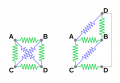
It would seem that the resistance measured at the four terminals could be given by resistors of two values arranged in a square with diagonals as shown. Across any two terminals will be one resistor in parallel with a bridge. When measuring diagonal terminals the bridge will be balanced, which makes it easy to calculate. However, when measuring adjacent terminals the bridge will be unbalanced (as shown unfolded in the right diagram). In order to calculate the equivalent resistance of an unbalanced bridge, the usual method is to perform a delta-wye transform before combining the resistors with series-parallel techniques.
Bridged-X.png
 

The Electrician

Joined Oct 9, 2007
2,986
It would seem that the resistance measured at the four terminals could be given by resistors of two values arranged in a square with diagonals as shown. Across any two terminals will be one resistor in parallel with a bridge. When measuring diagonal terminals the bridge will be balanced, which makes it easy to calculate. However, when measuring adjacent terminals the bridge will be unbalanced (as shown unfolded in the right diagram). In order to calculate the equivalent resistance of an unbalanced bridge, the usual method is to perform a delta-wye transform before combining the resistors with series-parallel techniques.
View attachment 92659
Consider that the topology can be arranged as a tetrahedron; there's more symmetry than you think.
 

RBR1317

Joined Nov 13, 2010
715
What difference does the physical topology make? If you take the physical square with diagonals and raise one corner out of the sheet of paper, you get a 3-D tetrahedron but the electrical symmetry has not changed. Between any two points there is a resistor in parallel with a bridge.
 

WBahn

Joined Mar 31, 2012
32,854
That's actually extremely clever, however when I went back and tried to use my former logic to find something like Rab, it wasn't as clear now. Could I just do two loops to solve for Rac and Rbd using Kirtchoffs laws? I'll try that and report back.

Update: I don't think kirchoff's laws will work, there's no voltage or current.
What you do is apply a test voltage across two terminals and then determine the test current that would flow as a result. The effective resistance is then simply Vtest/Itest.
 

WBahn

Joined Mar 31, 2012
32,854
It would seem that the resistance measured at the four terminals could be given by resistors of two values arranged in a square with diagonals as shown. Across any two terminals will be one resistor in parallel with a bridge. When measuring diagonal terminals the bridge will be balanced, which makes it easy to calculate. However, when measuring adjacent terminals the bridge will be unbalanced (as shown unfolded in the right diagram). In order to calculate the equivalent resistance of an unbalanced bridge, the usual method is to perform a delta-wye transform before combining the resistors with series-parallel techniques.
View attachment 92659
I'm not following the claim that when measuring the diagonal terminals that the bridge will be balanced. Are you making this claim specifically for the case of the measured values of resistance given?
 

The Electrician

Joined Oct 9, 2007
2,986
What difference does the physical topology make? If you take the physical square with diagonals and raise one corner out of the sheet of paper, you get a 3-D tetrahedron but the electrical symmetry has not changed. Between any two points there is a resistor in parallel with a bridge.
Think of it as a tetrahedron and you will see that there is no distinction such as "adjacent" and "diagonal" terminals.

You said "When measuring diagonal terminals the bridge will be balanced, which makes it easy to calculate. However, when measuring adjacent terminals the bridge will be unbalanced". The bridge is not balanced or unbalanced depending on whether one makes the measurement across "diagonal" or "adjacent" terminals, regardless of resistor values, which is what you seem to have implied.
 

WBahn

Joined Mar 31, 2012
32,854
Think of it as a tetrahedron and you will see that there is no distinction such as "adjacent" and "diagonal" terminals.

You said "When measuring diagonal terminals the bridge will be balanced, which makes it easy to calculate. However, when measuring adjacent terminals the bridge will be unbalanced". The bridge is not balanced or unbalanced depending on whether one makes the measurement across "diagonal" or "adjacent" terminals, regardless of resistor values, which is what you seem to have implied.
In the general case I absolutely agree. But for special cases it might be true. For instance, if all of the resistors are the same value, it will be true for the bridge created by choosing any pair of terminals. Given the partial symmetry of the measurements given in the first post, it may well be true for this circuit when a particular pair of terminals are considered to be "diagonal".
 

RBR1317

Joined Nov 13, 2010
715
Are you making this claim specifically for the case of the measured values of resistance given?
Yes, because the balanced case can be handled via shortcut method. But the delta-wye transform approach will give the correct Req for the bridge whether it is balanced or unbalanced. I believe there are only two values of resistor involved, and 499 is the same as 500.
 

The Electrician

Joined Oct 9, 2007
2,986
In the general case I absolutely agree. But for special cases it might be true. For instance, if all of the resistors are the same value, it will be true for the bridge created by choosing any pair of terminals. Given the partial symmetry of the measurements given in the first post, it may well be true for this circuit when a particular pair of terminals are considered to be "diagonal".
What I (and to an extent, you) was chiding RBR1317 about was that he didn't mention resistor values; without doing that, he was suggesting that balance or unbalance depended on which pair of terminals was used for the measurement, without regard to resistor values.

He says in post #30 that he thinks there are only two resistor values, and looking back to his image in post #23, perhaps he intended the blue resistors and green resistors to represent the two distinct resistor values. If that is what he intended, it would clarify his discussion if he would tell us that.
 

The Electrician

Joined Oct 9, 2007
2,986
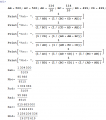
In post #7, the OP gives his formulas so far. Evaluating them, I get;

BlackBoxRes1.png

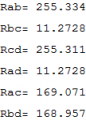
Here are the values as decimals:

BlackBoxRes2.png

There are 5 different resistor values. Rbc and Rad are identical; the others are all different.

But when I substitute these values back in the circuit I don't get the right resistances between the terminals.
 

RBR1317

Joined Nov 13, 2010
715
If that is what he intended, it would clarify his discussion if he would tell us that.
Sometimes one does not realize what should be universally obvious, or not. But given the resistance measurements taken (with a voltmeter), there seemed no other conclusion possible than two resistor values arranged in a square with diagonals.
 

WBahn

Joined Mar 31, 2012
32,854
In post #7, the OP gives his formulas so far. Evaluating them, I get;

View attachment 92678

Here are the values as decimals:

View attachment 92681

There are 5 different resistor values. Rbc and Rad are identical; the others are all different.

But when I substitute these values back in the circuit I don't get the right resistances between the terminals.
In fairness, we know that the TS's equations are wrong because of the lack of symmetry, so it is not surprising that they yield values that don't work and, as such, they shed no light on whether the actual values are grouped into two resistor values.

Second, assuming for the moment that the equations were correct, it is unfair to say that there are five different resistor values. 255.334 Ω and 255.311 Ω differ by 0.023 Ω, which is less than 100 ppm. Similarly 168.957 Ω and 169.071 Ω differ by just 0.114 Ω which is less than 0.07%. Since these measurements were made with physical resistors using a real VOM, those two pairs of resistors are the same to within any reasonable tolerance.
 

The Electrician

Joined Oct 9, 2007
2,986
Sometimes one does not realize what should be universally obvious, or not. But given the resistance measurements taken (with a voltmeter), there seemed no other conclusion possible than two resistor values arranged in a square with diagonals.
If this were true, then the values of AB, BC, DC and AD (as given in post #1) would all be the same. Those are the 4 possible measurements taken between "adjacent" terminals. But the values given in post #1 doesn't have them as identical.

However, in post #30 you said "...499 is the same as 500." This is another thing you said whose significance wasn't very clear. Apparently you think that the measurements of 499 ohms and 500 ohms are imprecise, and that the 500 ohm measurement and the 499 ohm measurement are really the same value.

If they are the same, then there are 4 external measurements of one value, and two of another. If this is true, then I agree that there are only two resistor values in the box. But if the 499 ohm measurement is really different than the 500 ohm measurement, which is what I took to be true, and apparently most of the others posting to this thread did, then there are more than two distinct resistor values in the box.

However, given the OP's values for AB, AC, AD, BC, BD and DC it would be necessary to relabel the corners (A,B,C,D) differently than the OP did in http://imgur.com/rUSjRZn, and as you did in post #23 in order for the 4 "adjacent" resistors to be one value, and for the 2 "diagonal" resistors to be the other value.
 

The Electrician

Joined Oct 9, 2007
2,986
In fairness, we know that the TS's equations are wrong because of the lack of symmetry.
If we accept that there are only two resistor values in the box, whether they arrange themselves so that 4 like values are on the "adjacent" terminals, and 2 like values are on the "diagonals" depends on how we label the terminals. If the resistors were arranged that way, then given the OP's labeling as shown at http://imgur.com/rUSjRZn, the measured values for AB, BC, DC and AD should all be the same, but they aren't, so his labeling doesn't give the desired "4 like resistors on the "adjacent" terminals and 2 like values on the "diagonals". We do get 4 resistors of one value and 2 of another value but without the 4 like values being in the "adjacent" positions and the other 2 in the "diagonals".

I solved the general case where all 6 resistors are different, and it would be all but impossible without the aid of mathematical software, but it's true that the formulas are symmetrical in this case.

However, for the problem to be tractable for the level of class the OP is attending, assumptions have to be made. If the assumption is made that there are only two resistor values in the box, then all 6 formulas are not symmetrical--there is symmetry among 4 of them and also between the other two.
 

RBR1317

Joined Nov 13, 2010
715
Even without doing any derivations, one can tell that the diagonal resistors are low valued and the side resistors are high valued - with approximately two orders of magnitude between the values. Assuming that the side resistors are infinite, then the diagonal resistors are each 11.4 ohms. Assuming that the diagonal resistors are zero, then the side resistors are each 2000 ohms. I think a more accurate guess for the side resistors would be 2000 minus twice the diagonal resistance yielding 1977 ohms.
 

The Electrician

Joined Oct 9, 2007
2,986
Second, assuming for the moment that the equations were correct, it is unfair to say that there are five different resistor values. 255.334 Ω and 255.311 Ω differ by 0.023 Ω, which is less than 100 ppm. Similarly 168.957 Ω and 169.071 Ω differ by just 0.114 Ω which is less than 0.07%. Since these measurements were made with physical resistors using a real VOM, those two pairs of resistors are the same to within any reasonable tolerance.
This is quite relevant, but my point in giving all these numbers to 6 decimal places was to be able to reconstruct the various terminal measurements and compare to what we started with. I had thought that the OP's formulas might be close, but they're not. I did my calculations with 16 digit arithmetic and I would have expected agreement to 6 digits for sure.

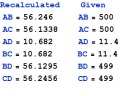
I started with the values given in post #1 and using the OP's formulas, derived values for Rab, Rac, etc. Then assigning those values to six internal resistors, I calculated the values for AB, AC, etc., and compared to what I started with. The calculated values for AB, AC, etc. are not even close to the starting values for AB, AC, etc. Here's the comparison:

BlackBoxRes3.png
 

WBahn

Joined Mar 31, 2012
32,854
If we accept that there are only two resistor values in the box, whether they arrange themselves so that 4 like values are on the "adjacent" terminals, and 2 like values are on the "diagonals" depends on how we label the terminals. If the resistors were arranged that way, then given the OP's labeling as shown at http://imgur.com/rUSjRZn, the measured values for AB, BC, DC and AD should all be the same, but they aren't, so his labeling doesn't give the desired "4 like resistors on the "adjacent" terminals and 2 like values on the "diagonals". We do get 4 resistors of one value and 2 of another value but without the 4 like values being in the "adjacent" positions and the other 2 in the "diagonals".

I solved the general case where all 6 resistors are different, and it would be all but impossible without the aid of mathematical software, but it's true that the formulas are symmetrical in this case.

However, for the problem to be tractable for the level of class the OP is attending, assumptions have to be made. If the assumption is made that there are only two resistor values in the box, then all 6 formulas are not symmetrical--there is symmetry among 4 of them and also between the other two.
How do the formulas become asymmetrical just because we assume that each of the six resistors is one of two possible values? If they are symmetrical for six different values, how can choosing the same values for some of the resistors break the symmetry that is inherent in the configuration?
 

WBahn

Joined Mar 31, 2012
32,854
We were given a "black box" with four terminals sticking out of the top, and told to take the voltmeter and do a set of readings for each combination of terminals. 6 combinations total, and they are listed below:

Segment Resistance(Ω)
AB 500
AC 500
AD 11.4
BC 11.4
BC 499
DC 499
Going back to the original data, we see that there is an apparent typo here. There are two BC measurements. I'm going to assume that the second one is supposed to be BD.

If we look at the two low valued measurements, we see that they are between disjoint pairs of terminals -- one measurement between A and D and the other between B and C.

Whether we call these the diagonal measurements or not is irrelevant. We can just as easily consider them the measurements between horizontal pairs of terminals or vertical pairs of terminals -- it's all the same.

The difference between 500 Ω and 499 Ω is probably due to a slight mismatch between nominally same-valued resistors. Probably. It is a 0.2% mismatch, which not only challenges the matching even of precision resistors, but of the VOM making the measurements. So let's assume, at least for now, that we have two measurement results -- 500 Ω and 11.4 Ω.

If we then assume (notice the number of assumptions being made here -- and there is nothing that I see that makes them anything other than assumptions) that we have two equal low valued resistors between disjoint terminals and four equal higher valued resistors between the others, the circuit across the low-valued resistors presents us with a balanced bridge allowing us to express the high-valued resistor in terms of the low-valued measurement and the low valued resistor.

We can then do the analysis for the unbalanced case however suits our fancy (and, fortunately, we only have to do it once) to get another expression between the two resistor values.
 
Top