Facebook
 Google
 GitHub
 Linkedin
Hi!
I'm experimenting with diodes for some time. I know 2 models. First one is used very often, it is 0.7 voltage drop and second one is Shockley model, \(I=I_s(e^{\frac{Vd}{nV_t}}-1)\). Here is my experience with these models:
1. Model - 0.7 voltage drop model
Various diode models have various voltage drops across them, which depend on few parameters. I used this simple circuit for my experiment:
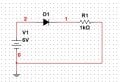
And here are voltage drops for few diodes:
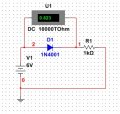
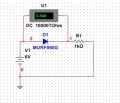
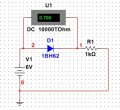
It is obvious that this model is not 100% accurate.
2. Model - Shockley diode model
This is much more accurate diode model. It models current through diode with equation \(I=I_s(e^{\frac{Vd}{nV_t}}-1)\) , where:
Vd - voltage across diode,
Is - inverse saturation current,
n - Emission Coefficient,
Vt - thermal voltage.
I used this equation for my calculations and results I got match almost 100% (not exactly 100%) with results I got in Multisim. It doesn't match 100% probably because Multisim use much more parameters to model diode. But this is deffinitely better model than first one.
Third and most accurate model would be (I think) one that simulation software use. How does actually this model look like? Multisim involves 29 parameters in this model:
Saturation current, Parasitic resistance, Emission Coefficient, Transit Time, Zero-bias junction capacitance, Junction potential, Junction grading coefficient, Activation energy, Saturation-current temperature exponent, Flicker noise coefficient, Flicker noise exponent, Forward-bias depletion capacitance coefficient, Reverse breakdown knee voltage, Reverse breakdown knee current, Low-level reverse breakdown knee current, High-injection knee current, Recombination current parameter, Reverse breakdown ideality factor, Low-level reverse breakdown ideality factor, Emission coefficient for ISR, BV linear temperature coefficient, BV quadratic temperature coefficient, IKF linear temperature coefficient, RS linear temperature coefficient, RS quadratic temperature coefficient, Parameter measurement temperature, Parameter measurement temperature, Model operating temperature, Change relative to global temperature
I'm experimenting with diodes for some time. I know 2 models. First one is used very often, it is 0.7 voltage drop and second one is Shockley model, \(I=I_s(e^{\frac{Vd}{nV_t}}-1)\). Here is my experience with these models:
1. Model - 0.7 voltage drop model
Various diode models have various voltage drops across them, which depend on few parameters. I used this simple circuit for my experiment:
And here are voltage drops for few diodes:
It is obvious that this model is not 100% accurate.
2. Model - Shockley diode model
This is much more accurate diode model. It models current through diode with equation \(I=I_s(e^{\frac{Vd}{nV_t}}-1)\) , where:
Vd - voltage across diode,
Is - inverse saturation current,
n - Emission Coefficient,
Vt - thermal voltage.
I used this equation for my calculations and results I got match almost 100% (not exactly 100%) with results I got in Multisim. It doesn't match 100% probably because Multisim use much more parameters to model diode. But this is deffinitely better model than first one.
Third and most accurate model would be (I think) one that simulation software use. How does actually this model look like? Multisim involves 29 parameters in this model:
Saturation current, Parasitic resistance, Emission Coefficient, Transit Time, Zero-bias junction capacitance, Junction potential, Junction grading coefficient, Activation energy, Saturation-current temperature exponent, Flicker noise coefficient, Flicker noise exponent, Forward-bias depletion capacitance coefficient, Reverse breakdown knee voltage, Reverse breakdown knee current, Low-level reverse breakdown knee current, High-injection knee current, Recombination current parameter, Reverse breakdown ideality factor, Low-level reverse breakdown ideality factor, Emission coefficient for ISR, BV linear temperature coefficient, BV quadratic temperature coefficient, IKF linear temperature coefficient, RS linear temperature coefficient, RS quadratic temperature coefficient, Parameter measurement temperature, Parameter measurement temperature, Model operating temperature, Change relative to global temperature
Last edited: