Variable Wattage Box

Thread Starter

q12x

Joined Sep 25, 2015
2,227
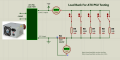
I replicate Ron basic circuit from your cct_link. Ron used 2R in series, I used directly 4R.
I also had to slightly calibrate (the tolerance) of some resistors (3.985R) to get a consistent (.00 and not .99) mV reading over the Shunt [mV].
Where you see my mV, over the shunt, Ron used an amplifier and after an ADC and after the software reading on PC (in this order).
Ron is mentioning the Amps through the circuit in his description, so I inserted that Ampmeter too, for completeness.
1726791077191.png
This circuit is good to compare it with mine. This circuit is classic ! Mine is a proto-type.
 
Last edited:

Reloadron

Joined Jan 15, 2015
7,889
I believe the circuit presented in your_link , it's input is the 12V and 3.3V FROM the ATX PSU that the author is actually testing.
Yes, that unit was merely the proto-type I measured the 12 volt and 3.3 volt rails. The end unit had more whistles and bells including the 5.0 volt rail and 5.0 volt SB output.

It won't matter if your load is purely resistive or inductive but for inductive loads think about using a flyback diode or a snubber RC network to snub any inductive kick. My best guess is I designed what I linked to maybe 25 years ago. Hell been retired 11 plus years now. :)

The reason for using 2R verse a single resistor was to dissipate power. I also used trimmer high power pots in my final draft so the actual current could be trimmed. As I mentioned this was strictly a load bank for testing ATX PSUs.

Ron
 
Last edited:

Thread Starter

q12x

Joined Sep 25, 2015
2,227
to @Reloadron
I just compared your cct with mine. They are similar but not really the same...hmmm
In my case the power passes through that tr, because Im controlling the current with the opamp, but other than that, current pases through component in test, and 1RLoad (not shunt). Hmmm.
Here is how it looks side by side:
1726792600104.png
And here is a simplification and adaptation, -your cct idea- to mine :
1726792113287.pngAnd yes thats 365 Amps! Haha. I think that 1R or 0.001R is there only as a reading element.
Is important to be low enough to let some current/power through the component in test. To controllable stress it.
The problem with my cct, is that I have to control the current, to step it up/dw, bit by bit, read the Wattage, the temp and conclude the optimum or maximum at the end.
Very interesting circuit ! Again, very classic ! I like it.
 

Thread Starter

q12x

Joined Sep 25, 2015
2,227
Hey, I had a bright idea, check it out:
That diode near +5V is the X component under test. (it can be anything)
Im collecting the Voltage over it with that mV, and down over the Shunt Im collecting the I through the entire circuit.
The Wattage of the component in test will be from these 2 readings !
The resistors values remained from last cct, but they can be easily changed into smaller toggle current suppliers. Its what I will tweak next.
Only Now!!!! is starting to look Very interesting ! right?
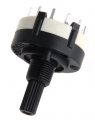
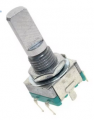
This can be scaled very easily ! I can even include my 1P12T Rotary Switch 1726794546960.png. Mmmmm ! Or even my Gray Code Rotary Encoder. 1726794441428.png
1726793300834.png
- To transform into Wattage reading, I'll have to walk over Ron steps, like he did it, using 2 opamp voltage amplifiers (probably), then 2 ADC's (1 for V and 1 for I), and then use an arduino to display the wattage. Yah ! Actually I will have 3 displays, for V over component, I in cct, and Wattage consumed. Right?
Feel free to intervene, add or take to this logic so far.
------
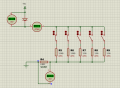
After some time... This is more calibrated cct. Notice the "reference component" is now a wire. Is important because I can calibrate the resistive side and check how on .00 are the readings.
1726796740991.png
I also formulated the rotary switch 1P12T circuit, which is a bit more complicated resistor wise.
1726796822367.png
 
Last edited:

Reloadron

Joined Jan 15, 2015
7,889
The problem with my cct, is that I have to control the current, to step it up/dw, bit by bit, read the Wattage, the temp and conclude the optimum or maximum at the end.
This is not difficult. Your current source circuits are the standard basic design which is fine as long as you follow what has already been covered. To ramp up the current a simple sawtooth generator will work. Let me look through some of my old drawings and see what I may have.

OK this is where I hope the damn images fit.

This is a circuit I used, basic current source.
Current Voltage plot.png

Current Amp.png

The green trace is just a linear ramp up and ramp down triangle wave. The blue trace is Iout through the 5.0 Ohm load. Now these are continuous but if you wanted step changes we can do that. Eventually this can benefit from a uC like an Arduino or similar.
Just took evening meds so I am gone till morning :)

Ron
 

Thread Starter

q12x

Joined Sep 25, 2015
2,227
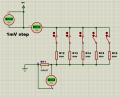
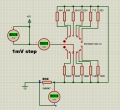
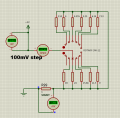
I finished the 10mV and 100mV steps.
Look at those Res values - hahaha. Oh boy.
1726799038671.png
But I might have a very interesting idea on how to tweak to precision a film resistor. All these days, I was thinking on this problem.
They are basically a ceramic cylinder with a resistive paint over them that cured and hardened.
To tweak them to precision, I think a simple longitudinally scratching on it's body will do the trick. Multiple scratching will lower more its value. I didnt try it in reality, I only thought on it. When I will try it, I will announce it.
- If this will not play out, then close enough will be good enough.
 

WBahn

Joined Mar 31, 2012
32,823
I finished the 10mV and 100mV steps.
Look at those Res values - hahaha. Oh boy.
View attachment 332075
But I might have a very interesting idea on how to tweak to precision a film resistor. All these days, I was thinking on this problem.
They are basically a ceramic cylinder with a resistive paint over them that cured and hardened.
To tweak them to precision, I think a simple longitudinally scratching on it's body will do the trick. Multiple scratching will lower more its value. I didnt try it in reality, I only thought on it. When I will try it, I will announce it.
- If this will not play out, then close enough will be good enough.
You are once again chasing a fool's errand.

What is the point of using resistors that need to be accurate to four significant figures?

Say you put your switch to 4.555 Ω. With your shorted wire, that will give you a current of 900.1 mA (which I presume you wanted 900 mA).

So what?

Put any device in your system and guess what? You no longer have 900 mA.

Put a diode that drops 700 mV in the vicinity of 1 A and now your current in that same switch position will only be about 774 mA. Put a different diode that drops 750 mV at that same point and your current will drop to about 765 mA.

So what is the point of going to a lot of effort to make a test system that has very precise currents at given switch positions when they are only correct when you aren't actually testing anything?

As for scratching film resistors to adjust their values, that's another fool's errand. Even if you happen to scratch just enough to get the value you want, you have damaged the resistor and introduced stress points and contaminants into it that are likely to result in the value of that resistor changing over time as a consequence, even if you then seal over the scratches with something.

Thin film resistors have a thickness that is about 0.1 µm. In a cylindrical package, they are usually spiral cut. If your scratch goes across one of those spirals, you now have an open resistor.

But, again, let's assume that you manage to pull it off. You now have a resistor that is exactly 4.555 Ω at room temperature. You now run 900 mA through it, forcing it to dissipate about 4.1 W. It is going to get hot -- like burn your fingers. And good luck even finding a thin film resistor rated to handle that kind of power. Digikey has a grand total of eight 4.7 Ω film resistors (none of them thin film).

Since you have gone to the effort of making 4.555 Ω and not 4.556 Ω, presumably that's because 4.556 Ω isn't acceptable to you. So how much does the temperature need to go up by in order for the resistance to change by 0.001 Ω? That a change of 220 ppm. The smallest tempco of any of those eight resistors mentioned previously is 100 ppm/°C (most are 300 ppm/°C) -- and they are $2 to $3 a piece in quantities of 150. That means that the resistor only has to change by 2.2 °C to now be unacceptable to you.
 

Thread Starter

q12x

Joined Sep 25, 2015
2,227
Put a diode that drops 700 mV in the vicinity of 1 A and now your current in that same switch position will only be about 774 mA. Put a different diode that drops 750 mV at that same point and your current will drop to about 765 mA.
So what is the point of going to a lot of effort to make a test system that has very precise currents at given switch positions when they are only correct when you aren't actually testing anything?
- You dont get it at all. It is very easy to criticize and blame and point the finger. I can do it too on someone work, even on your work if you have any. Oooh I can be a real bitch. Because is that easy. Everyone can be a critic. This is very true especially in art. It's actually a saying that is teach from younger age.
I actually agree with what you just pointed out. And I know it, I can see it, like you do. Good eyes btw. Haha.
- The real question is how to repair it? How to make it better? Do you have any plan or circuit or idea how to make it work? No? Then comment there that everything is wrong. What Im doing here, and a few more like minded friends, is to build it up. From literally scratch. Ive worked like an idiot so far. And if is like you say, a "fool errand", then so be it. At least I tried my best about it. Because is important to me. Im not sure if you can feel what I am telling you here. I want it. And if I want it, I will get it, later or sooner. Depends on many variables, including friends. Verstanden?
-
Well, it gets even worse than @WBahn critique. Hahaha. When I link together the 1 with 10 with 100mV steps, and make a single "total output", the 'shit' goes real crazy. At least this is what the sim is showing. Im not sure in reality. By itself, each module performs excellent, but linked to each other, bam, very nasty values I get in the output reading. Theoretically, I should calibrate all the cct, all together from the start. But remember that everything changes and when Im correcting something here, at the next change it will go to hell. Also like I said, the modules themselves are perfect, when 2 are zeroed and only 1 is switched, is showing excelent values. But when Im adding another one or all 3 toghether, allah aljazir is there. Hahaha...oh boy. Yah... I also find a possible solution to this "total output" problem, by adding additional fine adjustment for error correction, like 3pot's aditional to those 1P12T's. Is an idea.
In other words, even if Im making everything perfect, it will still be a problem IF linked together. The obvious solution is to NOT link them together, which I will probably do. This means to change the component between these 3 modules if I want another scale reading. Hmmm... we'll see.
 
Last edited:

WBahn

Joined Mar 31, 2012
32,823
I have asked you several times to define what you need and you won't, almost certainly because you don't have a clue what you actually need and refuse to even think about it. You just keep going down the same road no matter how many people tell you how many times that the route you are taking will not do what you claim you want it to do, or that you are expecting completely unrealistic things. Instead of even trying to answer the questions you are asked, you choose to get offended and ignore what is pointed out and keep pursuing the same thing, while proclaiming that you know exactly what you are doing.

Fine. Go have fun endlessly chasing your tail instead of making the effort to figure out a reasonable set of specifications for what you need so that people can help you design something that will achieve what you actually need it to achieve.
 

Thread Starter

q12x

Joined Sep 25, 2015
2,227
Then show me what you are thinking. Show me the solution if you know it.
I think it is very clear so far what I want because I was very specific all the time, from the circuits I made and showed, from the amount of explanations and replies I give. If you want to know something specific, then ask me and I will clarify as best as I can.
 

Thread Starter

q12x

Joined Sep 25, 2015
2,227
- I might have a solution to the Wattage problem !
So far I am collecting the V over component X in test, and Current in the entire circuit. This = with the W for the component in test.
But if Im changing the resistance of the component in test, the wattage changes and the SET parameter will change as well. If I SET it to 10mV it will change to 15 or 50mV for example, and the Wattage will be skewed as original planned. Also true if the component is other type, non-resistive, like my test diode.
- The solution I thought when I wake up (I usually have the best ideas this time) is to make an Active Wattage Setting. This means that I originally set to 10mV but that is only a request to the uC, that is scanning it's inputs nonstop. It is not switching any resistors in reality. After he register the request, he will output a specific signal to a specific Current limiter, and actively set the requested Wattage based on the resistive value of the component under test. So far I only thought on the logic part. And it is very doable !
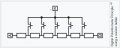
- Here is a mechanism to command from software a specific Current limit. I also read about Digital potentiometer with this occasion.
Screenshot_1.jpg
My ladder will be Res in // not in series as shown in this img. Im only showing the idea here.
- It is not a good idea to use an IC for this job because it will handle only 10mA through it, is what I read from the page, while in my project here I need way more current. So a discrete version will be necessary which will be bigger in size. So, 'DA, eta ia'.
- I'll have to jump and design the thing.
Tell me what you think.
 
Last edited:

Thread Starter

q12x

Joined Sep 25, 2015
2,227
You are a genius. Clearly your design skills are at a level I cannot even comprehend. I never would have thought of this (whatever it is.)
hahaha ! and yes, thank you, very much appreciated. It was a bit hard core until here.
- So what this thing is, after all? It is a component tester but Im testing by power stress to a 50*C limit. I dont plan to destroy a component, but I plan to push it to a 50*C and that is MY limit I am pushing and also comfortable with and also like to see anything running when is pushed. Usually I like them run at ambient temp or the classic 25*C but if I have to push it for a small period of time, seconds, minutes or 1 or 2 hours, it should be fine at 50*C. So again, this is my limit. While getting to this temp, it will vary it's power through it, either component stress or different component structure. It will also show me how stressed it is compared with a new one or another equivalent. I can test resistors, diodes, transistors, and even ICs or only a gate from inside an IC for example, or even an entire circuit, just to tell what will weak first. The possibilities are endless and I see it a very practical tool to have in my arsenal. It is a test tool after all. I thought I was clear enough so far, but I promised I will answer everything so here it is. I hope it is more clear now.
 

Reloadron

Joined Jan 15, 2015
7,889
OK let's all be happy. :) Seriously you want to heed the words of WBahn and BobTPH as they know their stuff very well. Yes, your resistance numbers are unrealistic and not going to happen. The old trick of filing a carbon resistor does work to increase resistance but you will never resolve a hundredth of an Ohm. Be it 50C or 122F no problem and as we heat a resistor the resistance generally increases.

Ron
 

Thread Starter

q12x

Joined Sep 25, 2015
2,227
Yes, your resistance numbers are unrealistic and not going to happen. The old trick of filing a carbon resistor does work to increase resistance but you will never resolve a hundredth of an Ohm.
Its not old, I just thought of it. Taking out the material will decrease the resistance.
I know they are unrealistic, but is what I got in the sim. Now I know what Im dealing with, realistically. And I will get as close as possible to their values, filing the carbon if it needs to. I already asked the question but no answer, how to do it another way than stacking resistors in // or in --, which is the hard way to do it, in my book. And also very big in size. So if I didnt get an answer, I give one myself, the one with the filing (or with the nichrome wire) - Do you know something else? Please think on something, an alternative. Whacky or not, I dont care. Just put it on the table. All I need is ideas. The manual labor is up to me. And you know how I am already.
OK let's all be happy.
thank you, I am, ATM. haha.
I am also afraid in the same time because is a lot of work ahead and bad luck will happen. Talking from experience. And tired after all these failures.
 

Reloadron

Joined Jan 15, 2015
7,889
Its not old, I just thought of it.
You just thought of it but yes, it's old. When carbon resistors were made in the 1920s the values were typically -20% +50% and the bigger ones actually had a flat on one side for filing. Been around for over 100 years. Longer than even I have been around. However, don't believe me, Google is your friend. I can't begin to tell you how many carbon shunt resistors I filed down on old analog type current meters and series resistors on old analog volt meters. :) Less getting into details low resistances are typically measured using a four wire measurement using Kelvin 4 wire measurement. This eliminates lead resistance errors encountered with low resistance measurements. All here nor there but good to know. Also think about what you said.
Taking out the material will decrease the resistance.
You are removing material from a carbon composition resistor. Will the resistance increase or decrease? My money is on increase not decrease so you may wish to rethink that. :) This is all part of a learning curve.

How accurate do you really need? Consider something, your measurements will only be as good as the instrumentation used to take the measurements. You can't make a silk purse out of a sows ear, While you may be tired of failure get use to it because it's all part of the learning curve. I can't begin to tell you how many times I designed a circuit only to have it fail and kept at it through frustration till the light came on. :)

Ron
 

Thread Starter

q12x

Joined Sep 25, 2015
2,227
So if you remove all the material the resistance must be zero, right?
ha...... I didnt think it through. You are right, the resistance is infinite if you cut or scratch all the R paint. Is 0 when is a wire or metal jumper. Rookie mistake from my part but you catch it very fast. Good for you.
 

wayneh

Joined Sep 9, 2010
18,104
I’m perplexed at all the effort (time equals money) to avoid what would be a fairly easy task with the right tool. You need a controller with a feedback loop: supply a voltage, measure current (the feedback), calculate power, compare to target, apply new voltage calclated according to algorithm, repeat. Exactly what you could do manually, but automated to replace the slow human with a faster processor.
 
Top