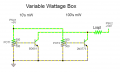
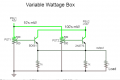
Variable Wattage Box

Thread Starter

q12x

Joined Sep 25, 2015
2,227
Hi everyone,
I want to make a variable Wattage box. Mainly for testing purposes.
I want some small scale, medium and if possible, some big scale variable wattage ranges.
Lets start with something easy, the small scale. From the back of my mind, I would use a small npn tr like BC548 or BD681 to variate between tens of miliwatt. (Without a Heatsink). For variation of hundreds of mW up to 1W, I remember from my tests, that my 2N3773 was the best choice in this range, again (Without a Heatsink).
- So this is simple, right? The hard part is to switch between a couple of watts, not many, maybe 5W, maybe 10W, Im undecised.
- One important design future is that I want a POT to scale the values, but also in // with it some sort of digital button inc/dec, and the simplest possible I can think of is with a counter IC like my favorite 4017. I was thinking originally on switches but a POT is more elegant.
- I want from you a cct design, an idea, of how you will make it. I already give you half of the solution how I will make it. Im curious how you will do it. Its very important if you already made it in your past, and now its time to shine with its circuit here for me. I love practical solutions, not only the theoretical ones, although Im accommodating any weird ideas that I never tried. See if you can design something quick in your simulator or on paper, or search on the www. Or something that is already consecrated, and you know about it but I don't, will actually be the best, if possible.
Thank you.
 

Thread Starter

q12x

Joined Sep 25, 2015
2,227
You can build a simple variable load using a common collector transistor configuration.
The Load will be the component under wattage test. I will variate the "common collector" tr, as you say. - How do you variate the Load ?
This is how I think it should look like. Please correct any possible problems with it, because I "slap" this cct, from the back of my memory, without checking with anything. I didn't add the 1's Watts because that's where I need your expertise. I can solve it in 3 ways actually, but I'm not sure completely.
1725422787118.png
 
Last edited:

Thread Starter

q12x

Joined Sep 25, 2015
2,227
What kind of loads do you want to test?
- The load is fixed, not variable - theoretically. Initially I was thinking to insert many switches for each 10mW then 100mW then 1W ranges. So in total should be 30 switches. But if Im using a POT for each category, I will escape with only 3 POTs and also finer resolution, even 0.5 steps, in between the planned values.
- Ideally this circuit should power a load of maximum 10W. Usually will be smaller power elements connected for test.
Lets say for now that the max is 1W for simplicity. Check my circuit in post#3 and tell me if it will be good enough for a max 1W, and what I should add more to it? or change?
thank you
-----
Hmmmmmmm...I just had an idea while writing all this. Probably is best to include the Load resistor in the circuit now in design mode, and take it out from it when Im building it, leaving the output floating, ready to connect external future loads to it.... no? heh... Or design it from start as a removable or variable Load... hmmm. Im thinking out loud here. Do tell me your thoughts. I think Im right.
---
 
Last edited:

boostbuck

Joined Oct 5, 2017
1,032
ElectricSpidey said:
What kind of loads do you want to test?

- The load is fixed, not variable - theoretically.
Is the purpose secret? Varying WATTAGE with a pot or digital control is not simple. Variable loads normally vary the resistance offered, and a PSU will vary control applied voltage or current to a load but in case of a variable wattage PSU I think you will be using a simple linear voltage control but with wattage feedback.

Knowing what you are trying to achieve would help.
 

Thread Starter

q12x

Joined Sep 25, 2015
2,227
The circuit you show has the transistors in common emitter mode.
Very interesting subject. Ive read about the subject, and it gets very hairy very quickly. I want to say that Now, I get what it means. I hope. I have see it explained, very badly I may add, in many places, including this website. But from many bads, I could put head to head something. I hope Im right.
- So basically if the voltage signal on the Base is following through the output on the Emitter, it's called Emitter follower or common collector. If the Output is on collector its inversed, its called Collector follower or common Emitter. There's a 3rd mode, common base but that is used more for RF from what I can understand.
1725509352088.png
 
Last edited:

WBahn

Joined Mar 31, 2012
32,702
As others have pointed out, and which you seem to insist on ignoring, you have not specified exactly what you mean by a variable "wattage" box.

Taken literally, it means that you want to hook up some load to it and then turn a dial to the 50 mW setting and have the result be that the load is drawing 50 mW.

If that is the case, then that is not so simple. Making a device that will apply 5 V to the load when the dial is turned to 5 V, or a device that will force it to draw 50 mA when the dial is turned to 50 mA, or both pretty simple, because the device can directly detect how much voltage is being applied, or how much current is being drawn. But if you want it to control power, then it needs to be able to determine the product of voltage across the device and the current through the device. This is not impossible, but it is not simple, either. So your first step needs to be how to determine the power being supplied by a load and convert that to a usable form, such as a voltage or current, that you can then build your box around.
 

WBahn

Joined Mar 31, 2012
32,702
Very interesting subject. Ive read about the subject, and it gets very hairy very quickly. I want to say that Now, I get what it means. I hope. I have see it explained, very badly I may add, in many places, including this website. But from many bads, I could put head to head something. I hope Im right.
- So basically if the voltage signal on the Base is following through the output on the Emitor, it's called Emitor follower or common collector. If the Output is on collector its inversed, its called Collector follower or common Emitor. There's a 3rd mode, common base but that is used more for RF from what I can understand.
View attachment 330966
No, it is not collect a collector follower, because the collector doesn't follow anything in that configuration.
 

Thread Starter

q12x

Joined Sep 25, 2015
2,227
Taken literally, it means that you want to hook up some load to it and then turn a dial to the 50 mW setting and have the result be that the load is drawing 50 mW.
If that is the case, then that is not so simple. Making a device that will apply 5 V to the load when the dial is turned to 5 V, or a device that will force it to draw 50 mA when the dial is turned to 50 mA, or both pretty simple, because the device can directly detect how much voltage is being applied, or how much current is being drawn. But if you want it to control power, then it needs to be able to determine the product of voltage across the device and the current through the device. This is not impossible, but it is not simple, either. So your first step needs to be how to determine the power being supplied by a load and convert that to a usable form, such as a voltage or current, that you can then build your box around.
yes, thats what I want. And I understand it is more difficult to make it.
Is this the kind of thing you want? A multiplier chip (eg AD633) for watts = volts x amps in a feedback loop.
https://www.analog.com/en/resources/design-notes/constantpower-source.html
Ive read your page and it seems Ive crossed over that max4210 IC in my past. I understand it is more difficult than I imagine.
Ok, @boostbuck so you are talking about an automated way, when you mention AD633 and max4210 multiplying chips. I looked in both datasheets and also on aliexpress prices already but didnt buy anything for now. I find them very intriguing chips !!! haha. But... realistically, I have other plan in my head. Something more to the basics, more manual if you want, like 2 dials, 1 for V and 1 for A and dialing them, + a piece of paper to calculate the power, or some incremental W step or level W visual markers. Very analog, very manual, like in WW2 era type of device. Get my point? How you will make such a device? Because it is all I can think of, sincerely.
 

boostbuck

Joined Oct 5, 2017
1,032

WBahn

Joined Mar 31, 2012
32,702
yes, thats what I want. And I understand it is more difficult to make it.

Ive read your page and it seems Ive crossed over that max4210 IC in my past. I understand it is more difficult than I imagine.
Ok, @boostbuck so you are talking about an automated way, when you mention AD633 and max4210 multiplying chips. I looked in both datasheets and also on aliexpress prices already but didnt buy anything for now. I find them very intriguing chips !!! haha. But... realistically, I have other plan in my head. Something more to the basics, more manual if you want, like 2 dials, 1 for V and 1 for A and dialing them, + a piece of paper to calculate the power, or some incremental W step or level W visual markers. Very analog, very manual, like in WW2 era type of device. Get my point? How you will make such a device? Because it is all I can think of, sincerely.
As you change one, the other will change.

If you are willing to do the calculations by hand, then you just need one dial to control either the voltage or the current, and then you measure the other and do the calculations. Or get a cheap USB data acquisition unit and let the computer capture the data, do the computations, and produce a nice graph.
 

Thread Starter

q12x

Joined Sep 25, 2015
2,227
I showed you my circuit and my way of doing it already.
I want 1 single example of making 1 or 2 manual data reading. By hand. The basics, how you'll do it.
I do have an idea after all that was discussed here, and for the big part I was aware.
If you are doing it manually, then all you need its a simple constant current / constant voltage PSU and a calculator.
Very nice summarized !
In principle I have my variable PSU, that I can dial down and use as you say, for its CC and CV.
Ill have to test it then and come back to tell you the story. Hmmm. I was implying it in my circuit I post it, while now is more detailed. Which is good.
 
Last edited:

AnalogKid

Joined Aug 1, 2013
12,043
It was not immediately clear from the question if you wanted a constant-wattage source or load.

For a true constant-wattage load - that is, one that dissipates a specific amount of power no matter what the input voltage is (within some operating range), the circuit requires a (hopefully) analog multiplier. Power is voltage times current. For any applied voltage, the circuit must adjust itself to draw the correct current for the desired power dissipation. Many commercial electronic load instruments have this feature.

This can be a problem for some power sources because at its core, the load box acts as a negative resistance: To maintain a constant power, as the input voltage goes up the drawn current goes down. An excellent example of this is a high-density DC-DC converter, such as the "bricks" from Vicor, Syncor, etc, with a fixed resistance load The inputs of these devices appear as a negative resistance to whatever is driving them. This can unmask marginal stability issues, turning the power system into a 400 W oscillator. Not good.

ak
 

Thread Starter

q12x

Joined Sep 25, 2015
2,227
It was not immediately clear from the question if you wanted a constant-wattage source or load.
Very interesting problem you put here. I suppose, everything should remain constant, both the source and the load for a certain amount of time, to take the correct measurement. After that, change whatever and keep it constant again for the next measurement.

For a true constant-wattage load - that is, one that dissipates a specific amount of power no matter what the input voltage is (within some operating range), the circuit requires a (hopefully) analog multiplier. Power is voltage times current. For any applied voltage, the circuit must adjust itself to draw the correct current for the desired power dissipation. Many commercial electronic load instruments have this feature.
This is the exact inverse situation of what I want to do. I want to add an X value Load component and start dial up from 0W, and check at certain power disipation temp, what my component gets over it. Its very simple idea, really.
 
Last edited:

wayneh

Joined Sep 9, 2010
18,085
I second the idea of using a data acquisition device to measure both voltage and current, and then let a computer calculate and control power to the load. I have a LabJack U3 and it would not be hard to set that device up to do what you want.

That said, I think you should try just doing it by hand. Use a constant voltage supply and just turn the dial. The supply should report the current being drawn but you could use a cheap multimeter if it doesn't. Set the voltage, watch the current stabilize, record the result, repeat.

You'll have a much better idea of how things go and then you can decide whether it's worth the trouble to involve automation.
 

Thread Starter

q12x

Joined Sep 25, 2015
2,227
I second the idea of using a data acquisition device to measure both voltage and current, and then let a computer calculate and control power to the load. I have a LabJack U3 and it would not be hard to set that device up to do what you want.

That said, I think you should try just doing it by hand. Use a constant voltage supply and just turn the dial. The supply should report the current being drawn but you could use a cheap multimeter if it doesn't. Set the voltage, watch the current stabilize, record the result, repeat.

You'll have a much better idea of how things go and then you can decide whether it's worth the trouble to involve automation.
- Its a very interesting (data acquisition) device that I never heard of actually and I probably will buy if its cheap enough. Can you recommend something? Put a link of the best and then the cheapest, and tell me the difference bcz Im hearing about it for the first time. Thanks.
- Probably I forgot to mention and it might had been important, that my cct in #10 was intended from start, as a manual wattage box. I realize that now. So its my mistake not being 100% clear.
I have some time until I will make this W box. I wait for my new 12T (Turn) rotary switches. I always wanted to have some spares in my arsenal. I also took those (green) 'Gray code' Rotary encoder, with unlimited turns but a bit harder to implement. I'm not very sure what I will actually use. But this is a good idea about the rotary switch, especially for this project. I wanted to make it with a POT, but because I didn't got a clear answer about it in my last cct, I will try these alternatives. Although I think a POT and my cct should do the job just fine... but if you let to assumption is not good... What If I get a muscle spasm and turn the POT to the max and explode everything on my table? I am in doubt what to use.
1725640262161.png
 
Top