Variable Wattage Box

WBahn

Joined Mar 31, 2012
32,827
like I said, this is the hard way I was thinking/referring too. I was asking if there is another way. So probably no or is very expensive.
I was thinking on making myself specific value resistors... as a thought, I dont know in practice. I did seen something in my past, filing or grinding to precision what you needed but... is just a memory blur. I cant imagine how to make the contact with the cut side. Anyway...heh.
Cutting resistors and filing them is a fool's errand.

The approach has no solution until you determine what you mean by "specific value resistors". In particular, what is the tolerance over what operating range? If you ±1%, then you can just by a resistor with that tolerance, or tighter, using a standard value that is as close to your desired value as you can get. You can then bin them by buying a bunch and measuring each and selecting the ones that are closest.

But if you want 1012.5 Ω "exactly", then you are out of luck, since "exactly" virtually never happens in the read world. Even if you did find a resistor that, at room temperature with only a handful of microamps flowing through it, was 1012.500000000 Ω, as soon as your but a couple volts across it and it heated up a few degrees, the resistance would change.

It all comes down to YOU defining what level of accuracy and precision YOU need the value to be over what range of operation, primarily current/voltage and temperature.
 

schmitt trigger

Joined Jul 12, 2010
2,088
Failure is a normal side of experimentation ! (said mister q12). Is also learning, for unwanted lessons. (also said by mister q12).
I appreciate your sincerity candor. Your first sentence, which I have bolded, is absolutely true.

We all know the story of Edison attempting 1,000 different materials for his light bulb. Until he found one which could give an useful lamp life.
 

schmitt trigger

Joined Jul 12, 2010
2,088
I was thinking on making myself specific value resistors... as a thought, I dont know in practice. I did seen something in my past, filing or grinding to precision what you needed but...
Nowadays this is called laser trimming. Needless to say the trimming equipment is not cheap.
 

Thread Starter

q12x

Joined Sep 25, 2015
2,227
as soon as your but a couple volts across it and it heated up a few degrees, the resistance would change.
Probably you are more right than me, from this pov. I agree with you, that a super close value will shift with temperature, either ambient or from current passing through it. But, close enough is better than nothing.
Nowadays this is called laser trimming.
I actually know a way, using a bit of Resistance Heating Wire, but that is to be used only to tweak very small values like 1R and less like 0.5R. If you want to make 5R with it, it will get a very loooong resistor. But is a way.
 

WBahn

Joined Mar 31, 2012
32,827
Probably you are more right than me, from this pov. I agree with you, that a super close value will shift with temperature, either ambient or from current passing through it. But, close enough is better than nothing.
Which brings us right back to where we were, with the need for YOU to decide what "close enough" is! We can't really offer you meaningful advice to help you achieve results that are close enough unless you tell use how close is close enough.

What is so difficult to understand about that concept? Or about the fact that it is pointless for you to try to come up with a way to get resistor values that are "close enough" if YOU don't have any idea what qualifies as close enough.

I actually know a way, using a bit of Resistance Heating Wire, but that is to be used only to tweak very small values like 1R and less like 0.5R. If you want to make 5R with it, it will get a very loooong resistor. But is a way.
Please use proper units. If you mean 1 Ω, say 1 Ω (or 1 ohm) - the 1R notation is an old convention used on schematics to avoid the use of decimal points in values because false decimal points were so easy to get due to printing/copying defects.
 

AnalogKid

Joined Aug 1, 2013
12,128
We all know the story of Edison attempting 1,000 different materials for his light bulb. Until he found one which could give an useful lamp life.
Not the best example.

First, it was around 200, not 2000.

Second, Edison did it that way because he had no other way. He knew nothing about metallurgy or thermodynamics.

Third, "useful lamp life" - ? Useful to whom? Edison was searching for a lamp life that fit his business model, which included a steady flow of replacements. Later, one of his guys who actually knew something about metallurgy suggested tungsten. Edison said no because the lamp life would be too long, hurting replacement sales. The guy took the idea to Westinghouse.

And finally, his researchers (and others) noticed something going on inside the light bulb, something they dubbed "the Edison effect". Edison patented it, but did not see its potential (!). 20 years later, de Forest "invented" the vacuum tube.

ak
 
Last edited:

dl324

Joined Mar 30, 2015
18,326
@dl324 How you will have done it?
Or have you done something similar in the past, that can help me here?
If it's a one-off situation, I use parallel resistors or a pot. If I need a number of a particular value, I'll cherry pick from a batch of resistors. I remember doing that for some 820 ohm resistors. It's a standard value, but I wanted 820, not 820 +/- 5%. I only had 5% resistors, but I had a thousand of them.
 

Thread Starter

q12x

Joined Sep 25, 2015
2,227
I haven't paid enough attention to understand what the requirements are.
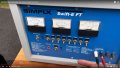
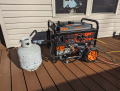
read my #1 post - everything is there. Later, I also made a circuit but it is partially good. You can draw inspiration from it and continue it/repair it if you can. But thats my idea of how to make this thing. I actually seen such a box but it was not called like I do, and I only seen its external case, but not it's internal circuit so I had to invent it myself. The real thing was used to test the AC wattage in fuel generators, at greater power than what Im trying here ofcourse. And it had a couple of switches for different wattage output.
I put some pictures for you to get the idea more clearly. So, it does exist !
Screenshot_3.jpg1726760366931.png
 
Last edited:

dl324

Joined Mar 30, 2015
18,326
read my #1 post - everything is there
The requirements are still unclear and nothing in any of the subsequent posts offered sufficient clarification.

You want a variable wattage load, but you don't mention how voltage and current will be constrained. 1W can be 1V at 1A, 2V at 0.5A, 100V at 0.01A, or 0.001V at 1000A.

I don't see what you're trying to show with first picture. The second picture looks to me like a propane powered generator.
 

schmitt trigger

Joined Jul 12, 2010
2,088
The “wattage” load box is nothing more than a bunch of very high power resistors with lots of forced air ventilation to remove all the heat.

Of course, these really are constant resistance loads. The constant wattage is met as long as the supply voltage remains more or less constant.
If you would like to emulate such a box, my suggestion would be to use a bank of power resistors. Making a two-quadrant AC load it is not a trivial circuit.
 

schmitt trigger

Joined Jul 12, 2010
2,088
Actually, I have an idea: if in addition to the fixed resistor steps you require to fine trim some power load, you could add a 500 W variac driving a resistive load. By adjusting the variac’s output, the wattage load can be fine tuned.

Edit: to avoid making manual calculations, I would also include a fouth meter that directly reads watts.
Or purchase one of those all-in-one digital panel meter.
 
Last edited:

Thread Starter

q12x

Joined Sep 25, 2015
2,227
to @schmitt trigger and anyone else
I am not trying to reproduce or copy THAT box. Im showing you that I know they exist !
It happens to be a big box for AC and for generators. This doesnt mean I want one.
All I want is a DC Resistive Load --LIKE-- the one Im showing but for very small power, from 10mW to 1W DC not AC.
That image is only an example and proof that it exists. Are we clear now?
But Im very curious what is the core principle it is working on, to apply it in my project.
the “wattage” load box is nothing more than a bunch of very high power resistors with lots of forced air ventilation to remove all the heat.
Ok, make me a circuit please, of how you are seeing it.
I always thought it might be a very simple principle to it. But I dont know everything. Maybe you do.
Edit: to avoid making manual calculations, I would also include a fouth meter that directly reads watts.
that W box in the picture has a W meter. It has 3 meters, look more closely with more attention.
you could add a 500 W variac driving a resistive load.
No no no, Im only making a very small power box, up to 1W. Again, that image is only an example and a proof that it exists. Are we clear? We only need to guess what is the mechanism inside it and apply it to my project.
 

BobTPH

Joined Jun 5, 2013
11,515
Your box is supplying power, that box is consuming power. Not the same thing at all. Why did you even mention it? This confusion has permeated this entire thread.
 

Thread Starter

q12x

Joined Sep 25, 2015
2,227
You want a variable wattage load, but you don't mention how voltage and current will be constrained. 1W can be 1V at 1A, 2V at 0.5A, 100V at 0.01A, or 0.001V at 1000A.
Yes, you are right and here lies the problem with a Wattage box, because like you are suggesting, it can be 1V5A or 5V1A but both =5W, as an example. So thats the tricky problem that must be clarified from the very begining.
Yes...I believe I confused you by showing that variable PSU in the circuit I made. That was there to check or to prove that indeed the opamp circuit is maintaining a constant current while the voltage varies. I probably should mention a fixed Voltage, and you should have mentioned it too, or insist on it. Because things remain in the circuit as some other parts of it progress.
Now, to answer to your question, I want a 5V constant from my ATX PSU (which has a 12V as well) and its max A is about 30A if I remember right.
 
Last edited:

Reloadron

Joined Jan 15, 2015
7,889
Initially I thought you were looking to build a load bank. That got dispelled. Considering an adjustable or variable current source there are a few considerations and you can build or buy. Anyway...
Output or Compliance Voltage A The key parameter in applying constant current sources is the range of load impedance. This determines the range of output voltage needed to maintain a constant current through the varying load impedance. For example, if the load were to vary from 1 ohm to 200 ohms and the desired constant current were 50 mA, then the output voltage range needed would be 50 mV to 10V. The power supply must be 5 Volts greater than the compliance voltage or 15 Volts, in this case. Think about compliance voltage.

Years ago I did both build and buy. The advantage to buy is a turn key solution off the shelf and build is a good cost cutting measure, just keep in mind if you build you will eventually need to make your own PCB or leave things on a bread board. An op-amp and a few transistors capable of passing your load current. Also, consider the stability you want/need. CALEX was a good brand of constant current sources.

Maybe 20 years ago I was involved with a forum which did ATX PSU testing. I designed a load bank and while the finished unit included MOSFETs for programming loads the initial prototype uses common SPST switches for increasing or decreasing the load. This is an old (very old) web page of some of the proto-type. This is an old schematic of the guts. I used software to create a form and put the data into Excel and monitor my data acquisition module. Not much to it.

So what exactly were you looking to do with an ATX PSU? If you use 5.0 volts from the PSU I suggest you consider what I posted regarding compliance voltage.

Ron
 

Thread Starter

q12x

Joined Sep 25, 2015
2,227
to @Reloadron - Excellent reading material ! I like it and is very close to what I want to make. I read both webpages, fully. Very easy reading.
The problem in my case is the component under test that will vary both in resistance but also in the type (non-resistive).
I believe the circuit presented in your_link , it's input is the 12V and 3.3V FROM the ATX PSU that the author is actually testing.
Yes, he specified it into his cct image : 1726777813113.png -very good.
- Now, in my case, I want to TEST some stuff... Right?
1726778057695.png
- Make abstraction of that variable PSU, this I admit is confusing, I should change it into a Fixed (5V or 12V) PSU. It remained variable to proove the opamp is creating (succesfully) a constant current, indiferent of the varying voltage, from the very begining of the project.
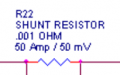
- Im actually amazed how close to Ron (webpage author) I actually was, only using my simple logic, not looking anywhere until you provided these 2links. In the sense that he is using 2 Shunts (marked as resistors) of 0.001R in his prototype 1726778444594.png .
Like I mentioned already, but using Ron terminology, I used a "reference" shunt resistor of 0.1R. Not as low as his but way under 1RLoad. So I was on the right path ! Very cool from my part. And all this arrangement was from my head, not copying anything. Im more surprised than you are, haha.
- Here are some notable/important observations from his webpage:
- "The resistors are the heart of any PSU test system. They will provide the necessary loads to simulate a running computer." -in his case, but is telling/confirming the right direction for me.
- "A current shunt is little more than a very low value resistor. Current passing through the shunt produces a small milli volt drop across the shunt. This small voltage is proportional to the current flowing through the shunt." - I want to believe my logic was close to his logic at this point. Only my intention was different.
- "I used two DC amplifiers to amplify the shunt outputs." they are called "Action Pack". - Its a new device for me. I get that they are amplifying from mV to Volts for the ADC to properly read, but I never encounter such device in my life, so its a novelty for me. In my case another opamp should do this amplification job.
- "The system is to be software driven and an ADC (Analog to Digital Converter) used in a display. The ADC used in the demo version has only 4 channels ... The small milli volt outputs of the shunts would not read well without amplification." - Now this is the cherry on the cake for me. I think this is one of the important things I was originally asking. Why? Because I was trying to make it with Logic ICs instead of MCU. I am normally trying to keep away from MCU as much as possible. But this is answering my question, how to properly do it. For some reason I switched my mentality towards analog or Logic IC's electronics in general, and purposely avoided software driven MCU/PICs/Arduino. For the simple reason of learning new stuff. I like Options!!! Haha. But now... this cherry is telling me I should re-imbrace the software because Im screwed otherwise. I already mentioned in #53 that I should probably (see my incertitude then) try arduino for the W reading... so I was right (with half of mouth).
-Here is what ADC's I already have in my IC's arsenal: 1726781633909.png
---
- In conclusion, do you start to have a feel of what Im trying to do here? Excelent these last 2 webpages, very helpful and they bring some light to the matter. Little bits like these, are helping the great, glorious and divine cause Im fighting here !
 
Last edited:
Top