Facebook
 Google
 GitHub
 Linkedin

""
If using a Noise-Cancelling-Type Electret-Element is feasible,
You may not need any special High-Pass-Filter-Circuitry,
which may ultimately result in superior Sound-Quality.
Is this possible ?, or
are You restricted to using a commercially-available Lapel-Mic ? ""
A Single-Wire Shielded-Cable is all that is needed to power any Electret-Microphone-Element.
Standard "Phantom-Power", ( if available from your Mixer ),
can be used to Power your Interface-Box,
while still using a very small Single-Wire-Shielded-Cable from the Box to the Mic.
A 9-Volt-Battery, or a Stomp-Box-Board-Power-Supply, will also work just fine.
If You want to use long-Cables,
it's a very good idea to have the Interface-Box attached to the Guitar-Strap.
An Electret-Mic-Element will not perform well pushing a Long-Cable.
For pushing a Signal through Long-Cables
You will need an Amplifier to provide a Low-Impedance-Output in to the Cable.
Do You intend to incorporate "Phantom-Power" functionality into your Box ?,
and will it be the standard ~48-Volts ?,
or do You intend to use a Custom type of Phantom-Power ?
A "2-Box" solution may be the best bet,
one on the Guitar-Strap, and one on the Pedal-Board,
this way You can use any standard generic Guitar-Cable between the 2 Boxes,
and have as much Clean-Gain as You need, with zero loss of Fidelity.
And, the Pedal-Board-Box can be larger to
accommodate 3-Way-Tone-Controls as well as Gain/Volume.
If You expect all of this to work with a commercially-available Microphone
You will need to provide the Operator's-Manual, or PDF with all the Specs.
However, I still highly recommend a
Noise-Canceling-Microphone-Element for your application.
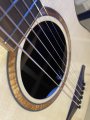
In any case, ANY Microphone used should NOT be rigidly attached to the Guitar-Body.
Some type of Foam Mount needs to be fabricated which will securely hold the
Microphone suspended approximately ~1-inch below the Strings.
.
.
.
If using a Noise-Cancelling-Type Electret-Element is feasible,
You may not need any special High-Pass-Filter-Circuitry,
which may ultimately result in superior Sound-Quality.
Is this possible ?, or
are You restricted to using a commercially-available Lapel-Mic ? ""
A Single-Wire Shielded-Cable is all that is needed to power any Electret-Microphone-Element.
Standard "Phantom-Power", ( if available from your Mixer ),
can be used to Power your Interface-Box,
while still using a very small Single-Wire-Shielded-Cable from the Box to the Mic.
A 9-Volt-Battery, or a Stomp-Box-Board-Power-Supply, will also work just fine.
If You want to use long-Cables,
it's a very good idea to have the Interface-Box attached to the Guitar-Strap.
An Electret-Mic-Element will not perform well pushing a Long-Cable.
For pushing a Signal through Long-Cables
You will need an Amplifier to provide a Low-Impedance-Output in to the Cable.
Do You intend to incorporate "Phantom-Power" functionality into your Box ?,
and will it be the standard ~48-Volts ?,
or do You intend to use a Custom type of Phantom-Power ?
A "2-Box" solution may be the best bet,
one on the Guitar-Strap, and one on the Pedal-Board,
this way You can use any standard generic Guitar-Cable between the 2 Boxes,
and have as much Clean-Gain as You need, with zero loss of Fidelity.
And, the Pedal-Board-Box can be larger to
accommodate 3-Way-Tone-Controls as well as Gain/Volume.
If You expect all of this to work with a commercially-available Microphone
You will need to provide the Operator's-Manual, or PDF with all the Specs.
However, I still highly recommend a
Noise-Canceling-Microphone-Element for your application.
In any case, ANY Microphone used should NOT be rigidly attached to the Guitar-Body.
Some type of Foam Mount needs to be fabricated which will securely hold the
Microphone suspended approximately ~1-inch below the Strings.
.
.
.