Variable High Pass Filter

Thread Starter

rpschultz

Joined Nov 23, 2022
838
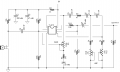
OK, so on the Single Pole, the bars on terminal 4 and the 47k are real ground. Where does the virtual ground go? Or is it just floating, connecting one of the pots to the 22k?

I read through your explanation a few times, will take time for me to fully comprehend that. I think I see the advantage of the virtual ground opamp. Seems to me the Single Pole would be best for my situation. ?
 

Audioguru again

Joined Oct 21, 2019
6,826
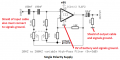
Yes, the original filter circuit schematic stupidly uses a heavy bar symbol instead of a ground symbol.
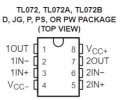
The TL072 has two opamps in it. It could be used for a stereo preamp opamps or used for one preamp and one virtual ground opamp.
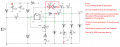
Here is the filter circuit with explanations of the grounds:
 

Attachments

Thread Starter

rpschultz

Joined Nov 23, 2022
838
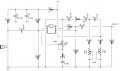
So back to this. I could use a single TL072 to perform both opamp funtions?
preamp-hpf-combined.png
TL072.png

TL072 combined pinout:
1 short to pin 5
2 goes to preamp gain pot ground (left side of circuit)
3 mic input
4 ground
5 shorted from pin 1
6 virtual ground??? 22k, 10k, ?
7 final output
8 9v power supply
 

Thread Starter

rpschultz

Joined Nov 23, 2022
838
Yeah, OK I think I got it mostly right:

TL072 combined pinout:
1 short to pin 5 output of 1st opamp
2 goes to preamp gain pot ground
3 mic input
4 ground
5 shorted from pin 1 after 2nd order HPF section
6 virtual ground??? 22k, 10k, ?
7 final output
8 9v power supply
 

Thread Starter

rpschultz

Joined Nov 23, 2022
838
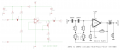
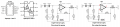
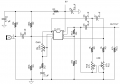
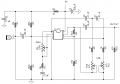
Been working on my Eagle skills, here's a combination of the 2 circuits in post #24.
Mic preamp uses first opamp, then HPF uses 2nd opamp within TL072.
HPF uses the combination of 47 nF, 3k and 37k pots to give a 68 - 1128 Hz range. preampHPF.png
 

Attachments

Thread Starter

rpschultz

Joined Nov 23, 2022
838
For those wondering, this will be used for an internal guitar electret mic. Lapel type mics are often paired with other standard pickups and mixed together. HPF in the 250-500 hz range is a must in this type setup. Guitars frequency range is 82+, but that first octave or so gets very boomy and feedback prone with mics so hpf work well.

Most people buy expensive two channel preamps that have phantom power. I use a Helix Stomp which has a ton of processing power and can mix the two channels together, but no phantom power. So I’m designing this circuit for people who don’t want to spend $500-1000 on a blender preamp as such. I think I can fit this in a Hammond 1590 L 2x2” enclosure, 9v power, two knobs, in/out jacks.
 

Thread Starter

rpschultz

Joined Nov 23, 2022
838
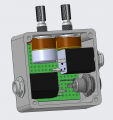
Here’s a design of the 2x2 Hammond 1590 L:

22E3A207-5EDC-4CAD-A58A-200BFD851EB8.png

I just have to get the circuit to fit on a 15x15 hole prototype board. Eventually a pcb, but I’ve never done pcb design.

the pots are soldered on the board, the 3 jacks are wired.
 
Last edited:

Thread Starter

rpschultz

Joined Nov 23, 2022
838
Part of my motivation comes from this guy, AWOL pedals. Aaron Wahl. All his pedals are 2x2, which is unprecedented in the guitar pedal world. My design is somewhat different without the 3PDT on top. But it could be a cool utility type pedal.
 

LowQCab

Joined Nov 6, 2012
5,101
"" Lapel type mics are often paired with other standard pickups and mixed together. ""
.
The exact Microphone used in this application makes all the difference.
Most commercially available Lapel-Mics are "Omni-Directional" and have very good
Frequency-Response down to as low as maybe ~5-Hertz.
So even if You have a very effective High-Pass-Filter "after-the-fact" the
Microphone's Diaphragm and internal Amplifier are still being
very much affected by all the Frequencies that You wish to reduce or eliminate.

Is it acceptable to use this Box with a "Custom-Selected-Electret-Microphone" ???
This can eliminate most, if not all, of the problems that You are trying to solve.

There are 2 basic types of Electret-Microphones, "Omni-Directional" and "Noise-Cancelling".
The "Omni-Directional" Mics have the back-side of the Diaphragm "Sealed" so that
no outside Sounds will have an effect on it.
The "Noise-Cancelling" Mics have the back-side of the Diaphragm "open" to outside Sounds,
this causes Low-Frequency-Sounds to be acoustically-nullified,
which means that Low-Frequencies will have zero effect
on the Diaphragm, or the Internal-Amplifier,
this also means that Low-Frequency-Sounds can not
cause Distortion or "Intermodulation -Effects" that can
degrade the Higher-Frequency-Sounds.

If using a Noise-Cancelling-Type Electret-Element is feasible,
You may not need any special High-Pass-Filter-Circuitry,
which may ultimately result in superior Sound-Quality.

Is this possible ?, or
are You restricted to using a commercially-available Lapel-Mic ?
.
.
https://www.digikey.com/en/products...00785?s=N4IgTCBcDaIKIFkC0AWADARgKwDlUpAF0BfIA
.
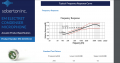
Noise Cancelling Mic .png.
 

Attachments

Last edited:

Thread Starter

rpschultz

Joined Nov 23, 2022
838
Over on AGF, most guys use 3pin condenser lapel type mics, but they short the shield to ground to make it like an electret. The constraint is the 1/4” jacks used in guitars, a TRS jack and cable is common, Tip is the main pickup with Ring having the mic, or viceversa.
Doug Young is one of the main gurus, he references a T-power method here.

So that is where this all started for me. I took those articles, bought a cheap Shure WL50 mic and built a battery box for it… not a preamp, just T-power. It works great, I use my helix stomp to gain it up and HPF.

Most of the mics I have looked at start at 40-50hz, and have output impedances of 0.1-3 kohm. For example, DPA 4061, Audix L5, Rodes Go, all omni.

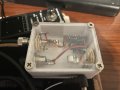
Here’s my current 3D printed box, just T-power, 9v powered, no preamp or hpf.

38414550-264A-43EF-87CA-5BD237EE9646.jpeg
 
Last edited:

Thread Starter

rpschultz

Joined Nov 23, 2022
838
Most guitarists using this technique, with an internal mic, set a hpf at 250-300 hz. They don’t need full range (82+) from the mic, they get the low end from the main pickup.
 
Top