Using voltage difference as trigger

Tonyr1084

Joined Sep 24, 2015
9,744
OK, so your goal is to completely disable the DLR's. Well, I drive a Tacoma. I'm not sure, but I think there's a setting in the computer that is driver accessible, and I can disable certain settings. I don't know what vehicle you're driving for sure, Chevy; Model; Year, but there may be a way to disable the DLR's totally. Here's a video of a guy who did just that:
 

Tonyr1084

Joined Sep 24, 2015
9,744
After looking at the second video I noticed that both guys had the same "DOME OVERRIDE" SWITCH. So you don't even have to go under the dash. IF you have the same arrangement.
 

Tonyr1084

Joined Sep 24, 2015
9,744
Now, as far as your alternate lighting arrangement, all you have to do is wire them to a controlled voltage and they'll be on every time you start your truck. A whole lot simpler than trying to detect voltages and add switches and relays.
 

dcbingaman

Joined Jun 30, 2021
1,065
A comparator circuit should suffice for deciding when the voltage is above a pre-determined setting. However, since the DRL "Dim" setting is probably PWM controlled, a comparator might see the full voltage long enough to turn it on and act like yet another headlight.

If I understand the request correctly, you want the DRL to go out but have another light acting as the DRL. My concern would be the law regulating the use of lights on a vehicle. I've heard of people being charged with "Unauthorized Use of Lighting". Not a serious charge, probably just a fix-it ticket making you restore the system to OEM settings. Would you be opposed to having the DRL on both the headlights AND your secondary lights?
The PWM issue to the comparator can be solved by smoothing it out using an RC low pass filter prior to sending it to the comparator.
 

Thread Starter

geselaw

Joined Dec 21, 2021
18
I think I missed something. If the new DRL is on in the daytime and the nighttime, then why does it need a switch?

ak
Sorry for the confusion. You are absolutely right. This circuit will disable the OEM DRL in the daytime and power on the new DRL. In the night time, the circuit will turn on the Low beam and turn off the new DRL.
Thank you for pointing that out.
 

AnalogKid

Joined Aug 1, 2013
12,158
OK.

A DPDT relay can handle the power switching, removing or applying the PWM from/to the headlight, and applying or removing 12 V to/from the new DRL.

PWM signal > lowpass filter > comparator > relay driving transistor > relay

An alternative that is a bit more complex but probably fits in better in the automotive world is to replace the DPDT relay with one SPST relay to switch the PWM power to the headlight, and a power MOSFET to switch 12 Vdc to the new DRL.

An interesting alternative is to go with one SPDT relay, and switch the PWM signal back and forth between the headlight at night and the new DRL in daytime. How do you think your new DRL would respond to an unfiltered PWM power source?

Note - if your vehicle is new enough to have PWM headlights, it probably also has current sensors to detect failed bulbs, and open relay contacts will look like a failed bulb.

ak
 

Thread Starter

geselaw

Joined Dec 21, 2021
18
After looking at the second video I noticed that both guys had the same "DOME OVERRIDE" SWITCH. So you don't even have to go under the dash. IF you have the same arrangement.
Thanks for your tip but this is 2020 truck. Almost everything is programed. You could have it reprogramed but that is very expensive.
 

Thread Starter

geselaw

Joined Dec 21, 2021
18
OK.

A DPDT relay can handle the power switching, removing or applying the PWM from/to the headlight, and applying or removing 12 V to/from the new DRL.

PWM signal > lowpass filter > comparator > relay driving transistor > relay

An alternative that is a bit more complex but probably fits in better in the automotive world is to replace the DPDT relay with one SPST relay to switch the PWM power to the headlight, and a power MOSFET to switch 12 Vdc to the new DRL.

An interesting alternative is to go with one SPDT relay, and switch the PWM signal back and forth between the headlight at night and the new DRL in daytime. How do you think your new DRL would respond to an unfiltered PWM power source?

Note - if your vehicle is new enough to have PWM headlights, it probably also has current sensors to detect failed bulbs, and open relay contacts will look like a failed bulb.

ak
Hi, Thank you for your interest. The truck could sense both under drawn and over drawn current. When I was testing the custom LED DRL, I connected it with the low beam. On power on the light would turn on, flash twice and turn off with notification.
Can we use the PWM controlled power both as signal to the comparator by filtering it and also as a power source to the relay so that if the comparator activate the relay, the PWM power will be transmitted to either the low beam or the custom DRL to bypass the current test ?
 

AnalogKid

Joined Aug 1, 2013
12,158
Can we use the PWM controlled power both as signal to the comparator by filtering it and also as a power source to the relay so that if the comparator activate the relay, the PWM power will be transmitted to either the low beam or the custom DRL to bypass the current test ?
That is my proposal -- IF -- the new DRL can tolerate a PWM power source instead of clean DC.

ak
 

ThePanMan

Joined Mar 13, 2020
932
New to this thread - Which model is your "Chevy 2020 Truck"?

Here's a website for Chevy, GM truck owners who have questions about different things. You have to sign up but I'll bet once signed up you can probably find others who have successfully disabled their DRL systems.
 

MisterBill2

Joined Jan 23, 2018
27,672
How about a totally different scheme, a transistor to switch off the DRL when the headlights are switched ON. Use the +12 volts from the headlight switch to operate the transistor. Use A PNP so that the +12 can switch it off. No complex electronics and no sensing the 9 volts or PWM signal. The switch function is already there, just finding the right wire will be the hard part.
 

Thread Starter

geselaw

Joined Dec 21, 2021
18
Not sure.
The first is analog and the one-shot is more digital.

The analog would require a few resistors and capacitors, an LM339/393 comparator, a transistor, and a relay.
The one-shot would take a 555 timer, a few resistors and capacitors, and a relay (no transistor).

So not a big difference in parts count either way.

To design the one-shot circuit, it would be helpful to know the frequency of the PWM frequency.
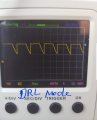
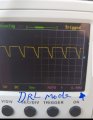
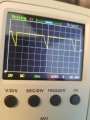
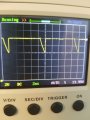
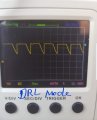
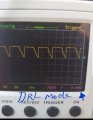
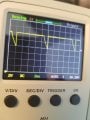
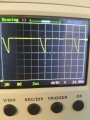
Finally got my new handheld oscilloscope. I am pretty new in using this tool this is what I think the frequency is. From what I calculated PWM is using 100Hz. The DRL cycle between 6.5v-13v. The low beam cycle between 10v-14v. I might be wrong so can you please let me know by looking at the screenshot of graph? Thanks again.
 

Attachments

Thread Starter

geselaw

Joined Dec 21, 2021
18
How about a totally different scheme, a transistor to switch off the DRL when the headlights are switched ON. Use the +12 volts from the headlight switch to operate the transistor. Use A PNP so that the +12 can switch it off. No complex electronics and no sensing the 9 volts or PWM signal. The switch function is already there, just finding the right wire will be the hard part.
The DRL and the low beam is the same bulb. It becomes DRL /Low beam by regulating the voltage . So disabling the DRL is disabling the low beam.
 

Thread Starter

geselaw

Joined Dec 21, 2021
18
New to this thread - Which model is your "Chevy 2020 Truck"?

Here's a website for Chevy, GM truck owners who have questions about different things. You have to sign up but I'll bet once signed up you can probably find others who have successfully disabled their DRL systems.
I have seen that website before. I found a link to another website that sell a harness that would exactly do what I need for $311. I am kind of guy who likes to get my hand dirty and learn at the same time rather than paying $311 for a harness that cost less than $25.
 

Thread Starter

geselaw

Joined Dec 21, 2021
18
That is my proposal -- IF -- the new DRL can tolerate a PWM power source instead of clean DC.

ak
Finally got my new handheld oscilloscope. I am pretty new in using this tool this is what I think the frequency is. From what I calculated PWM is using 100Hz. The DRL cycle between 6.5v-13v. The low beam cycle between 10v-14v. I might be wrong so can you please let me know by looking at the screenshot of graph? Thanks again.
 

Attachments

Tonyr1084

Joined Sep 24, 2015
9,744
Sounds like you're making progress. I'd agree, spending $300 or more for a cable harness doesn't seem to make much sense to me either. However, you still haven't told us the make, model and year. Well, you Did say it is a Chevy, so if you can fill in the rest of the missing information someone could look up the schematic for your DRL's and probably come up with a very good solution.
 

MisterBill2

Joined Jan 23, 2018
27,672
The DRL and the low beam is the same bulb. It becomes DRL /Low beam by regulating the voltage . So disabling the DRL is disabling the low beam.
OOPS!! True indeed. Another option could be to use some other light power as the control, if there are other lights that switch on only when the headlights are on. Are the tail lights also used as stop lights? I know on some vehicles it is the same LEDs, either dim for tail or bright for stop. But if not, then that might work. If that $310 harness actually works, and does not include some active circuits, then a suitable circuit must exist someplace, which could be discovered somehow.

Looking at the scope displays, it does appear that the on voltage is different between DRL and Low beams, but not by much. The different sweep speeds confuse the fact that the pulse rate is about the same, so scheme to detect a frequency difference will not work either. The pulse rate seems to be about 100 Hz in both cases. Possibly a diode-isolated RC filter would provide an adequate voltage difference to operate a voltage sensitive relay. The isolating diode would be needed to prevent the existing loads from pulling the voltage down.
 
Last edited:

Thread Starter

geselaw

Joined Dec 21, 2021
18
Sounds like you're making progress. I'd agree, spending $300 or more for a cable harness doesn't seem to make much sense to me either. However, you still haven't told us the make, model and year. Well, you Did say it is a Chevy, so if you can fill in the rest of the missing information someone could look up the schematic for your DRL's and probably come up with a very good solution.
I thought I did, sorry about that .It is 2020 Silverado 1500 Custom.
 
Top