using / selecting DC Relay

Thread Starter

Raymond Williams

Joined Feb 23, 2018
2
Hello

I am creating a circuit that is going to use a microcontroller to switch 3 relays.

The Circuit it needs to control is 32 Volts and upto 5 Amps

The microcontroller can only take 4-6 Volts.

I am struggling to find a relay that can take 32Volts. All seem to be 5-12-24. Then go to AC.

Is there a relay that can do this? or is there another method?

This will be my first time using relays and voltage of this amount.

Thanks
 

GopherT

Joined Nov 23, 2012
8,009
Hello

I am creating a circuit that is going to use a microcontroller to switch 3 relays.

The Circuit it needs to control is 32 Volts and upto 5 Amps

The microcontroller can only take 4-6 Volts.

I am struggling to find a relay that can take 32Volts. All seem to be 5-12-24. Then go to AC.

Is there a relay that can do this? or is there another method?

This will be my first time using relays and voltage of this amount.

Thanks
If the 32volts is DC, then you can use a MOSFET (a voltage controlled Transistor). Just make sure you get a "logic level" mosfet. That is, one that completely turns on when 5volts is applied.
 

ebp

Joined Feb 8, 2018
2,332
I'm a little confused.
Two voltage ratings apply to relays. One is for the coil - you need one rated for 5 volts unless you add some circuitry and have a higher voltage power supply available. The other rating is for the contacts. There are few inexpensive relays rated for more than 30 volts DC. Some automotive relays are rated for 30 V or a bit higher, but they usually are available only with 12 or 24 volt coils. The reason for the low voltage limit on the contacts is that DC is hard on them (tends to make metal transfer from one contact to the other) and much more likely to result in sustained arcing when the contacts open.

Each of the 3 circuits is 32 volts and 5 amps, or 5 amps total?
What is the nature of the load?
How often will the relays switch and what kind of lifetime do you require?
How do you plan to power the microcontroller?

Gopher's solution of switching the loads with FETs may work very well, but there are some "hooks" (aren't there always?). The more we know about what you are trying to do the better we'll be able to help. One issue that influences FET circuits is how the load needs to be connected. If the load can have one side connected to +32 volts and have the other side connected to "ground" through the switch (be it FET, relay contact or other), it makes it simpler. If the load must have one side connected to "ground" and the switch must be on the 32 volt side, it is less easy. If the load part of the circuit has to be completely electrically isolated from the micorcontroller, as it would be with relays, it makes it more complex.

Can you show us a block diagram or sketch of what you want to do. It's OK to draw it on paper and post a picture, but please make sure we can see things clearly and the picture is the right way up.
 

AnalogKid

Joined Aug 1, 2013
12,090
A critical difference between a conventional relay and almost any solid state switching circuit is "grounding". For the uC to switch the load with a power transistor, both the uC power system and the load power system must share a common ground. Because of this, the load in most solid state switching circuits is *not fully isolated* from the control circuit. This is a big deal, and before you can go forward with a MOSFET or other power transistor you have to determine if your load has to be fully isolated from the control. You still can grow your own starting with an optocoupler, but it is important to get the requirements nailed down first.

Solid state relays with DC outputs also are an option, but start at $20:

https://www.digikey.com/products/en/relays/solid-state-relays/183?k=&pkeyword=&pv127=62&pv127=1&pv127=16&pv127=9&pv127=4839&pv127=2&pv127=128&FV=1c0003,1c0008,a40154,a40155,a40156,1140050,1140375,1140381,20800ed,mu10A|434,mu11.1A|434,mu12A|434,mu15A|434,mu16A|434,mu17.4A|434,mu17A|434,mu18A|434,mu20A|434,mu23A|434,mu24A|434,mu25A|434,mu5.25A|434,mu5.5A|434,mu5A|434,mu6.5A|434,mu6.75A|434,mu6A|434,mu7A|434,mu8A|434,mu9A|434,1f140000,ffe000b7,yr0V+~+100V|2133,yr0V+~+200V|2133,yr0V+~+400V|2133,yr0V+~+500V|2133,yr0V+~+600V|2133,yr0V+~+60V|2133,yr1V+~+100V|2133,yr1V+~+150V|2133,yr1V+~+200V|2133,yr1V+~+300V|2133,yr1V+~+48V|2133,yr1V+~+72V|2133,yr1V+~+80V|2133,yr3V+~+100V|2133,yr3V+~+60V|2133,yr4V+~+220V|2133&quantity=0&ColumnSort=1000011&page=1&stock=1&pageSize=500

Separate from that, many telecom relays are rated for 40, 60, or 72 Vdc, although most of them are not rated for 5 A. Digi-Key says they have 46 models, but many of them are rated for only 30 Vdc. Here are some that appear to be fully rated. Some have 6 V coils that should work at 5 V. Note that the coil current is too high for a uC to drive directly.

http://omronfs.omron.com/en_US/ecb/products/pdf/en-g6c.pdf
http://omronfs.omron.com/en_US/ecb/products/pdf/en-g6b.pdf
https://industrial.omron.us/en/media/G2R-_-S_Datasheet_en_201604_J140I-E-02_tcm849-95821.pdf
http://www.ia.omron.com/data_pdf/cat/ly_ds_e_4_8_csm54.pdf

https://www.digikey.com/products/en/relays/power-relays-over-2-amps/188?k=relay&k=&pkeyword=relay&pv72=31&pv72=1&pv72=13&FV=1c0003,a8c0001,a8c0007,mu10A|1410,mu11A|1410,mu12A|1410,mu14A|1410,mu15A|1410,mu16A|1410,mu18A|1410,mu20A|1410,mu5A|1410,mu6A|1410,mu7.5A|1410,mu7A|1410,mu8.5A|1410,mu8A|1410,160c0064,160c0065,160c0066,160c006c,160c007a,160c0091,160c009b,160c009f,160c00aa,160c00ad,160c00b3,160c00b4,160c0026,160c002c,160c002d,160c002e,160c0030,160c0035,160c0036,160c0039,160c003e,160c003f,160c0041,160c0049,160c004a,160c004c,160c004e,160c005f,160c0060,1f140000,ffe000bc&quantity=0&ColumnSort=0&page=1&stock=1&pageSize=500

The first question is - do you want to build a circuit or buy a component?

ak
 
Last edited:

shteii01

Joined Feb 19, 2010
4,644
Relay has two thing.
1. Coil voltage.
2. Contact ratings.

Coil is what closes (or opens) contacts. Your micro can provide 4-6V. This means you want relay that has coil voltage of 5V. In this situation, micro tuns digital pin On, 5V is applied to the relay coil, coil is energized and activates the switch inside the relay that closes (or opens) the contacts.
 

AnalogKid

Joined Aug 1, 2013
12,090
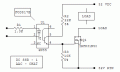
Here is a basic solid state relay circuit. Many of the industry standard 4N series of optocouplers cannot handle 32 V, so I found a few other types at Digi-Key that will:

https://www.digikey.com/products/en/isolators/optoisolators-transistor-photovoltaic-output/903?FV=a40003,a4013a,9580074,95800df,958001d,958001e,9580023,9580029,9580031,9580032,9580033,958004b,958004c,142c05cd,142c0289,16540005,16540006,16540009,1f140000,ffe00387,7680028&quantity=&ColumnSort=1000011&page=1&stock=1&pageSize=25

Do not use the part numbers in this schematic; they are generic devices in my library. The power MOSFET can be any n-channel part that is rated for at least 60 V and 10 A.

ak
DC-SSR-1.gif
 

Thread Starter

Raymond Williams

Joined Feb 23, 2018
2
Thnk you all for your replies. Sorry for my late reply, all the messages were going to Spam. I will look at the Relays and also look at the MOSFET idea.
 

ebp

Joined Feb 8, 2018
2,332
A common optocoupler rated for less than 32 volts can easily be protected in AK's circuit by adding an appropriate zener diode (e.g. 24 V) from the OC collector to 32V RTN. This does come at the expense of some steady power consumption, which may be unacceptable. The higher the zener voltage the lower the standby power consumption.

If the load is inductive, the FET may need protection from the discharge voltage. Depending on the amount of inductance a FET with avalanche rating may be able to handle it with no additional parts, though sometimes an RC snubber is still useful to suppress ringing.
 
Top