And I also suspect they did not mean you shouldn’t be in the room when it is operating, but I thought the two translation errors made It pretty amusing.
originally the electronic term "chopper" described a mechanical switching device used to convert low level signals into AC signals so that they could more easily be amplified. It seems like servo systems used choppers in that era. It had to be the early sixties,because better transistors quickly ended the technology.
There was a cartoon type advertising comic strip with characters Anna, Log, and bad-guy Spike. Don't recall which company they were advertising or even exactly what the product was.
After that era "Chopper" referred to custom chopped motorcycles and helicopters.
originally the electronic term "chopper" described a mechanical switching device used to convert low level signals into AC signals so that they could more easily be amplified. It seems like servo systems used choppers in that era. It had to be the early sixties,because better transistors quickly ended the technology.
There was a cartoon type advertising comic strip with characters Anna, Log, and bad-guy Spike. Don't recall which company they were advertising or even exactly what the product was.
After that era "Chopper" referred to custom chopped motorcycles and helicopters.
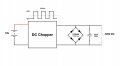
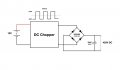
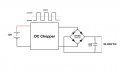
I now have information back from the supplier of the DC Chopper. It is in fact an AC square wave output so that will require full rectification. I have drawn what I think is required if someone could confirm it. Thanks.
The connections to the bridge are OK on the input side, but the DC output comes from the other two corners of the bridge circuit. and to make things more confusing, the waveform shown is 840 volts peak to peak. so there is a bit of a problem now.
It all depends where the reference for this voltage is.
If those voltages are referred to ground (as is inferred by the dotted line through the middle) then you will get 840V output.
If they are measured on one of the output wires referred to the other wire then you will get 420V.
Yes, that circuit is right.
Now looking at the image of the waveform, if the line through the middle is zero volts, then it is 840 volts peak to peak. So I am hoping that the waveform drawing is wrong.
But now, once the wave is rectified and used to charge a capacitor , switching the voltage on and off to provide pulses will not be terribly complex, except that the switching circuit will need to operate far above the zero-volt level. AND it is important to know the required rise and fall times of those pulses, as I mentioned before. Millisecond, microseconds, or faster, rise and fall time makes a great deal of difference in how the switching is done.
Yes, that circuit is right.
Now looking at the image of the waveform, if the line through the middle is zero volts, then it is 840 volts peak to peak. So I am hoping that the waveform drawing is wrong.
But now, once the wave is rectified and used to charge a capacitor , switching the voltage on and off to provide pulses will not be terribly complex, except that the switching circuit will need to operate far above the zero-volt level. AND it is important to know the required rise and fall times of those pulses, as I mentioned before. Millisecond, microseconds, or faster, rise and fall time makes a great deal of difference in how the switching is done.
Ok. I think I need to wait till it arrives and then I will put the output on my scope and see what the waveform actually is. The details say it has various outputs so I should be able to play around till I get the right DC output.
It all depends where the reference for this voltage is.
If those voltages are referred to ground (as is inferred by the dotted line through the middle) then you will get 840V output.
If they are measured on one of the output wires referred to the other wire then you will get 420V.
Ok. I think I need to wait till it arrives and then I will put the output on my scope and see what the waveform actually is. The details say it has various outputs so I should be able to play around till I get the right DC output.
400 Volts on a BLDC? This must be one out of a Fisher and Paykel appliance right? Putting that much voltage into any thing else not meant for mains levels will let out the smoke in the motor windings.
Good point. Mine is 400V max I think but I can use a simple voltage divider to take the source voltage down by a factor of 10 or so. Same as I used to measure 2200V back emf pulses.
Good point. Mine is 400V max I think but I can use a simple voltage divider to take the source voltage down by a factor of 10 or so. Same as I used to measure 2200V back emf pulses.
While I wait to receive the chopper unit and then post details of the output voltage and waveform here, because the posts have evolved quite far from the original topic, I’m going to start a new thread entitled ‘Arduino controlled BLDC motor sensing’ in the 'Sensor Design & Implementation' forum, for the next stage of the project and enquiry.
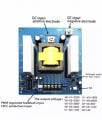
After waiting for nearly a month the DC Chopper unit has arrived with its various pick off voltages (pic 1).
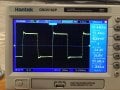
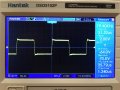
For use with my nominal 24V BLDC motor I plan to use 50V and adjust the duty cycle to an appropriate level for running. Looking at the native output waveforms of the Chopper at the nominal 18V and 50V pick off points, the following waveforms resulted (pics 2&3).
Firstly I notice that p2p they are in fact a bit more than twice those values and so if I plan to have a rectified DC of about 50V I had better use the 18V point. Secondly, there is a bit of noise at the start of each 1/2 cycle but I’m assuming that will disappear after rectification and smoothing.
My query is then whether the planned rectification circuit (pic 4) will be adequate and also fine for potentially higher voltages up to about 400V (using the V1-V4 200V pick off points).
What was pointed out to me in one reference is that at a lighter load the filter capacitors will cgharge up to that peak voltage of that "bit of noise" at the start of each cycle. That is actually some ringing instability and it is what makes the output so much higher than it should be a t lighter loads.

 Facebook
 Google
 GitHub
 Linkedin